


A trade barrier is never “just a rule”
The first time most students meet trade barriers in IB Economics, it feels tidy: a tariff here, a quota there, and a neat diagram to prove the point. Then the exam question hits. Suddenly it’s not tidy at all. It’s about winners and losers, short-run politics vs long-run efficiency, and why the world keeps choosing friction even when free trade looks cleaner on paper.
Trade barriers matter because they’re the moment international trade stops being abstract. They turn a global market into a local argument.
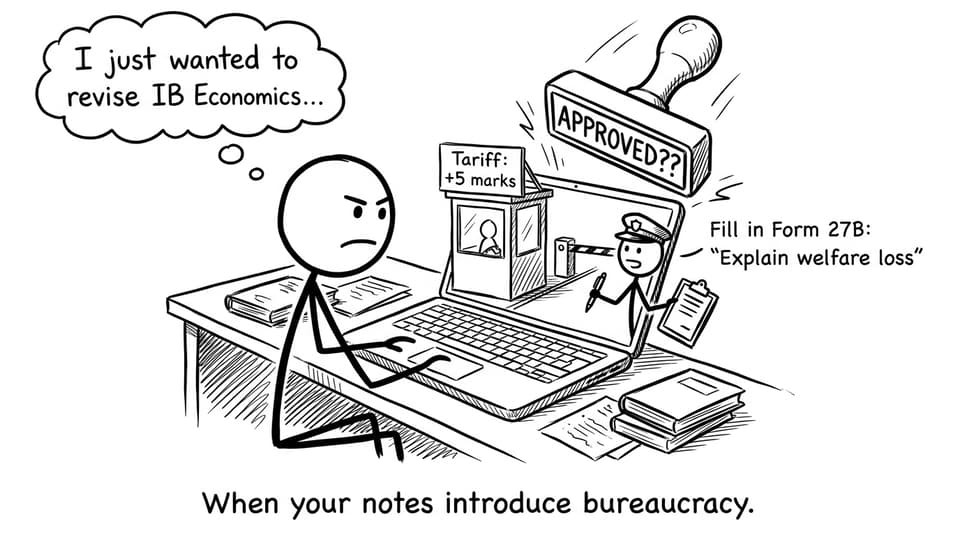
Trade barriers in IB Economics: a quick checklist
Use this as your fast revision frame before you write anything in Paper 1 or Paper 2:
-
Define trade barriers: government restrictions on imports/exports.
-
Name the type: tariff, quota, subsidy, administrative/technical barrier.
-
Show the mechanism: how it changes price, quantity, or costs.
-
Explain stakeholder impacts: consumers, domestic producers, government, foreign firms.
-
Evaluate: short-run vs long-run, retaliation risk, equity vs efficiency.
For syllabus alignment and exam-style practice, keep Topic 4 open while you revise: IB Economics 4. The Global Economy.
What are trade barriers? (IB Economics definition)
In IB Economics, trade barriers are government-imposed restrictions that reduce or control international trade. They’re used to protect domestic industries, raise revenue, influence the balance of payments, or pursue non-economic goals like safety standards.
In Topic 4, trade barriers sit at the center of the free trade vs protectionism debate. That’s why they show up so often in evaluation tasks and diagram-based explanations.
If you want the full set of trade protection tools in one place, see: IB 4.2 Types of Trade Protection.
Types of trade barriers you must know for IB Economics
Tariffs (import taxes)
A tariff is a tax on imported goods. In IB Economics, you’re usually expected to explain how a tariff raises the domestic price above the world price, reduces import quantity, and creates welfare loss.
What to remember for exams:
-
Consumers pay higher prices and lose consumer surplus.
-
Domestic producers gain from reduced competition.
-
The government earns tariff revenue.
-
The economy suffers deadweight loss due to inefficiency.
To tighten your diagram explanations, revise the detailed breakdown here: Notes for 4.2.1 Tariffs.
Quotas (quantity limits)
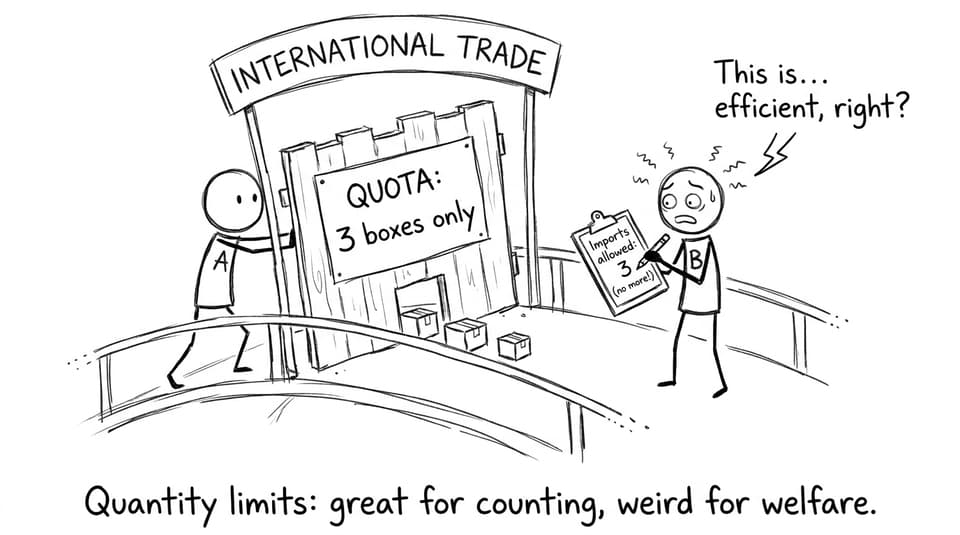
A quota sets a physical limit on imports. It restricts supply directly, often pushing prices up as scarcity increases. In IB Economics, quotas are great evaluation material because they don’t generate government revenue unless licenses are auctioned.
Key impacts:
-
Higher prices, lower quantity imported.
-
Domestic producers benefit.
-
Potential for rent-seeking (firms lobbying for licenses).
For targeted revision: 4.2.2 Quota and quick active recall with Quota Flashcards.
Subsidies (especially export subsidies)
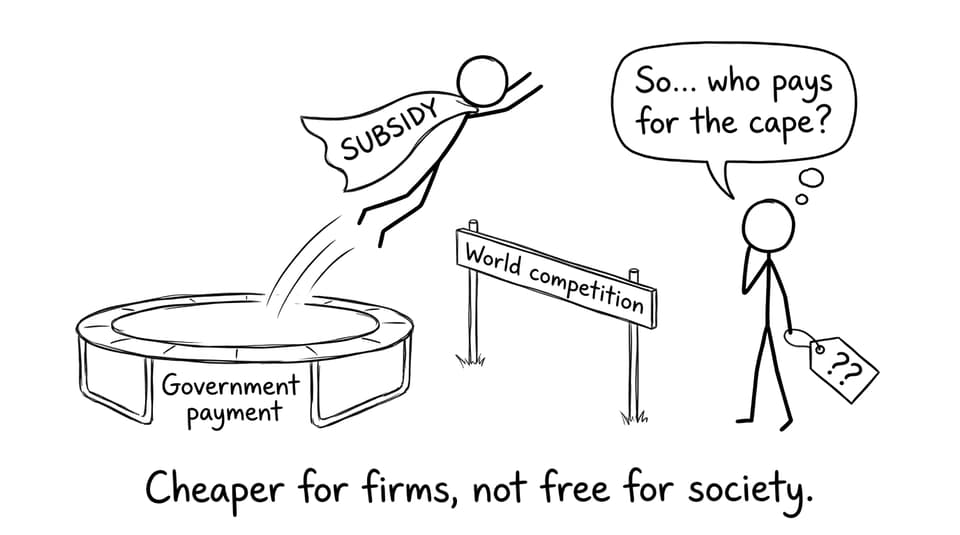
A subsidy is a payment to domestic producers that lowers costs and increases supply. Export subsidies aim to make a country’s exports cheaper abroad. In IB Economics, you should be ready to explain distortion: world prices and competition no longer reflect true costs.
Typical effects:
-
Domestic firms become more competitive.
-
Governments face budget costs (opportunity cost matters for evaluation).
-
Trading partners may retaliate.
To practice arguments and counterarguments, use: 4.3 Arguments For and Against Trade Protection Questionbank.
Administrative and technical barriers
These include licensing rules, product standards, inspections, labeling requirements, and paperwork. They’re often justified as safety or quality measures, but in IB Economics evaluation you can discuss “disguised protectionism.”
A strong syllabus-aligned summary is here: Notes for 4.2.4 Administrative Barriers.
Trade barriers vs free trade (how to evaluate)
Most IB Economics questions are not asking whether protectionism is “good” or “bad.” They’re asking whether it’s effective given a specific goal: protecting jobs, stabilizing an infant industry, reducing import dependence, or improving the trade balance.
A clean evaluation paragraph often contrasts:
-
Short-run gains (job protection, producer stability, political support)
-
Long-run costs (inefficiency, higher prices, weaker innovation, retaliation)
For a well-structured comparison, revise: Notes for 4.3.3 Free Trade Versus Trade Protection.
Exam technique: how to score with trade barriers in IB Economics
Trade barrier questions reward structure. If your writing feels messy, your mark band drops even when your ideas are right.
Two reliable ways to improve fast:
-
Use a consistent essay method: Step-by-Step Approach to Writing IB Economics Essays
-
Remove common pitfalls under time pressure: Top 7 IB Economics HL Mistakes and How to Avoid Them
Then train with RevisionDojo the way you actually sit exams: the Questionbank for targeted weaknesses, Study Notes for clean definitions, Flashcards for rapid recall, and AI Chat when your chain of reasoning breaks. Add Grading tools to check whether your evaluation is balanced, and use Predicted Papers and Mock Exams to build stamina.
Closing: turn trade barriers into easy marks
Trade barriers are one of the most scoreable parts of IB Economics because the toolkit is finite: define, diagram, explain stakeholders, evaluate. Do that calmly, and the marks follow.
If you want to make this topic feel automatic, build a short routine on RevisionDojo: drill trade barrier questions in the Questionbank, lock in definitions with Flashcards, and test yourself with Predicted Papers and Mock Exams until “tariff welfare loss” becomes muscle memory. That’s how IB Economics revision stops being stressful and starts being predictable.