

Analysis is the quiet superpower in IB Digital Society.
You can feel it when you read your own paragraph back. The sentences are clear, the example is relevant, the terminology is correct... and yet the response still lands like a flat report. Nothing is wrong. It’s just not doing the one thing the examiner is waiting for: showing how a digital system’s design choices create consequences for real people.
In IB Digital Society, that shift from “what it is” to “what it does, how, and why” is the difference between mid-band and top-band writing. This guide shows you what strong analysis looks like and how to practise it under exam conditions.
A quick checklist for stronger IB Digital Society analysis
Use this as a one-minute pre-submit scan in IB Digital Society:
-
Have I named a specific digital system (not just “technology”)?
-
Did I explain a mechanism or design choice (algorithm, policy, UI, data flow, incentives)?
-
Did I build a cause-and-effect chain (feature -> behaviour -> outcome)?
-
Did I apply a concept as a lens (power, ethics, identity, change, systems)?
-
Did I address both individuals and communities (even briefly)?
-
Did I include evidence and then explain what it proves (and what it doesn’t)?
If two or more are missing, your IB Digital Society response is likely descriptive.
What “analysis” really means in IB Digital Society
In IB Digital Society, analysis means breaking a digital system into parts and showing the relationships between:
-
system features (how it’s built and governed)
-
user behaviour (how people respond to the system)
-
impacts (who benefits, who is harmed, and why)
A useful mental model is: design choice -> incentives -> behaviour -> outcomes -> uneven effects.
When you practise using that chain, your writing becomes harder to argue with. You stop sounding like you’re summarising a topic and start sounding like you’re explaining a system.
To keep your examples and definitions tight while you practise, start from the IB Digital Society Resources hub and build from there.
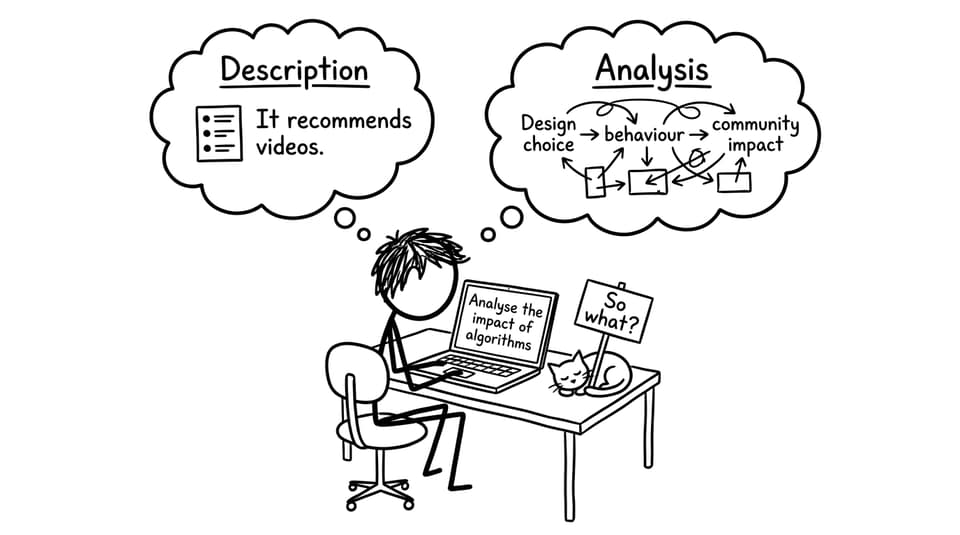
Description vs analysis: the “so what?” test
Most students don’t choose description on purpose. It happens when you write facts without explaining the link between them.
Description in IB Digital Society tends to:
-
list features (“it uses an algorithm”)
-
state impacts (“this can be harmful”)
-
repeat the stimulus or question wording
Analysis in IB Digital Society tends to:
-
explain interaction (“the algorithm optimises watch time, so it rewards extreme content”)
-
show causality (“this increases exposure, which shapes beliefs”)
-
identify distribution (“new users are affected differently than creators or advertisers”)
A practical fix: after any sentence, ask “so what, and why?” If you can’t answer, you’ve found the spot where analysis should go.
Start with the digital system, not the topic
High-scoring IB Digital Society responses feel “system-centred.” They don’t float above the problem. They point to the gears.
Instead of writing:
- “Social media is influential.”
Write:
- “A recommendation system that prioritises engagement (likes, watch time, shares) tends to amplify content that triggers strong emotions, because that content keeps users on-platform longer.”
Notice what changed: you named a mechanism and made it testable.
If you want structured topic coverage to practise with, RevisionDojo’s notes pages are perfect starting points, like IB Digital Society Topic 3 -- Content and IB Digital Society Topic 4 -- Contexts.
Build cause-and-effect chains examiners can follow
A strong IB Digital Society paragraph often has a visible chain of reasoning. Try this simple template:
System feature: what the system does mechanically.
Immediate effect: what users experience.
Secondary effect: what changes over time.
Impact: who is affected and how.
Here’s a mini example you can adapt:
-
A platform’s targeted advertising system collects behavioural data.
-
That data improves ad personalisation.
-
Improved personalisation increases click-through and time-on-platform.
-
Over time, this can reinforce manipulation risks and privacy loss, especially for users who cannot meaningfully consent or opt out.
To drill this skill quickly, use the Questionbank and force yourself to write only one paragraph per question -- but make the chain explicit.
Use concepts as lenses, not labels
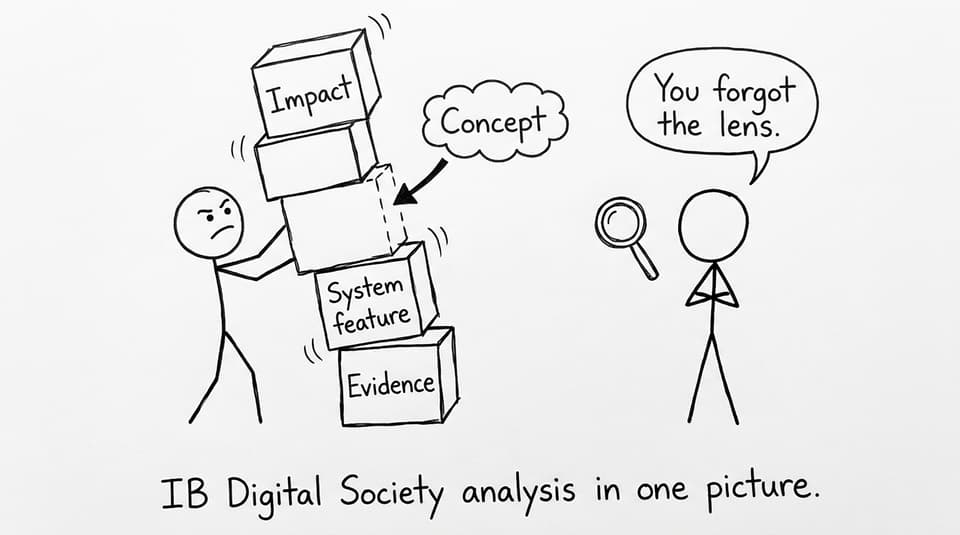
Concepts in IB Digital Society are not decorations. They are tools for explaining why the impact happens.
For example:
-
Power helps you analyse who controls data, rules, visibility, and decision-making.
-
Ethics helps you analyse consent, harm, responsibility, and trade-offs.
-
Identity helps you analyse self-presentation, belonging, and pressure.
-
Change helps you analyse short-term benefits vs long-term shifts.
-
Systems helps you analyse feedback loops and unintended consequences.
If you mention a concept, immediately connect it to the system mechanism: “This concentrates power because...” or “This raises an ethical issue because...”
For concept practice and exam phrasing ideas, RevisionDojo’s blog posts help you see what “concept as lens” looks like in action, such as Key Themes in IB Digital Society Explained and Understanding Change in Digital Society.
Analyse individuals and communities (even in one paragraph)
Top answers in IB Digital Society often show you can shift scale.
Individuals
At the individual level, focus on autonomy, wellbeing, behaviour, and informed consent. But always tie it back to system design, not personal opinion.
Example moves:
-
“This reduces user autonomy because default settings nudge behaviour.”
-
“This can increase anxiety because feedback metrics gamify self-worth.”
Communities
At the community level, focus on inequality, collective behaviour, social trust, and long-term patterns.
Example moves:
-
“This disproportionately affects marginalised groups because moderation errors are uneven.”
-
“This changes community norms by rewarding outrage and speed over accuracy.”
If you struggle to keep examples organised across scales, borrow the structure from Effective Note-Taking Tips for IB Digital Society.
Precision beats breadth (especially under time)
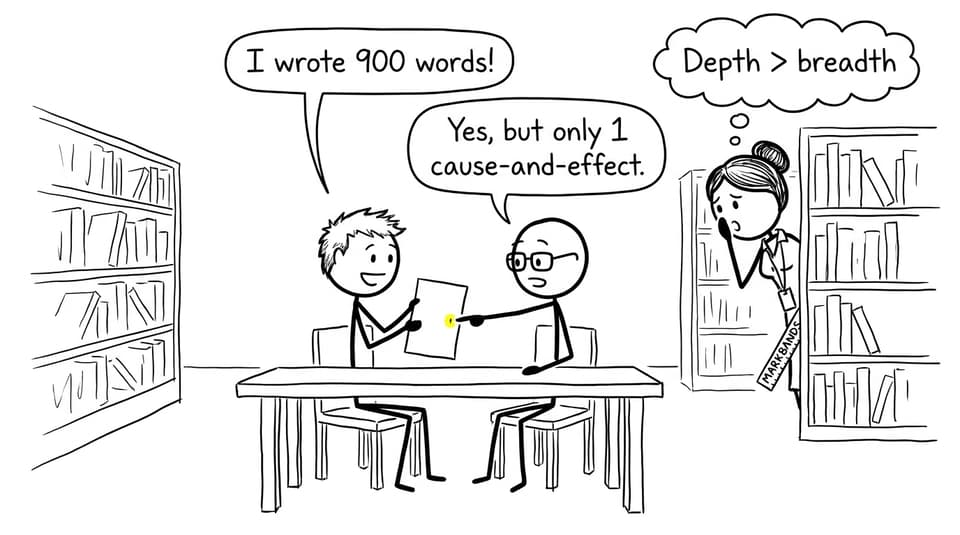
A common IB Digital Society trap is writing too many points too shallowly. Examiners reward developed reasoning more than coverage.
Aim for fewer points, but build the chain.
Helpful cause-and-effect phrases:
-
“This leads to...”
-
“As a result...”
-
“This reinforces...”
-
“This shifts incentives by...”
-
“This creates a feedback loop where...”
Practise analysis with a tight RevisionDojo loop
If your goal is exam performance, practise like a system too. RevisionDojo is built for that.
-
Use Study Notes to refresh the concept lens quickly: start from IB Digital Society Topic 3 -- Content.
-
Use Flashcards for precise terminology (definitions that keep your analysis accurate).
-
Use AI Chat when you get stuck turning a claim into a chain of reasoning.
-
Use Grading tools to see if your paragraph actually meets markband expectations.
-
Use Mock Exams and the exam builder inside the Questionbank flow to practise pacing.
-
If you’re balancing coursework stress, the Digital Society Coursework Guides and Coursework Library keep your IA work aligned.
-
When you need human feedback, RevisionDojo Tutors can help you diagnose why your paragraphs sound descriptive.
Conclusion: analysis is how you earn marks in IB Digital Society
The best IB Digital Society responses don’t sound louder or more complicated. They sound more connected. A clear digital system. A visible mechanism. A cause-and-effect chain that reaches individuals and communities. A concept lens that explains why the impact matters.
If you want a simple next step, open the IB Digital Society Resources, do one Questionbank paragraph today, and use RevisionDojo’s feedback tools to rewrite it once. That small loop, repeated, is how analysis becomes automatic in IB Digital Society.