A report card can turn an ordinary evening into a tense one. A parent sees a 4 where they expected a 6. A student sees months of work compressed into a single digit. Both may assume the number says more than it really does.
The reassuring answer is simple: an IB school report is a progress signal, not an official final result. It may include current attainment, predicted grades, effort indicators, teacher comments and coursework progress, but schools design their own reporting systems. Before reacting, establish what each column means, compare the report with earlier evidence and ask which specific skills would produce the greatest improvement.
Understanding an IB report card is therefore less about judging one number and more about reading the pattern behind it.
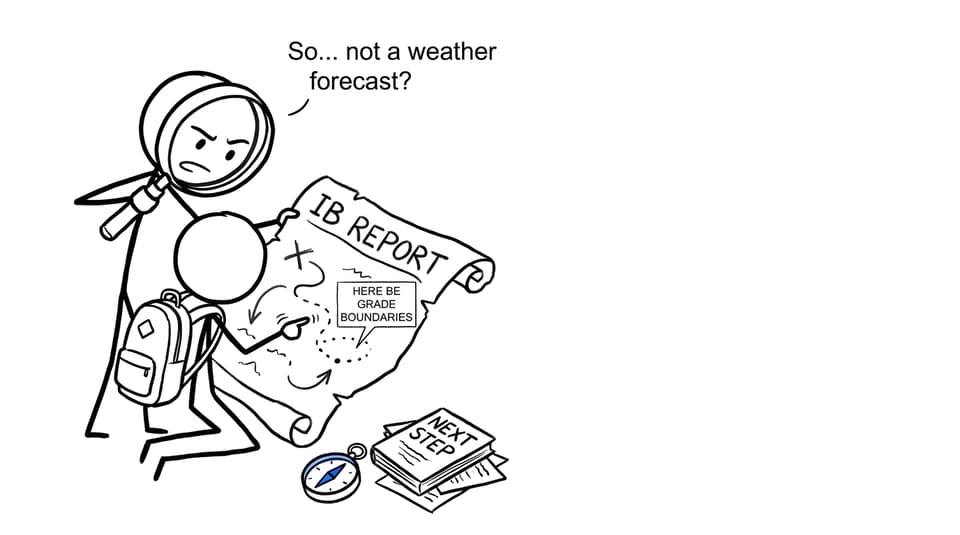
A parent and student decoding an IB report like a treasure map
The quick IB report card checklist
Use this order when reading the report with your child:
Confirm whether each number is a current grade, predicted grade or target.
Check whether the subject is Higher Level (HL) or Standard Level (SL).
Read teacher comments before drawing conclusions from the grade.
Separate attainment from effort, organization and participation.
Look for changes across multiple reporting periods.
Check progress in Theory of Knowledge (TOK), the Extended Essay (EE) and Creativity, Activity, Service (CAS).
Ask which assessment components and skills are lowering the result.
Agree on one or two measurable actions before the next report.
This approach keeps the conversation grounded. A report is most useful when it leads to a better decision, not a louder reaction.
4.5
X
Share on WhatsApp
Share on LinkedIn
Share on Facebook
What the 1-to-7 IB grading scale means
In the Diploma Programme, official subject grades run from 1 to 7, with 7 being the highest. These are achievement levels rather than percentages. A grade of 6 does not mean 60%, and a grade of 4 does not automatically mean 40%.
The IB assesses students against defined standards. Marks from different assessment components are weighted and combined, then grade boundaries convert the total into a subject grade. Those boundaries vary by subject, level and examination session, so parents should avoid applying a familiar letter-grade conversion without checking the school's explanation.
A useful broad reading is:
IB grade
General interpretation
7
Excellent performance
6
Very good performance
5
Good performance
4
Satisfactory performance
3
Limited performance with important gaps
2
Poor performance with substantial gaps
1
Very poor performance
These descriptions provide context, but subject-specific criteria matter more. A 5 in English may reflect different strengths and weaknesses from a 5 in Physics. RevisionDojo's guide to the IB grading system from 1 to 45 offers a fuller breakdown, while its IB grade boundaries guide explains why raw percentages cannot be interpreted in isolation.
School grades and official IB exam results are different
One of the most important distinctions for IB diploma parents is the difference between a school report and the official result issued after the final assessment session.
A school report may draw on unit tests, classwork, essays, laboratory work, oral tasks, mock examinations and teacher judgment. The precise evidence and weighting depend on school policy. Some schools report performance demonstrated so far. Others report the grade a student appears on track to achieve. Some show both.
Official IB exam results follow the IB's assessment process. For most Diploma Programme courses, final examinations form a major part of the result. Most subjects also contain internal assessment work that is marked by teachers and moderated by the IB, while some work is externally assessed.
This is why the first question should not be, "Why is this grade low?" It should be, "What exactly does this grade represent?"
Current, predicted and target grades
Three labels that look similar can carry very different meanings.
Current or attainment grade
This usually reflects the standard demonstrated in completed work. It is a snapshot of evidence available now. It may not account fully for content that has not yet been taught or assessments that have not been completed.
Predicted grade
The IB defines a predicted grade as a teacher's judgment of the grade a candidate is expected to achieve, based on available work and knowledge of IB standards. It is an informed estimate, not a guaranteed outcome.
Schools may also create predictions for university applications under their own policies. Ask whether the number on the report is an official IB prediction, an application prediction or an internal progress forecast. The guide to how IB predicted grades are calculated can help families understand the evidence behind these estimates.
Target grade
A target is an intended destination. It may be based on prior attainment, university ambitions or an aspirational school benchmark. It should not be mistaken for evidence that the student is currently performing at that level.
The gap between current and target grades matters, but only when it is translated into specific work. "Move from 4 to 5" is vague. "Improve data-response explanations and reduce errors in statistical tests" can shape a revision plan.
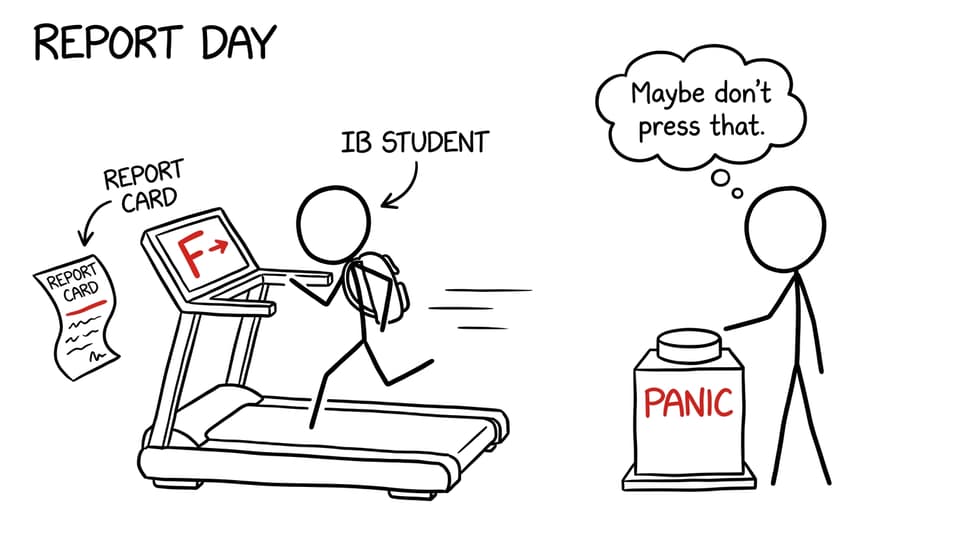
A student and parent resisting the panic button on report day
How six subjects become a score out of 45
Each of the six Diploma Programme subjects can contribute up to 7 points, producing a maximum subject total of 42. TOK and the EE are graded from A to E and can contribute up to 3 additional core points together. CAS does not add points, but successful completion is required for the diploma.
That creates a maximum possible score of 45.
A minimum total of 24 points is required for the diploma, but 24 points alone do not guarantee that it will be awarded. Current IB criteria also include completion of CAS, acceptable performance in TOK and the EE, minimum HL and SL totals, and limits on low subject grades. The IB scoring system guide explains how these conditions fit together.
For a progress report, however, adding six provisional grades can create false certainty. The total may exclude unfinished core work, rely on incomplete assessment evidence or combine grades produced under different school conventions. Treat it as an indicator and confirm its meaning with the DP coordinator.
Read comments for causes, not compliments
Numbers describe the outcome. Comments often reveal the cause.
Look for language connected to:
subject knowledge and conceptual understanding;
use of evidence, examples or calculations;
analysis, evaluation and argument structure;
command terms and examination technique;
time management or incomplete responses;
missed deadlines and coursework progress;
consistency across different assessment formats.
A student with a 4 because of weak conceptual understanding needs a different plan from a student with a 4 because they leave extended responses unfinished. The first may need explanation and retrieval practice. The second may need timed work, response planning and stricter pacing.
Effort indicators deserve similar care. Because schools define their own effort scales, check the reporting key. Strong effort with flat attainment can indicate an ineffective study method or a stubborn conceptual gap. Weak effort with acceptable attainment may signal future risk as the course becomes more demanding.
Focus on trends rather than one difficult assessment
A single grade is emotionally vivid. A trend is educationally useful.
Compare the latest report with the previous one, then ask:
Is the direction stable, improving or declining?
Does the same weakness appear in several subjects?
Are HL subjects creating most of the pressure?
Is performance stronger in coursework than under timed conditions?
Do teacher comments mention recurring habits such as incomplete work?
A movement from 6 to 5 is not automatically a crisis. The recent assessment may have tested more demanding material, used fuller IB criteria or exposed one narrow weakness. Conversely, an unchanged 5 can conceal meaningful progress if the assessments have become more complex.
The goal is not to explain every disappointing number away. It is to distinguish normal variation from a repeated pattern that needs intervention.
Questions parents can ask without creating defensiveness
The first conversation matters because students often read parental concern as disappointment, even when concern is well intended.
Begin with observation rather than accusation:
"Which result feels most accurate to you?"
"Was anything on the report surprising?"
"What does your teacher say is keeping this subject at its current level?"
"Is the challenge knowledge, technique, timing or workload?"
"What support would make the next step easier?"
Then speak with the teacher or coordinator when terminology is unclear, several subjects have declined, a core deadline is at risk or the report appears inconsistent with other evidence. Ask for examples and next actions rather than arguing for a different number.
Turn report card gaps into exam preparation
A report card becomes valuable when it changes what happens next week.
Create a short plan for each priority subject:
Report signal
Useful response
Knowledge gaps
Review one defined syllabus area, then test recall
Weak application
Complete topic-specific exam-style questions
Poor essay structure
Plan and write timed responses using the rubric
Timing problems
Complete short timed sections before full simulations
Inconsistent marks
Keep an error log and repeat similar questions
Coursework concern
Check the criteria and seek feedback before deadlines
Avoid the instruction to "revise more." It creates effort without direction. Choose the smallest identifiable gap, practise it and collect new evidence.
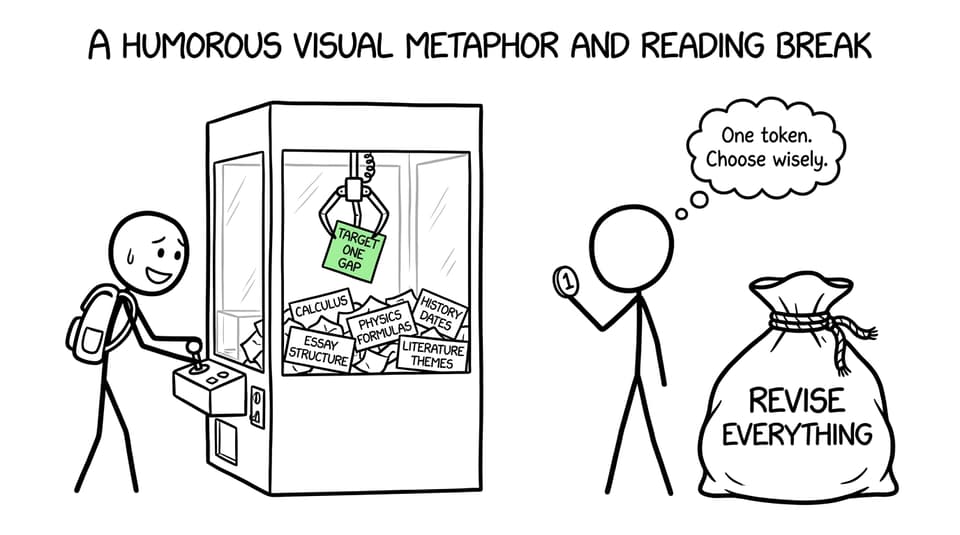
A student choosing one report-card gap instead of revising everything
This is where RevisionDojo can provide light, targeted support. A student can use syllabus-aligned Study Notes or AI Chat to clarify a weak concept, reinforce key material with Flashcards, and then apply it through the Questionbank. The RevisionDojo IB exam preparation workflow explains how these tools connect.
When the issue is examination performance rather than content, Predicted Papers and Mock Exams can help develop pacing and stamina. If the concern is an IA, TOK essay or EE draft, the IB Coursework Grader and Coursework Library can make rubric language easier to act on. Grading tools are useful sources of formative feedback, but teacher guidance remains essential. Students who need more individual support can also work with RevisionDojo Tutors.
Make the report the beginning of a better plan
Understanding your child's IB report card does not require decoding every number in one sitting. It requires three calmer moves: define what the report measures, identify the pattern behind the grades and choose a focused response.
The report is not a verdict on intelligence, effort or future potential. It is evidence gathered at one point in a demanding two-year programme. Read it accurately, ask specific questions and turn its gaps into manageable practice.
RevisionDojo is built to support that next step across the IB journey, from Study Notes and Flashcards to the Questionbank, AI Chat, Grading tools, Predicted Papers, Mock Exams, the Coursework Library and Tutors. Start with the weakest clearly defined skill. Then help your child produce better evidence, one practice cycle at a time.
Noor earned her MA in Applied Linguistics from the American University of Beirut and has taught IB Arabic ab initio and Language B for 9 years. Her focus is IB Arabic across ab initio and Language B, building the durable proficiency the oral and written assessments demand.
Learn whether universities see IB paper and IA component scores, what appears on official transcripts, and when detailed marks may still affect admission.