

Change is the easiest thing to notice and the hardest thing to explain.
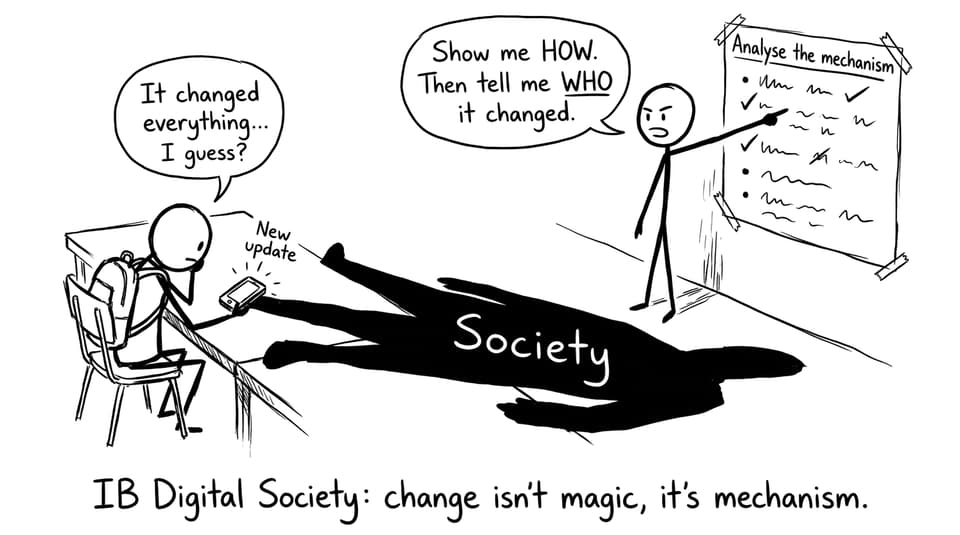
You see it when a platform redesigns its feed and your habits shift within a week. You feel it when a school moves to a new learning system and suddenly deadlines, feedback, and motivation work differently. In IB Digital Society, that instinctive “something changed” is only the starting line. Your marks come from showing how change happens, who experiences it, and whether the change is justified or harmful.
In this guide to IB Digital Society, you’ll learn a repeatable method for analysing change that works in exam answers and in your internal assessment. The goal is simple: move from vague statements to sharp, evidence-led analysis.
A quick change-analysis checklist (save this)
When a question mentions a digital system, run this checklist before you write:
-
Name the digital system (platform, feature, algorithm, policy, dataset)
-
Before vs after: what was the situation earlier, and what is different now?
-
Mechanism: which design choices or system features produced the change?
-
Stakeholders: who benefits, who is harmed, who is excluded?
-
Level: individual, community, institution (often all three)
-
Time: immediate effects vs long-term transformation
-
Evaluation: is the change proportionate, ethical, sustainable, governable?
To anchor your revision, start from the IB Digital Society resources hub and keep your concepts tight using the Topic 2 Concepts page.
What “change” means in IB Digital Society
In IB Digital Society, change is not “technology exists, therefore society changes.” Change is a transformation over time in behaviours, norms, relationships, structures, or values that occurs because a digital system is adopted and used.
That definition matters because it forces precision:
-
You must show a timeline (even a simple before/after)
-
You must link to a system mechanism (not just user choice)
-
You must discuss impacts on people and communities
If you want the syllabus-aligned framing, revise the concept directly via 2.1 Change and deepen it with the 2.1A change notes.
IB Digital Society change is system-driven (not inevitable)
A strong IB Digital Society answer treats change as something shaped by choices: interface, incentives, defaults, ranking systems, friction, moderation rules, and data practices.
When you write “the system caused change,” the next sentence should explain which part of the system did the causing.
Examples of mechanisms you can analyse:
-
A recommendation algorithm that rewards short-term engagement
-
A new verification policy that alters who is trusted
-
A shift from chronological to ranked feeds
-
A design that reduces privacy friction (one-click sharing, auto-tagging)
This is why analysing social media works well for change: it has visible mechanisms. If you need a model example, use Social media as a digital system as a reference point.
How to identify what has changed (without staying vague)
Most weak responses skip the comparison and jump straight to judgement. Don’t.
Instead, write one sentence for each:
-
Before: What was typical prior to adoption or redesign?
-
After: What is typical now?
-
Who: Which groups experienced the shift most strongly?
Even in an exam stimulus, you can infer a reasonable baseline. “Before” might mean “before widespread adoption,” “before a policy update,” or “before this tool was integrated into schools.” In IB Digital Society, you’re rewarded for making that timeline explicit.
If your notes feel scattered, keep them searchable and theme-based using Effective note-taking tips for IB Digital Society and the structured IB Digital Society revision notes hub.
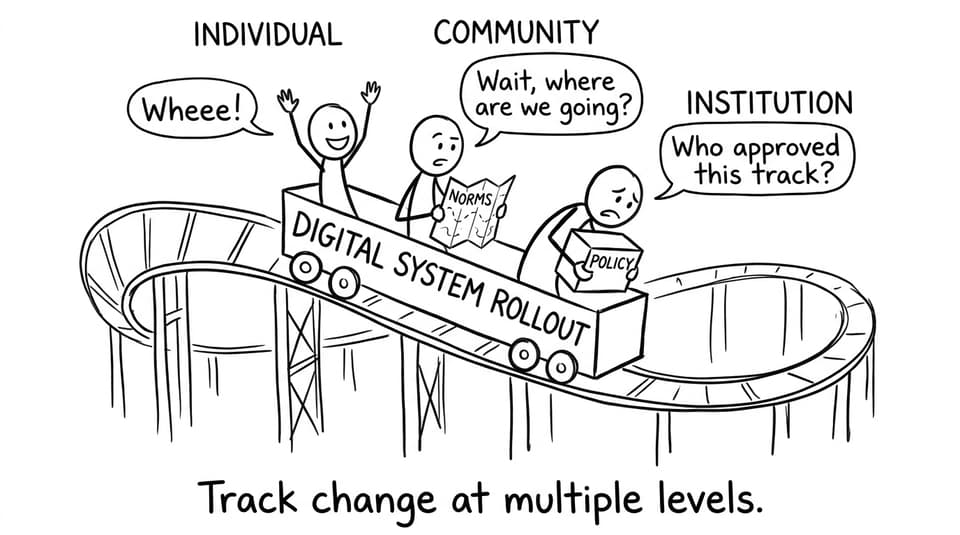
Analyse change at multiple levels (individual, community, institution)
High-scoring IB Digital Society responses rarely stay at just one level.
Individual-level change
Here, you’re looking at behaviour, autonomy, decision-making, or dependency.
Good analysis sounds like:
-
“The default notification settings increase checking behaviour by adding intermittent rewards.”
-
“Autoplay reduces deliberate choice by removing stopping cues.”
Notice how the focus is not “people are addicted,” but what in the system pushes behaviour.
Community-level change
Community change is where patterns emerge: access, inequality, norms, and collective behaviour.
Ask:
-
Who gains access to opportunities and who loses it?
-
Which groups are over-represented or under-protected?
-
What becomes normal that wasn’t normal before?
Institutional change
Institutions respond through policies, governance, and enforcement.
Look for:
-
New monitoring practices (schools, employers)
-
Regulatory responses (age verification, content laws)
-
Shifts in accountability (who is responsible when harm occurs?)
Change over time: why “long-term” is often the best paragraph
In IB Digital Society, the most interesting change is often gradual:
-
Early adoption feels optional; later it becomes socially required
-
Small features compound into new norms
-
Harms appear only after scale (misinformation, bias, exclusion)
A simple upgrade to a system can quietly reshape expectations. The point isn’t to predict the future dramatically. It’s to show examiners that you understand change as accumulation, not just immediate effects.
Link change to power and ethics (without bolting them on)
The cleanest way to improve your analysis is to connect change to other course concepts.
-
Change and power: Who now controls visibility, data, rules, or resources?
-
Change and ethics: Are benefits distributed fairly? Are harms foreseeable? Is consent meaningful?
The trick is integration: show how a mechanism produces a change that shifts power and triggers ethical trade-offs.
To practise concept connections, use Connecting multiple concepts in IB Digital Society inquiries and the broader map in How all the core concepts fit together.
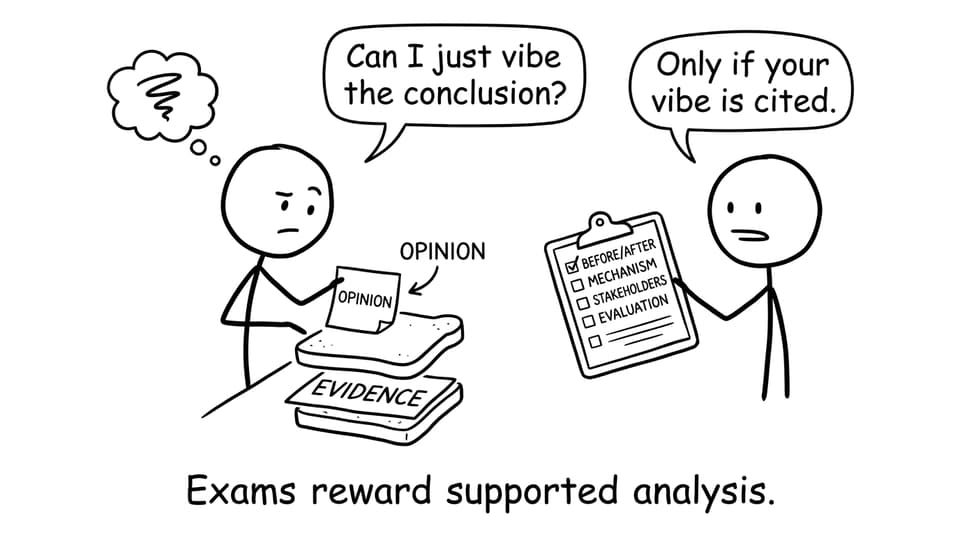
Exam practice: turn change into a paragraph template
Use this paragraph pattern for IB Digital Society essays and short responses:
-
Claim about change (specific, not generic)
-
Mechanism (feature/design choice)
-
Impact on individuals and communities
-
Evaluation (trade-offs, responsibility, justified?)
Then practise under time pressure with Questionbank and topic-specific drills like 1.1 What is digital society Questionbank.
Using change in the IA (internal assessment)
In the IB Digital Society IA, change becomes powerful when your real-world example has a visible timeline: rollouts, policy updates, adoption curves, or measurable shifts in behaviour.
Two moves help immediately:
-
Pick a specific digital system (not “social media,” but a feature, policy, or tool)
-
Define which change you’re tracking and which stakeholders you’ll evaluate
RevisionDojo’s IB Digital Society IA guide is the clearest place to see what examiners look for, and it pairs well with How to write a strong IA research question.
Closing: make change visible, then make it meaningful
Once you see change clearly, IB Digital Society becomes calmer. You stop guessing what examiners want and start showing them: a timeline, a mechanism, stakeholders, and a justified judgement. That’s the difference between “it changed everything” and “this system feature shifted behaviour and power over time, with uneven ethical consequences.”
If you want a structured way to build that skill fast, use RevisionDojo’s Study Notes, Flashcards, Questionbank, AI Chat, and Grading tools to practise the change-analysis loop. Start with IB Digital Society resources, then drill questions until analysing change in IB Digital Society feels like a habit, not a hope.


