


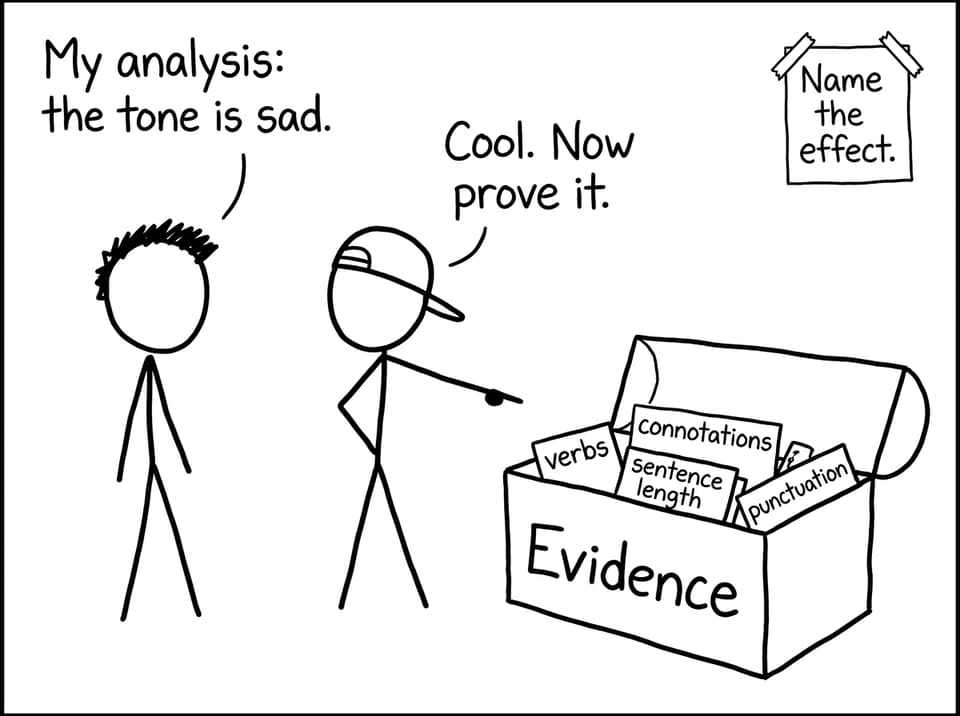
In the exam hall, the most dangerous sentence you can write is the one that feels true but proves nothing: “The tone is sad.”
It’s a mood. A hunch. And in IB English, hunches don’t earn marks unless you can show how language creates them.
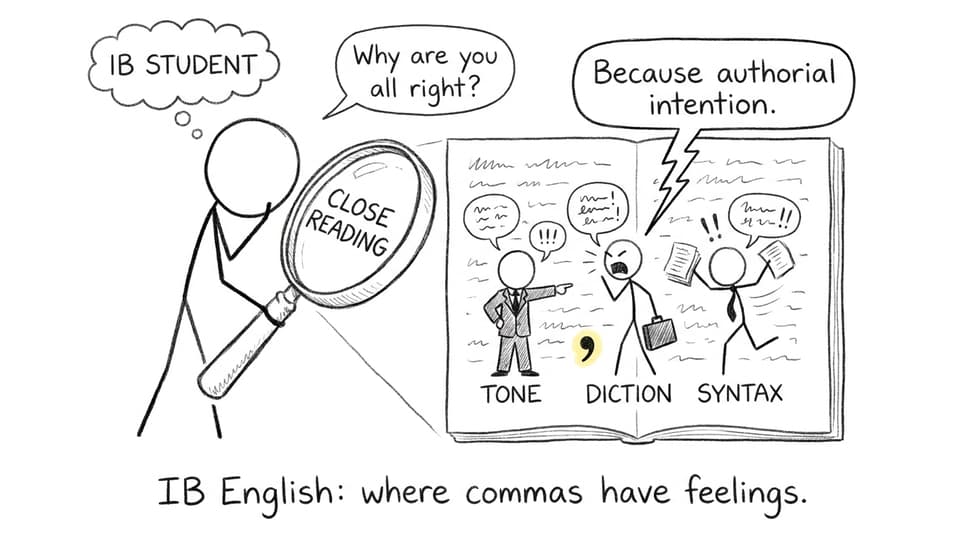
That’s where tone, diction, and syntax quietly take over. Not as a vocabulary list, but as a way of seeing. Once you learn to spot these choices, you stop reading like a passenger and start reading like a mechanic: you can point to the engine, name the part, and explain what it does.
A quick IB English checklist for language analysis
Use this mini-check before you draft any paragraph in IB English:
-
Name the tone with 1-2 precise adjectives (not “good/bad”).
-
Circle 3-5 charged words: that’s your diction evidence.
-
Underline one sentence you felt in your body: that’s likely syntax doing work.
-
Identify a shift (tone change, register change, sentence-length change).
-
Convert notes into a claim: choice -> effect -> meaning.
If you want a structured place to practise this under timed conditions, start with IB English A Lang & Lit Resources and build repetition using RevisionDojo’s Questionbank, Study Notes, and AI Chat.
Tone in IB English: the attitude behind the words
Tone is the speaker’s or writer’s attitude toward the subject and audience. In IB English, tone is less about what the text “is about” and more about what it sounds like it thinks.
A practical way to avoid vagueness is to pair tone words with a direction:
-
not “angry,” but accusatory toward authority
-
not “sad,” but resigned about loss
-
not “happy,” but self-congratulatory about success
Then prove it with technique. For targeted support, RevisionDojo’s guide on tone and mood in IB English analysis helps you separate what the writer projects (tone) from what the reader feels (mood), a distinction examiners reward.
How to write tone analysis that earns marks
In IB English, tone analysis becomes strong when it does three things in one breath:
-
Labels the tone precisely.
-
Points to the language that builds it.
-
Explains why that tone matters for purpose, character, or theme.
For example: instead of “the tone is ironic,” you might argue that irony makes the narrator seem both entertaining and untrustworthy, shaping how we judge the world of the text.
Diction in IB English: word choice with consequences
Diction is word choice, but in IB English it’s really about patterns: what kinds of words keep appearing, what feels unusually specific, what becomes abstract, what sounds clinical or intimate.
A helpful trick is to classify diction quickly:
-
Concrete vs abstract (objects and senses vs ideas and virtues)
-
Elevated vs colloquial (formal register vs everyday speech)
-
Soft vs harsh (phonetic texture and connotation)
-
Inclusive vs exclusive (“we” language vs “they” language)
RevisionDojo’s diction notes are useful here because they push you beyond spotting “interesting words” and toward explaining how connotation steers interpretation.
A fast diction sentence you can reuse
Try this template in IB English:
The writer’s diction shifts from ____ to ____, creating a sense of ____ that positions the audience to ____.
It forces you to connect language to effect, and effect to intention.
Syntax in IB English: sentence structure as pacing and power
Syntax is the arrangement of words into sentences, and it’s one of the easiest ways to sound sophisticated in IB English without using jargon.
Ask what the sentence does to the reader:
-
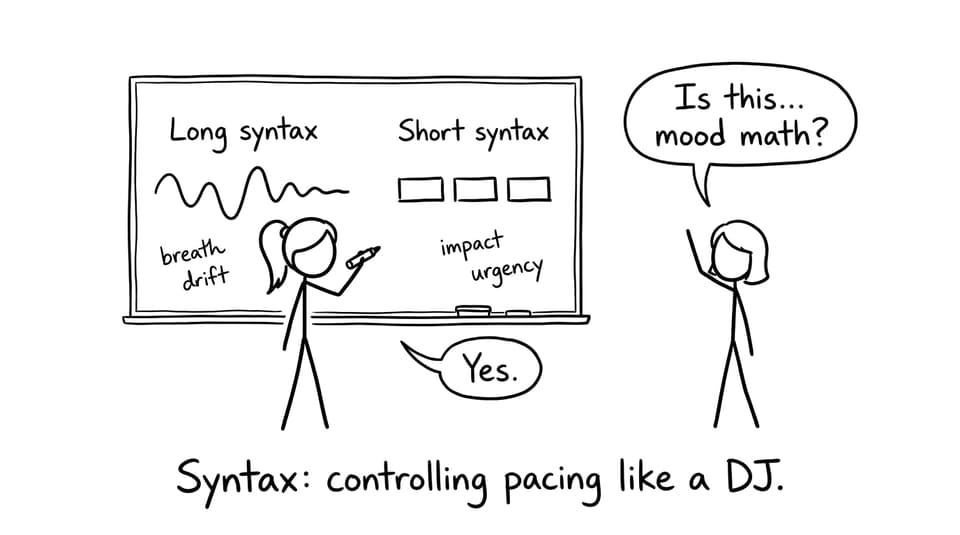
Long, unfolding syntax can feel reflective, overwhelming, hypnotic, or unstable.
-
Short syntax can feel decisive, brutal, urgent, or emotionally clipped.
-
Punctuation becomes stage direction: commas for breath, dashes for interruption, full stops for impact.
-
Parallel structure builds momentum and certainty.
-
Fragments can mimic shock, intimacy, or refusal.
If Paper 1 is your focus, pair this with RevisionDojo’s walkthrough on how to analyze language and style in Paper 1 unseens to see how syntax observations become paragraph-ready claims.
How tone, diction, and syntax work together
The best IB English paragraphs don’t treat tone, diction, and syntax as separate boxes. They show how choices reinforce each other.
Imagine a narrator describing a family dinner:
-
harsh diction (verbs that “snap,” “spit,” “grind”)
-
short, clipped syntax (few conjunctions, hard stops)
-
a cold tone (detached observation rather than empathy)
Together, these create conflict without the writer ever needing to announce it.
To practise weaving techniques instead of listing them, use the approach in RevisionDojo’s close reading techniques guide. It’s built around noticing clusters and shifts, exactly what examiners are trained to reward.
Closing: the quiet advantage in IB English
A strong IB English student isn’t someone who “gets” the text instantly. It’s someone who can show their working when the meaning is subtle.
Tone tells you what the voice is doing. Diction tells you what the voice values. Syntax tells you how the voice moves: calmly, violently, playfully, or in fragments. Put together, they turn your commentary from “I think” into “I can prove.”
If you want to practise this skill with feedback that actually changes your next draft, use RevisionDojo’s Questionbank and Study Notes for targeted drills, the Grading tools for rubric-aligned improvement, Flashcards for technique recall, and AI Chat for faster iteration. The goal isn’t to sound fancy. The goal is to sound precise, and in IB English, precision is power.


