
The hardest moment in IB English often arrives before the writing begins. You see a Paper 2 question about power, identity, memory, or conflict, and two studied works immediately come to mind. Both fit. Both contain useful moments. Yet the comparison still feels ordinary.
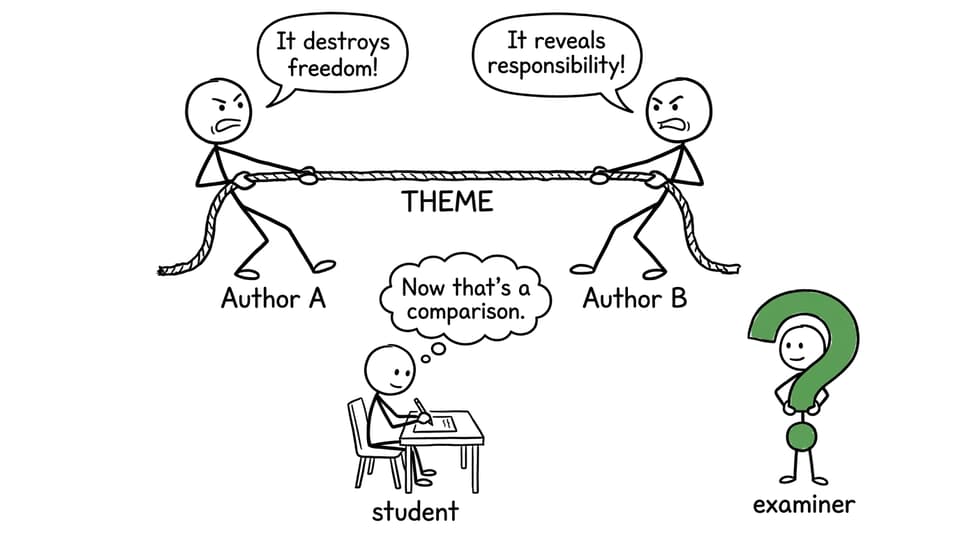
That hesitation reveals something important. Strong thematic comparison is not about proving that two works mention the same subject. It is about discovering how two authors place different pressures on the same idea. One may present power as something imposed by institutions; another may show it growing quietly inside a family. The theme connects them, but the difference gives your IB English essay its argument.
IB English Paper 2 at a glance
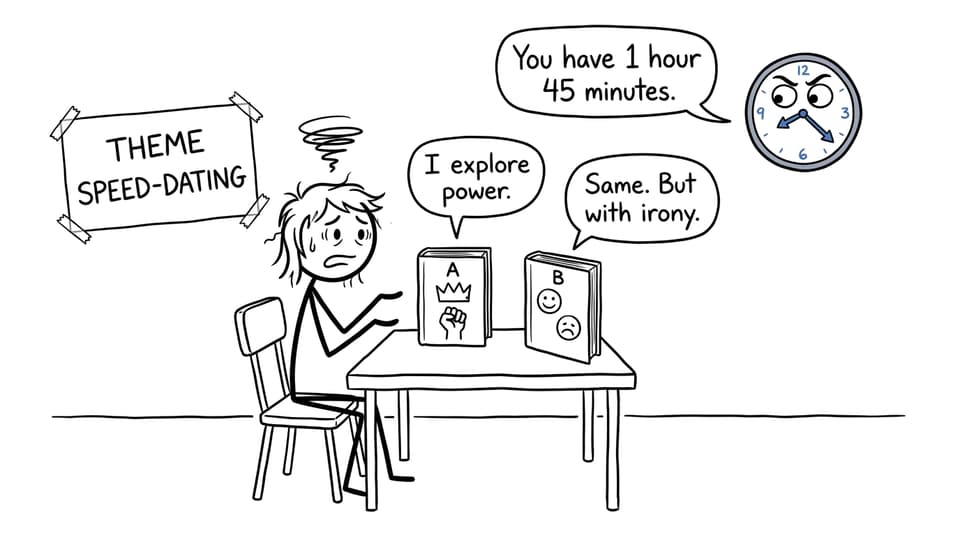
For the current IB English course, Paper 2 is a comparative essay completed in 1 hour and 45 minutes. Students choose one of four general questions and write about two literary works studied during the course. The assessment is worth 35% at SL and 25% at HL.
For first assessment in 2026, the 25 available marks are distributed across five five-mark areas: knowledge and interpretation, analysis of authorial choices, comparative analysis, focus and organization, and language. The explicit comparative component matters. Two individually impressive discussions do not automatically become an effective comparison.
Before writing, check that your plan can do the following:
-
Answer the exact wording of the question
-
Define the theme as an arguable idea
-
Establish a meaningful relationship between two works
-
Pair scenes, motifs, or structural choices by function
-
Analyze how authorial decisions shape meaning
-
Give both works balanced attention
-
Return to the thesis throughout the essay
The IB English Paper 2 Questionbank is useful for turning this checklist into repeated, exam-style practice.
What a theme means in IB English
A topic is usually a noun: power, freedom, isolation, justice. A theme is a proposition about that noun. It captures what a work suggests, questions, or exposes.
Consider the difference:
-
Topic: memory
-
Theme: private memory can preserve identity while separating people from a shared history
The second version gives an IB English essay somewhere to go. It invites questions about perspective, structure, silence, reliability, and context. More importantly, another author can disagree with it.
Try completing this sentence for each work:
Through its treatment of [topic], the work suggests that [arguable interpretation].
If both completions sound identical, look more closely. Perhaps one author treats belonging as protective while the other sees it as conditional. Perhaps both criticize authority, but one does so through satire and the other through tragedy. The best IB English comparisons begin where apparent similarity breaks apart.
When your analytical vocabulary feels limited, use the IB English Literature glossary alongside RevisionDojo Flashcards. Knowing terms such as focalization, dramatic irony, juxtaposition, and motif helps only when you can explain their effects precisely.
Building an IB English thematic comparison
Turn the question into a tension
Underline the conceptual words in the prompt, then rewrite the question as a tension. A question about freedom might become freedom versus security, internal freedom versus external restriction, or imagined freedom versus achievable freedom.
This prevents your IB English argument from becoming a list. It also helps you select works for analytical potential rather than superficial resemblance. Before committing, ask which pairing lets you discuss both theme and method with confidence.
The step-by-step comparative essay guide offers a useful framework for testing possible text combinations.
Define each author’s position
Imagine that both authors have entered a quiet debate. What does each appear to believe about the central issue? What does each blame? What possibility does each leave open?
For example, both works may depict social control. Author A might suggest that control survives because individuals internalize public rules. Author B might argue that control depends on visible violence and collective fear. That distinction creates an IB English thesis because the works now illuminate each other.
Avoid claiming to know an author’s private intention. Instead, write that the work suggests, constructs, frames, or invites the reader to consider. This keeps your interpretation grounded in the text.
Compare authorial choices
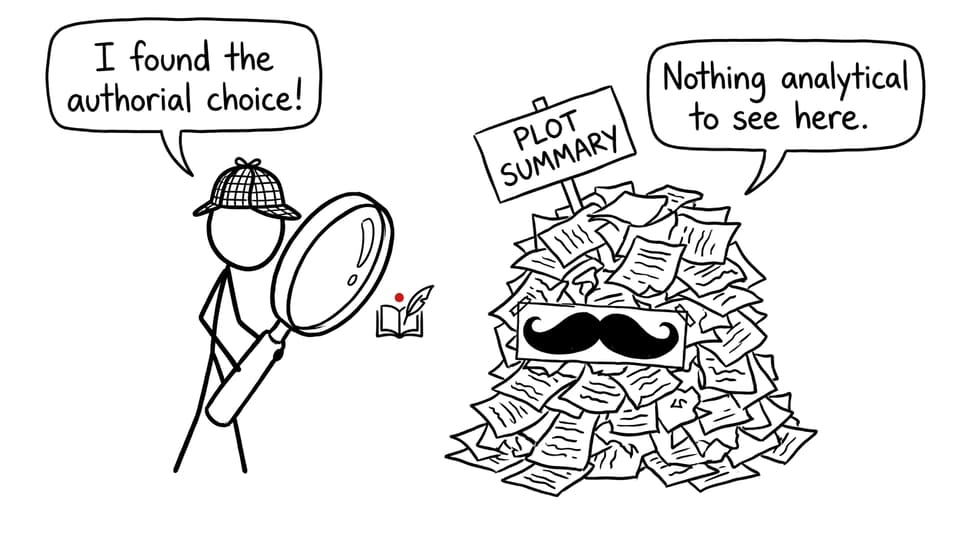
Plot tells you what happens. Authorial choices explain how the work turns events into meaning. Useful choices include:
-
Narrative perspective and reliability
-
Linear, cyclical, or fragmented structure
-
Setting and spatial contrast
-
Symbolism and recurring motifs
-
Dialogue, silence, and interruption
-
Tone, imagery, irony, or satire
-
Characterization and patterns of conflict
-
Genre conventions and their disruption
Do not merely identify a technique. Complete the analytical chain:
choice --> immediate effect --> thematic implication --> comparative significance
A fragmented chronology, for instance, might make trauma feel continuously present rather than safely historical. If the second work uses linear narration, that contrast may suggest a more stable relationship with memory. This is the kind of IB English analysis that converts terminology into interpretation.
RevisionDojo’s IB English study and revision notes can help you consolidate methods, while the Questionbank tests whether you can apply them independently.
Pair moments by purpose
Students sometimes memorize isolated quotations and hope the question will accommodate them. A more flexible IB English strategy is to prepare paired moments.
Match moments that perform comparable functions:
-
Two entrances that disturb an established order
-
Two confrontations that reveal unequal power
-
Two settings that restrict movement
-
Two endings that redefine responsibility
-
Two recurring images that change in meaning
You do not need lengthy quotations. Accurate references to specific moments, patterns, and choices can provide strong evidence, and the current supporting guidance does not require direct quotations. What matters is that your knowledge is precise enough to support interpretation.
Build a small comparison grid with the theme, moment, method, effect, and contrast for each work. RevisionDojo Flashcards can then turn those pairings into active-recall prompts instead of disconnected facts.
Writing an IB English comparative thesis
A thesis should answer the question, establish the relationship between the works, and explain why that relationship matters. If it only announces that both authors explore identity, it has not yet become an argument.
Use this adaptable pattern:
Although both works present [shared concern], Work A frames it as [position] through [choices], whereas Work B presents it as [contrasting position] through [choices]; together, they reveal [larger implication].
The final clause is the most valuable. It answers the silent question beneath every IB English comparison: why does this difference matter?
A strong thesis might argue that two writers depict silence as protective, but only one presents that protection as sustainable. The essay can then investigate who remains silent, how silence is represented, and what each ending does with it.
Use RevisionDojo AI Chat to challenge your thesis with counterarguments, not to replace your reading. If the argument survives questions such as “Is this always true?” and “Which authorial choices prove it?”, it is probably ready.
Structuring comparative body paragraphs
The safest structure places both works inside every major paragraph. This keeps comparison visible rather than postponing it until the conclusion.
A reliable paragraph sequence is:
-
Comparative claim: Make one arguable point about both works.
-
Work A: Analyze a precise moment and its construction.
-
Pivot: Identify the relevant similarity or difference.
-
Work B: Analyze a functionally related moment.
-
Synthesis: Explain what the relationship reveals about the theme.
Comparison words are useful, but they cannot create analysis by themselves. “Similarly” only signals a connection; the sentences after it must explain the significance of that connection.
For further models, read how to structure a comparative essay. RevisionDojo’s Grading tools can then show whether your own IB English response remains focused, balanced, and analytical.
High-value thematic lenses for IB English
Power as force or consent
Compare how control operates. Is it maintained through punishment, language, tradition, economic dependence, affection, or self-surveillance? Two works may condemn domination while disagreeing about why people participate in it.
Identity as inheritance or performance
One work may portray identity as inherited through culture, family, or historical memory. Another may show identity being performed for institutions or communities. The IB English comparison becomes richer when you examine who has the power to name someone.
Memory as witness or refuge
Memory can preserve experiences that official histories erase. It can also become a private shelter that prevents change. Compare chronology, narrative gaps, repeated images, and shifts in perspective to explain which possibility each work emphasizes.
Belonging as safety or surrender
Communities protect people, but they also demand conformity. An effective IB English response can explore what characters must hide, sacrifice, or perform to remain included.
These lenses are starting points, not scripts. The question must always control the essay.
Common comparison mistakes
Writing two separate essays: A paragraph on one work followed by a paragraph on the other leaves the relationship implicit. Use paired moments and synthesis sentences.
Comparing events rather than construction: Similar suffering does not prove similar meaning. Analyze voice, structure, imagery, form, and reader positioning.
Forcing perfect symmetry: Balanced treatment does not require identical word counts in every paragraph. It requires both works to contribute meaningfully to the argument.
Adding context as decoration: Historical information matters when it clarifies an authorial decision or interpretive implication. If it does neither, remove it.
Memorizing a fixed essay: A prepared argument may not answer the question set. Practise adapting your theme maps through the IB English Paper 2 under-time-pressure guide.
A practical IB English revision routine
Choose three to five adaptable themes for your two strongest works. For each theme, define each work’s position, select three paired moments, and attach one or two authorial choices to every moment. Then practise writing thesis statements for unfamiliar questions.
Once a week, complete a timed plan. On another day, write one comparative paragraph. Finish the cycle with a full response using RevisionDojo Mock Exams or Predicted Papers, then evaluate it with the Grading tools. The IB English exam time-management guide can help you establish a repeatable pacing strategy.
RevisionDojo’s Study Notes and Coursework Library provide models; Flashcards strengthen recall; AI Chat tests reasoning; and Tutors can diagnose persistent weaknesses. Together, these tools make IB English preparation a feedback loop rather than a collection of hopeful rereadings.
Make comparison feel inevitable
A memorable IB English comparison does not impress through complexity alone. It feels persuasive because every choice serves the same line of thought: the theme is defined, the contrast is meaningful, the evidence is paired, and the authorial methods are evaluated.
That control is built slowly. Practise seeing two works not as separate objects, but as participants in the same argument. Use RevisionDojo as the ultimate IB English resource to rehearse that argument through the Questionbank, Study Notes, Flashcards, AI Chat, Grading tools, Predicted Papers, Mock Exams, Coursework Library, and Tutors. By exam day, you should not be searching for a comparison. You should be choosing among several that already make sense.