


In every IB English class, there’s a quiet moment most students recognise.
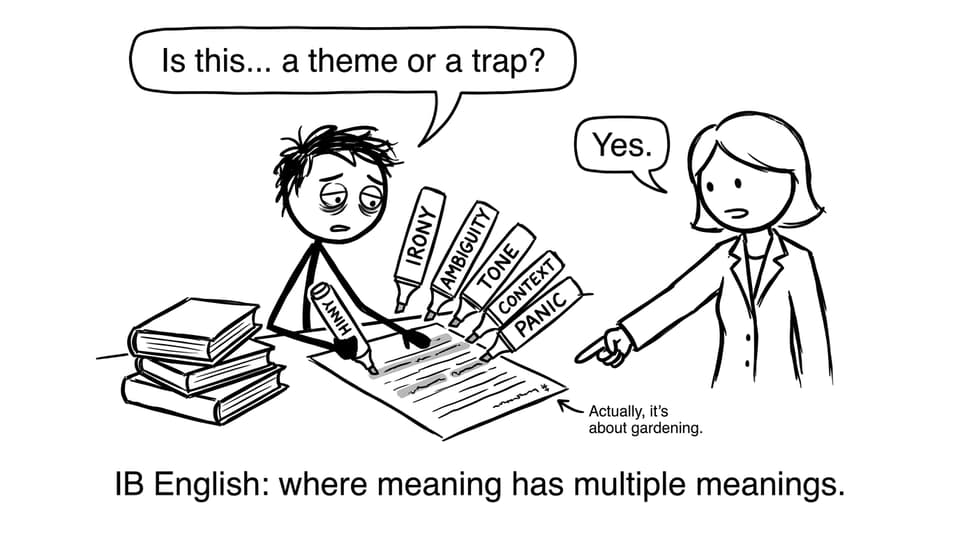
You read a line that looks simple. You underline it anyway. Then someone says, “Wait… I think it means the opposite.” Another person says, “Or maybe it means both.”
That’s not confusion. That’s craft.
Irony and ambiguity are two of the most reliable ways writers build depth without adding length. They let a text sound calm while saying something dangerous. They let a character speak with certainty while the story whispers doubt. And in IB English, they’re often the difference between an essay that describes and an essay that interprets.
If you want a strong home base for skills, examples, and practice, keep the main IB English A: Language & Literature resources open while you revise.
A fast IB English checklist for irony and ambiguity
Use this mini-checklist whenever you suspect irony or ambiguity in IB English:
-
Identify what the line seems to mean on the surface.
-
Identify what the context suggests it really does.
-
Name the type: irony (verbal/dramatic/situational) or ambiguity (lexical/structural/narrative).
-
Track tone shifts: sincerity to sarcasm, hope to dread, admiration to critique.
-
Explain the function: what truth, contradiction, or uncertainty is being created?
-
Tie it to a larger concern: power, identity, morality, society, or a global issue.
For timed practice, combine this checklist with a Paper 1 method like the one in Step-by-Step Guide to Revising IB English Paper 1.
What irony and ambiguity really mean in IB English
In IB English, definitions matter most when they lead to analysis. Here are the exam-useful versions.
Irony: meaning built from contradiction
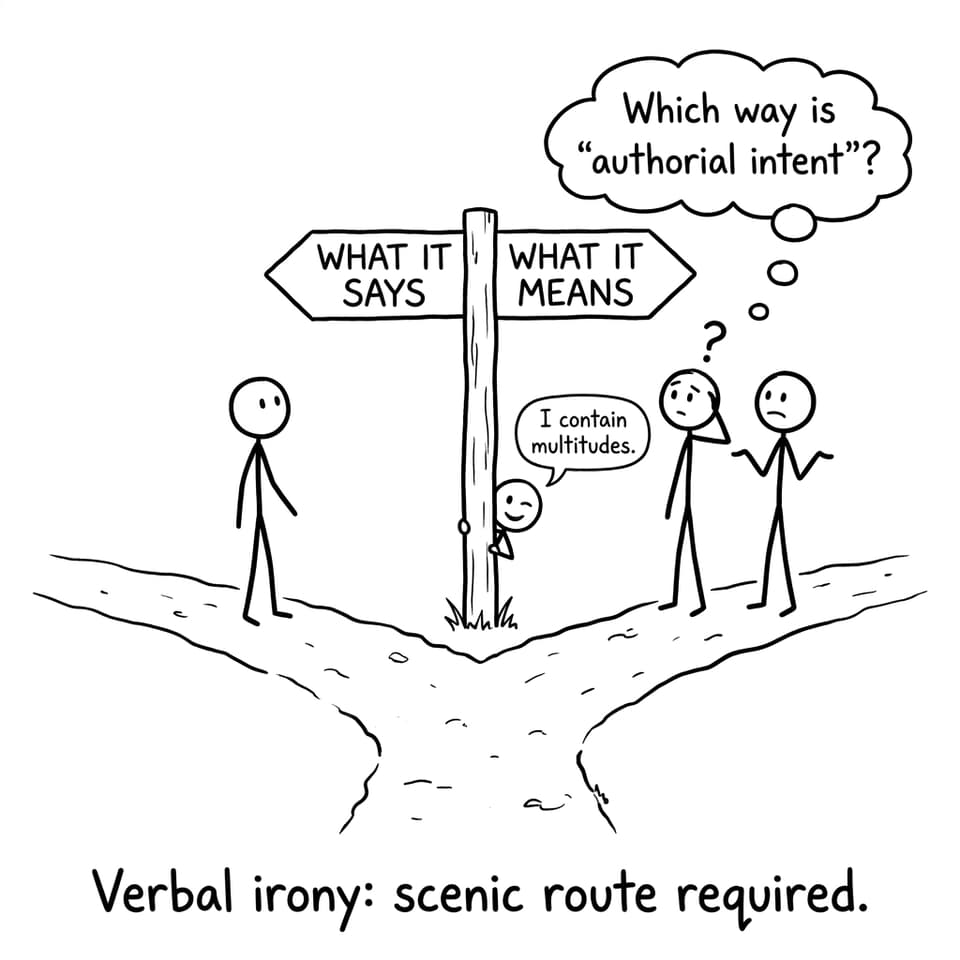
Irony is a gap. Between what is said and what is meant. Between what a character expects and what happens. Between what a society claims and what it does.
-
Verbal irony: language says one thing, implies another.
-
Dramatic irony: the audience knows what a character doesn’t.
-
Situational irony: outcomes contradict expectations in a revealing way.
In texts like Animal Farm, the utopian slogans (“All animals are equal”) become sharper precisely because reality keeps disproving them. In IB English, you don’t just spot that contradiction. You explain what it accuses.
Ambiguity: meaning built from uncertainty
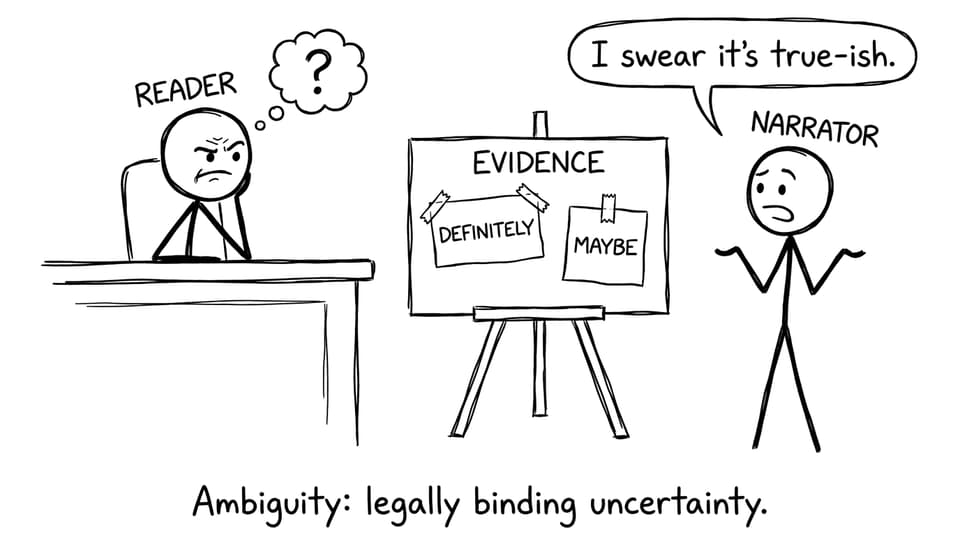
Ambiguity is controlled uncertainty. A writer creates a space where more than one interpretation stays plausible, and that tension becomes the point.
Common forms:
-
Lexical ambiguity: one word, multiple meanings.
-
Structural ambiguity: syntax or phrasing allows more than one reading.
-
Narrative ambiguity: unreliable narration, shifting perspectives, blurred time.
In novels like The Catcher in the Rye, Holden’s voice can read as sincere, performative, defensive, or all three. That uncertainty isn’t a flaw. It’s characterization.
How to analyze irony in IB English (without making it sound like a joke)
A frequent IB English mistake is treating irony as “the author being funny.” Sometimes it is funny. But the scoring comes from purpose.
Spot the mismatch
Start by stating the surface expectation, then the reality.
-
What does the speaker claim?
-
What do we observe instead?
-
What does the gap reveal about values, power, or self-deception?
Example anchor:
In Othello, dramatic irony burns because the audience sees Iago’s manipulation while Othello calls him “honest.” Each repetition tightens tragedy, turning trust into a weapon.
Track tone like it’s a mood swing you can prove
In IB English, tone is evidence. Notice understatement, exaggeration, or a suddenly “polite” voice around something ugly.
Austen’s famous opening in Pride and Prejudice (“It is a truth universally acknowledged…”) works because it performs certainty while mocking certainty. The narrative voice doesn’t argue with society; it smiles at it until it looks ridiculous.
Explain the function: what is being criticized?
Irony often exposes:
-
hypocrisy (institutions vs reality)
-
moral contradiction (virtue used for harm)
-
social performance (appearance over truth)
In The Crucible, irony deepens as those claiming righteousness become agents of injustice. The play isn’t merely showing chaos; it’s showing how moral language can be used as permission.
If you want targeted exam practice, use RevisionDojo’s IB English A Lang & Lit Questionbank to train technique-to-effect paragraphs under time pressure.
How to analyze ambiguity in IB English (without calling it “confusing”)
Ambiguity is not you being lost. It’s the writer refusing to close a door.
Identify the fork in interpretation
Point to the exact phrase or structural choice that creates two plausible meanings.
Look for:
-
pronouns with unclear referents (“it,” “they,” “you”)
-
symbols that operate on multiple levels
-
endings that resolve plot but not meaning
In The Turn of the Screw, James uses narrative ambiguity so the reader cannot settle whether the ghosts are real or psychological projections. That uncertainty becomes a commentary on repression, perception, and authority.
Connect ambiguity to theme (or global issue)
Strong IB English analysis treats ambiguity as a thematic engine.
Ask:
-
What does uncertainty suggest about truth?
-
What does dual meaning suggest about identity or morality?
-
Who benefits from the lack of clarity?
In works like Beloved, fragmented chronology and layered voices blur memory and time. The ambiguity reflects trauma’s resistance to neat storytelling.
Show how structure creates uncertainty
Ambiguity often lives in:
-
shifts in narration
-
jumps in time
-
gaps in information
-
contradictions that are never corrected
A practical habit: in IB English annotations, label “What we know” vs “What we infer.” Ambiguity often sits in the difference.
Irony vs ambiguity: how to compare them in IB English
A useful comparison for IB English essays:
-
Irony often creates distance: the author reveals a contradiction and lets the reader judge.
-
Ambiguity often creates intimacy with uncertainty: the author refuses certainty and lets the reader participate.
Comparative framing example:
While Orwell’s irony in Animal Farm exposes political delusion by making slogans collapse against reality, Atwood’s ambiguity in The Handmaid’s Tale keeps hope and despair entangled, forcing the reader to live inside the uncertainty of resistance.
Where irony and ambiguity score marks in IB English assessments
Paper 1: unseen analysis
In IB English Paper 1, irony and ambiguity are high-value because they naturally produce interpretation.
Do this:
-
Identify a tone shift and argue what it changes.
-
Use the chain: technique -> evidence -> effect -> meaning.
For structure support, pair this topic with How to Analyze Language & Style in Paper 1 Unseens and the broader comparison guide What’s the Best Way to Study for Paper 1 vs Paper 2.
Paper 2: comparative essay
Paper 2 rewards students who can compare how writers build meaning.
Try:
-
comparing the purpose of irony across two texts
-
comparing how ambiguity shapes endings, narrators, or moral judgments
When you practise, build a timed plan using RevisionDojo’s tools like Mock Exams and Grading tools, then refine with Study Notes and Flashcards for technique vocabulary.
Individual Oral (IO)
Irony and ambiguity shine in the IO because you can link them to a global issue and performance choices.
Use RevisionDojo’s IO hub for structure and exemplars: Individual Oral topic resources and the walkthrough Comprehensive IB Individual Oral (IO) Guide.
HL Essay
The HL Essay rewards depth: one line of inquiry, repeated close analysis.
Ambiguity is especially useful because it creates a sustained argument: you can track how uncertainty evolves across chapters or scenes.
For planning support, see Understanding the HL Essay for IB English A and the assessment lens from the HL Essay Grader.
Common IB English mistakes (and the clean fixes)
-
Mistake: “It’s ironic because it’s funny.”
Fix: State the contradiction and what it criticizes. -
Mistake: Calling ambiguity “unclear writing.”
Fix: Prove the two plausible meanings and explain why the writer keeps both alive. -
Mistake: Technique spotting without effect.
Fix: Always finish with reader impact and thematic significance. -
Mistake: Over-quoting.
Fix: Use short quotations and micro-analyze diction and tone.
If you want frequent, low-stakes feedback loops, RevisionDojo’s AI Chat, Questionbank explanations, and Grading tools make IB English practice feel less like guessing and more like calibration.
Closing: make IB English feel less like guessing
The best students in IB English aren’t the ones who “get it instantly.” They’re the ones who stay calm long enough to notice the gap between surface meaning and real meaning, and disciplined enough to explain what that gap is doing.
Irony teaches you to read against the grain. Ambiguity teaches you to respect uncertainty without surrendering to it. Together, they turn your analysis into something examiners can reward: clear claims, controlled evidence, and interpretations that acknowledge complexity.
If you want to practise this with feedback instead of hope, use RevisionDojo as your base: Study Notes for technique refreshers, Flashcards for analytical vocabulary, the Questionbank for repetition, Predicted Papers and Mock Exams for realism, and AI Chat plus Grading tools to tighten your paragraphs until they sound like IB English at its best.