


If you have ever stared at an IB Math AI question and felt your brain go quiet, you are not alone. The exam has a strange way of turning familiar topics into unfamiliar pressure. And the pressure does something sneaky: it convinces students that if they cannot see the final answer, they should stop.
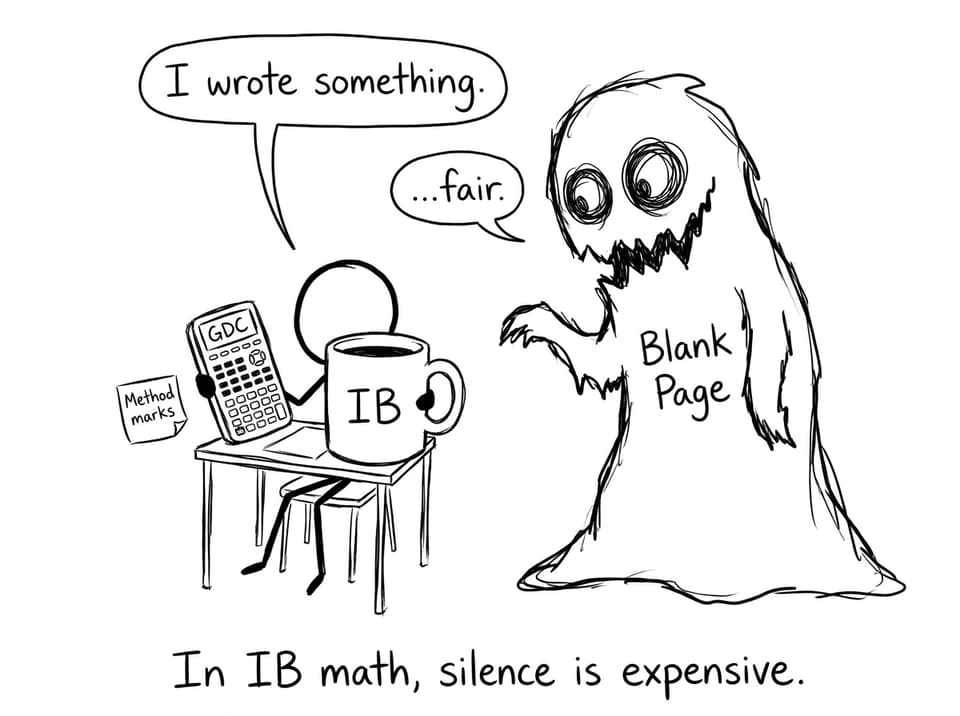
But IB Math does not reward silence. It rewards evidence of thinking.
That single idea changed my whole relationship with the Math AI exam: you are not judged only on the destination. In IB, you are often rewarded for the route. If you can show a correct method, a sensible setup, or even a meaningful substitution, you can earn marks that keep your grade afloat.
The IB Math AI exam success checklist (save this)
Here is a compact checklist you can run before every revision session and again on exam day. It is designed for IB students who want reliable results, not motivational noise.
-
Write something for every question (even a setup)
-
Hunt method marks: formula, substitution, diagram, regression steps
-
Use your calculator like a tool, not a lottery ticket
-
Move on fast, then come back (pacing beats perfection)
-
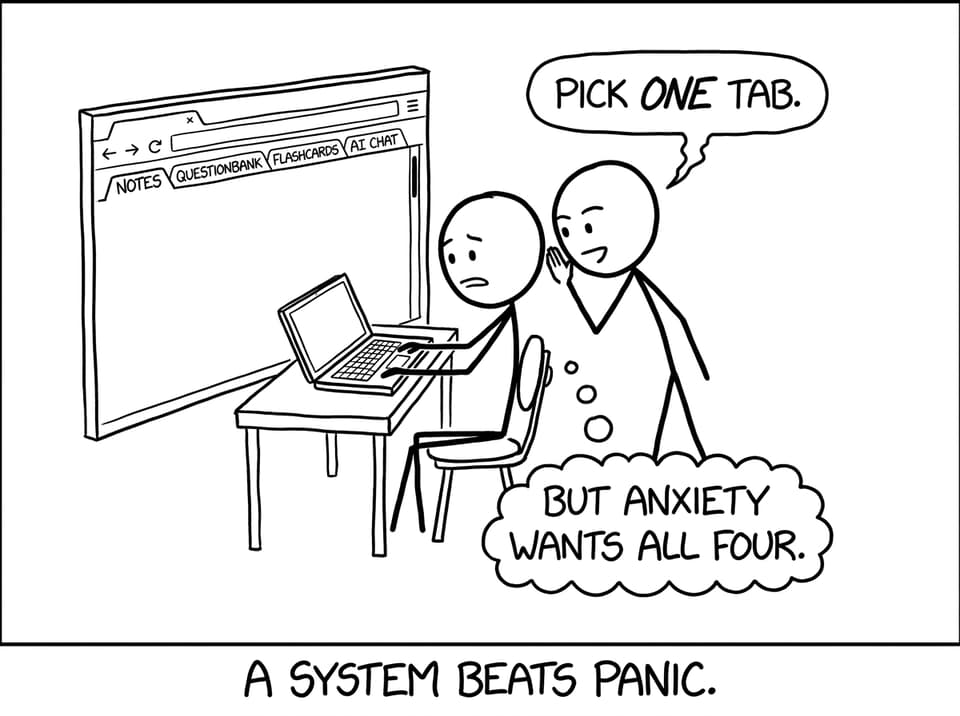
Review mistakes with a system: Notes, then Questionbank, then Flashcards
To build that loop in one place, start at the IB Math AI hub, then narrow to your weakest topic area.
Understand the IB Math AI exam structure (so you stop guessing)
Many IB students revise Math AI like it is one long mystery paper. It is not. The structure is stable enough that you can train for it.
For SL and HL, the core idea is consistent:
-
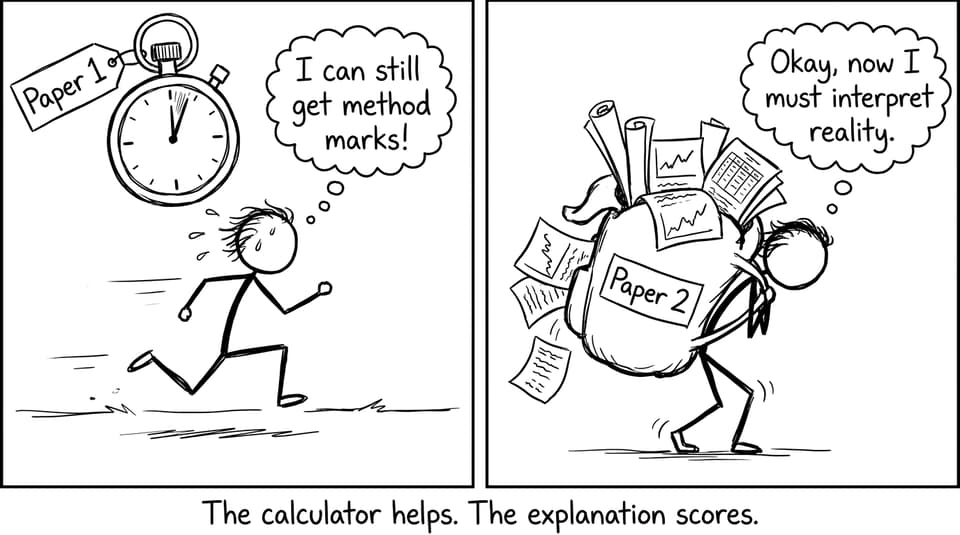
Paper 1 and Paper 2 are both calculator-permitted in Math AI
-
Paper 1 tends to be shorter-response and more varied across topics
-
Paper 2 tends to be longer, more scenario-based, and more interpretation-heavy
RevisionDojo’s IB Mathematics Applications & Interpretation Resources page lays this out clearly and links you into topic practice.
The most important IB exam tip: never leave a blank answer
In IB Math AI, a blank space is the only answer guaranteed to earn zero.
That sounds obvious. In practice, it is the hardest habit to build because blankness feels tidy. When you panic, writing a half-formed equation can feel like admitting defeat.
But IB marking is built to reward partial progress. You can often earn marks for:
-
identifying the correct formula
-
rearranging into a solvable form
-
substituting the correct values
-
stating a correct interpretation (even with arithmetic errors)
This is why the best exam technique is simple: leave a trail. Even if your trail does not reach the right number, it often earns credit.
If you want targeted drills for this, use the Questionbank feature to practise questions that force you to show method, not just output.
Paper 1 success in IB Math AI: train for breadth and speed
Paper 1 can feel like an unpredictable walk through your whole course. The trick is to treat it like a scavenger hunt for marks.
How to collect method marks on Paper 1
When you read a Paper 1 question, ask yourself:
-
What topic is this (functions, stats, sequences, geometry)?
-
What is the first line I can write that is definitely true?
-
What would a sensible next step look like even if I cannot finish?
For example, if you see sequences, writing the correct nth-term form or sum setup is already progress. If that topic is weak for you, practise it directly with SL 1.2 Sequences and Sigma Notation.
If your Paper 1 pain is algebra and manipulation, spend time in Number and Algebra before you do mixed sets.
Paper 2 success in IB Math AI: interpretation beats calculation
Paper 2 is where IB Math AI shows its personality. It is not asking, “Can you compute?” It is asking, “Can you model and explain?”
This is why students sometimes find Paper 2 oddly fair: once you know the expectations, you can rehearse them.
What Paper 2 rewards
Paper 2 tends to reward the student who can:
-
translate context into a model
-
use the GDC efficiently (regression, distributions, tests)
-
interpret parameters and graphs
-
write conclusions in full sentences when needed
To get a clear, exam-aligned breakdown, use Ace IB Math Applications and Interpretation Paper 2. It is the kind of guidance that feels like an experienced teacher quietly pointing at what matters.
And if statistics is your weak spot, build comfort with the dedicated topic page for Statistics and Probability.
The RevisionDojo loop for IB Math AI: a system that stays calm
A lot of IB exam stress comes from improvising revision. You sit down, feel guilty, and then do whatever seems hardest. That is not a plan. That is a mood.
A better approach is a loop you can repeat even when you are tired:
Notes, then Questionbank, then Flashcards, then AI feedback
-
Use RevisionDojo Notes for IB Math AI concepts to learn the story of a topic quickly.
-
Drill that exact topic with the Math AI Number and Algebra Questionbank or the Statistics and Probability Questionbank.
-
Turn repeated mistakes into Flashcards, so your memory stops leaking.
-
Use AI Chat and Grading tools to get immediate feedback when you cannot see what went wrong.
If you want the bigger-picture routine, How to Study Effectively for IB Math AI Exams ties it together.
Practice like it is the IB exam: timed, reviewed, repeated
Most IB students do practice questions. Fewer students do the uncomfortable part: reviewing them properly.
A high-scoring routine is:
-
25-40 minutes timed practice
-
20 minutes review immediately after
-
10 minutes of targeted reattempts
When you are ready to simulate full papers, use RevisionDojo’s Mock Exams and Predicted Papers to rehearse stamina and pacing. Start at IB Predicted Papers or go straight to Math AI Predicted Papers. (Remember: they are practice tools, not prophecy.)
For timing specifically, IB Math Time Management gives a pacing blueprint you can train.
The real success to the IB Math AI exam
The students who do well in IB Math AI are rarely the ones who never struggle. They are the ones who keep writing when they are unsure, keep moving when they are stuck, and keep practising with feedback instead of wishful thinking.
If you want a single place to do that with less friction, build your routine inside RevisionDojo: Questionbank, Study Notes, Flashcards, AI Chat, Grading tools, Predicted Papers, Mock Exams, the Coursework Library, and Tutors when you need a human eye on your patterns.
Start at the IB Math AI hub, pick one weak topic, and write something today. In IB, that is how scores move.