


If you have ever reread a passage and felt it quietly change shape, you were probably noticing narrative perspective.
A story can keep the same events, the same setting, even the same lines of dialogue, and still feel completely different depending on who is telling it and how much they can see. In IB English, that difference is not a side note. It is often the reason a passage feels intimate, suspicious, distant, or brutally objective. And because Paper 1 and Paper 2 reward analysis of authorial choice, narrative perspective is one of the fastest ways to turn “good summary” into “high-band commentary.”
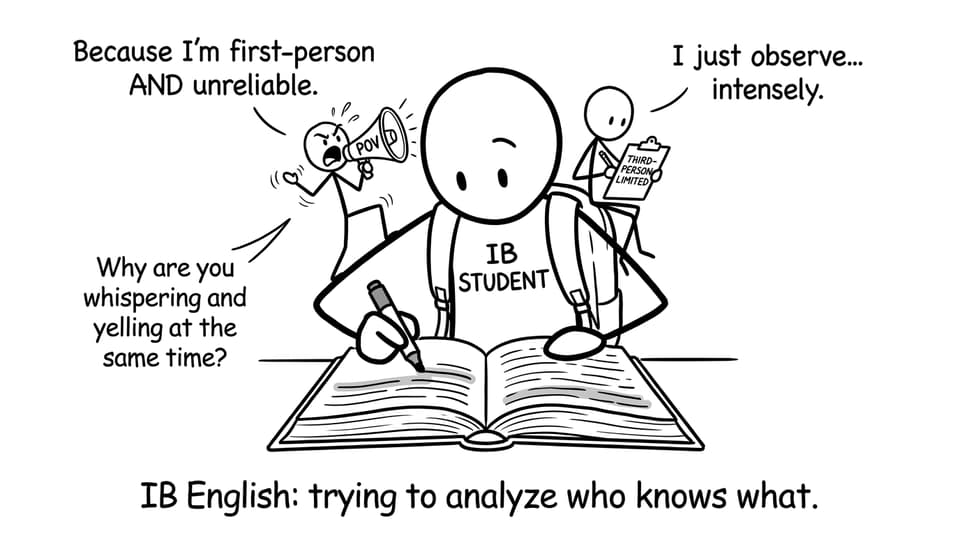
Quick checklist for analyzing narrative perspective in IB English
Use this as a 60-second scan before you write.
-
Identify the narrator: first-person or third-person?
-
Name the knowledge level: limited, omniscient, or objective.
-
Track reliability: self-justification, contradictions, gaps, exaggeration.
-
Notice focalization: whose mind are we inside (if anyone’s)?
-
Link it to tone: confessional, detached, ironic, anxious, nostalgic.
-
Prove impact: what does this perspective make the reader assume or feel?
If you like structured annotation, RevisionDojo’s Notes for Prose Fiction - IB builds perspective directly into a repeatable framework.
First-person narration: closeness, bias, and built-in tension
First-person narration uses “I” or “we,” but its real power is not the pronoun. It is the bargain it makes with the reader: you will experience this story through my interior world.
That bargain creates intimacy quickly. You get private thoughts, selective memories, and emotional reasoning that may not be logical but feels human. In IB English, this is gold because you can analyze how voice shapes characterization: diction, syntax, and sensory detail often reveal a narrator’s identity and self-image.
But the same intimacy also creates bias. The narrator may be honest and still be wrong. Or they may be persuasive because persuasion is their survival skill. When you write about first-person, the strongest move is to treat it like a lens with fingerprints.
Focus your analysis on:
-
Reliability: does the narrator misread people, omit key facts, or contradict themselves?
-
Motivation: what do they gain by telling the story this way?
-
Tone control: do they joke to dodge pain, moralize to feel safe, or confess to seek forgiveness?
-
Blind spots: what can the reader infer that the narrator cannot?
For more exam-ready language around voice, perspective, and reliability, RevisionDojo’s post on narrative voice and perspective in novels is a strong companion.
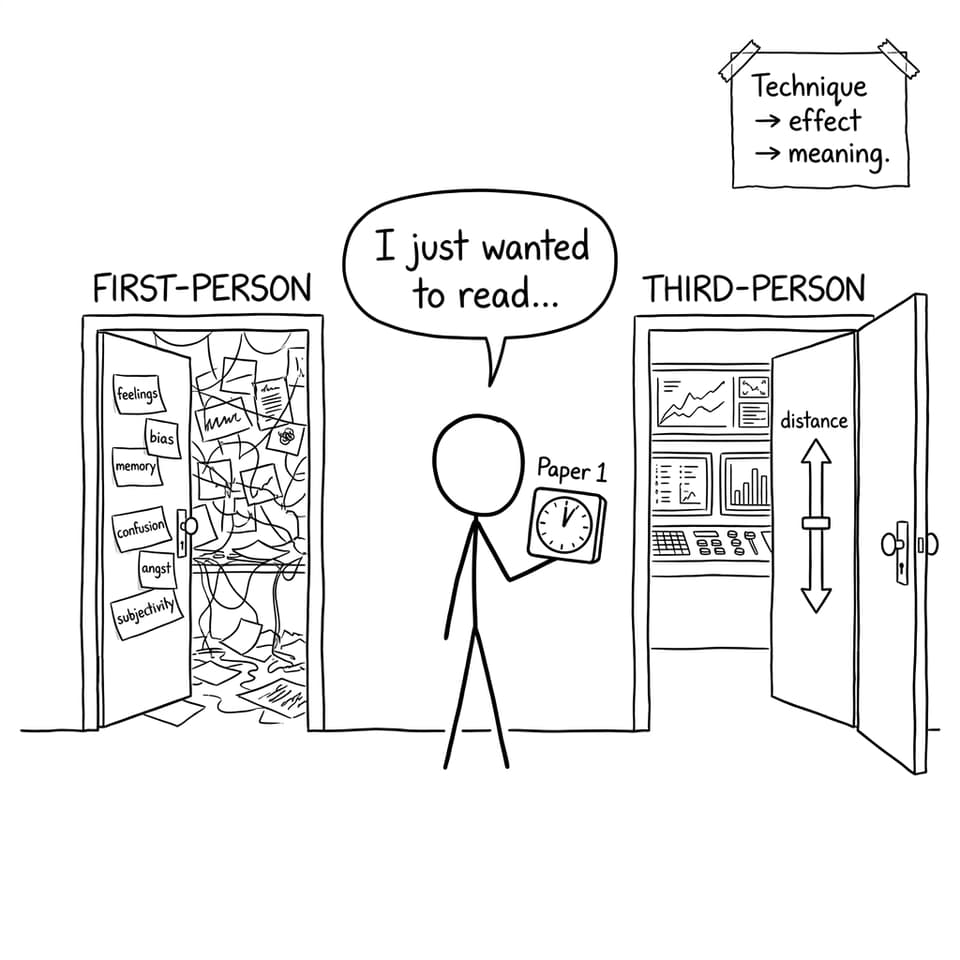
Third-person narration: range, structure, and narrative distance
Third-person narration (“he,” “she,” “they”) often looks neutral at first, which is exactly why students underestimate it.
Third-person is not one perspective. It is a spectrum of distance and knowledge. Writers can zoom in so tightly it feels like first-person without the “I,” or zoom out so far the narrator sounds like history itself.
Third-person limited
This perspective follows one character closely. You get their perceptions, but the narrator’s grammar stays third-person.
In IB English, third-person limited is excellent for analyzing controlled suspense: the reader learns only what the focal character learns, which means the author can withhold information without feeling unfair.
To sharpen your terminology here, RevisionDojo’s Notes for Gaze - IB helps you describe internal vs external focalization in a way that reads like top-band analysis.
Third-person omniscient
Omniscient narration can enter multiple minds, jump across time, and reveal background truths characters cannot access.
This is where structure becomes visible: cross-cutting between viewpoints, dramatic irony, and theme-building across a wider social world. If you are planning a Paper 2 paragraph, omniscience can be your bridge between character experience and author message.
Third-person objective
Objective narration reports only what can be observed. No thoughts, no interior confession.
That restraint is a technique. It can create coldness, realism, or moral discomfort by forcing the reader to interpret behavior without guidance.
For structural phrasing you can reuse under timed conditions, see Notes for Structure in Prose - IB.
How to turn perspective into exam marks (Paper 1 and Paper 2)
A reliable rule in IB English: perspective only earns marks when you connect it to meaning.
Try this sentence stem in your commentary:
By filtering events through __ perspective, the writer positions the reader to __ (trust/doubt/empathize/judge), which reinforces the theme of __.
Then support it with micro-evidence: a telling adjective, a repeated modal verb (“might,” “must”), a self-correction, a shift from interior reflection to external action.
If you want a step-by-step process for building this into a full Paper 1 response, use Mastering IB English Paper 1: A Complete Guide and IB English Paper 1 Commentary: Step-by-Step Guide.
And when you practice, do it with feedback loops. RevisionDojo’s Questionbank and the IB English A Lang & Lit Paper 1 Questionbank make it easy to drill perspective-based questions until your analysis becomes automatic.
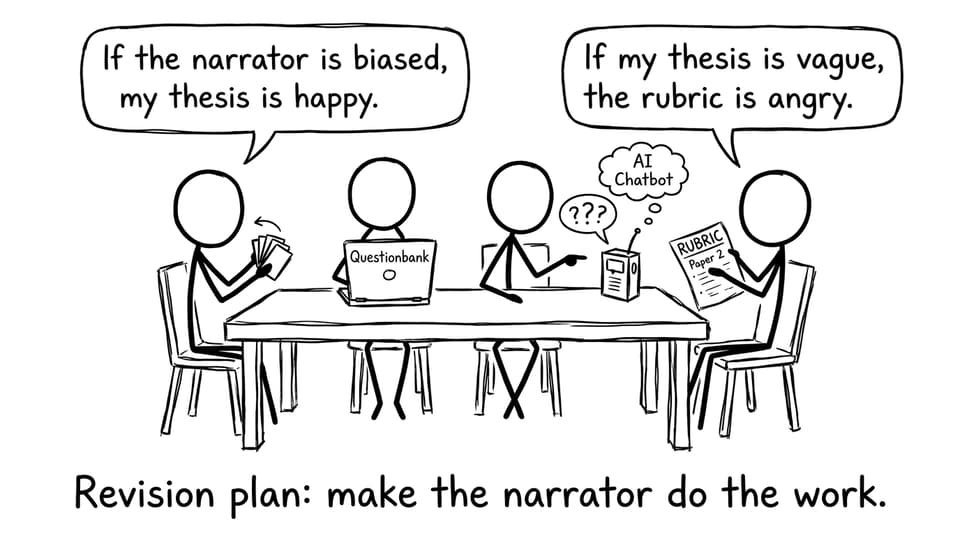
Conclusion: make perspective your fastest upgrade in IB English
Narrative perspective is the story’s steering wheel. First-person can give you intimacy and bias in the same breath. Third-person can offer structure, distance, and carefully rationed knowledge. In IB English, your job is to show how those choices guide reader trust, shape tone, and build theme.
If you want to practice this efficiently, use RevisionDojo’s Flashcards to lock in key terms (focalization, reliability, narrative distance), then apply them in timed sets through the IB English Questionbank. Add RevisionDojo’s AI Chat, Grading tools, Predicted Papers, Mock Exams, Coursework Library, and Tutors when you need feedback that feels specific rather than generic.
When the exam clock starts, you do not need a perfect interpretation. You need a defensible one, built on perspective-driven craft analysis. That is exactly what IB English rewards.


