

Media texts rarely lie to you outright.
They do something subtler.
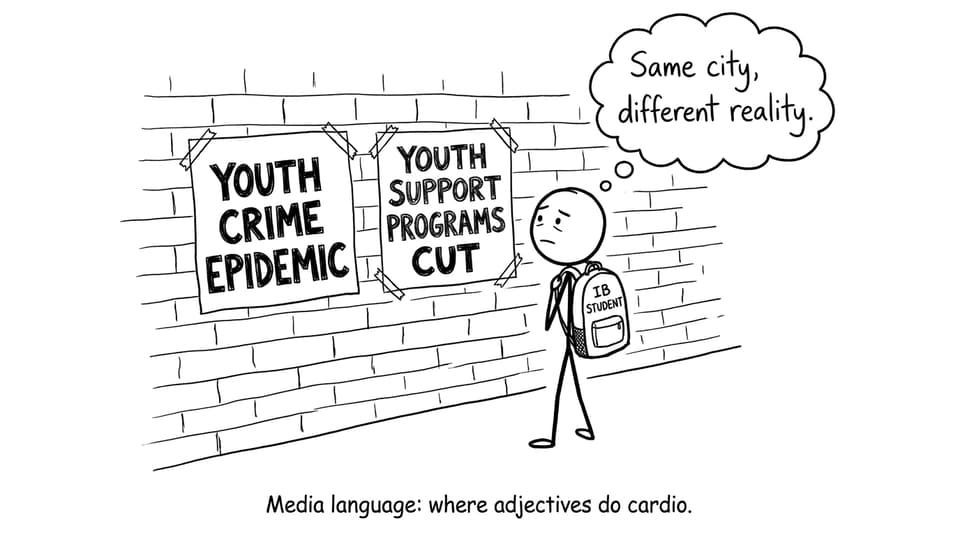
They choose one adjective instead of another. They crop an image by two centimeters. They put a quote in the headline rather than the third paragraph. And suddenly the same event feels like a threat, a tragedy, or a triumph.
For IB English students, that quiet shaping is the whole game. In Paper 1, the Individual Oral, and even the HL Essay, you are rewarded for showing how a text positions readers, not just what it “says.”
This guide breaks down how IB English media language affects interpretation, and how to turn those observations into examiner-friendly analysis.
Media language in IB English: a quick working definition
In IB English, media language means the deliberate choices creators use to communicate meaning and influence an audience. It includes:
-
Language: diction, tone, register, metaphor, modality, pronouns
-
Visuals: images, color, typography, camera angle, framing
-
Structure: layout, sequencing, captions, subheadings, pacing
-
Sound (for audiovisual texts): music, voiceover, editing rhythm
Media texts are constructed. That is your starting assumption in IB English. Nothing is “just there.”
If you want a central home base for practice across formats, keep the IB English A: Language & Literature resources open while you revise.
A fast checklist before you analyze any media text
Use this 60-second routine to keep your IB English analysis focused:
-
Identify text type (article, ad, infographic, speech transcript, social post)
-
Name the target audience (and what they likely value or fear)
-
State the purpose in one line (inform, persuade, sell, defend, attack, reassure)
-
Spot 2-3 patterns (repetition, contrast, shift in tone, loaded labels)
-
Link each pattern to effect on the reader (emotion + belief + action)
For timed practice, build this routine into your Paper 1 planning using RevisionDojo’s IB English Paper 1 commentary guide.
The media language features that most strongly shape interpretation
Headlines and titles: the first frame the reader wears
Headlines are tiny, powerful arguments. In IB English, treat them like a thesis statement that primes the reader.
Compare:
-
“Climate Activists Clash with Police”
-
“Police Suppress Peaceful Climate Protest”
Both describe the same event, but the verbs (“clash” vs “suppress”) and the labeling (“activists” vs “peaceful protest”) push readers toward different moral conclusions.
In your commentary, don’t stop at identifying “bias.” Explain how the bias is built.
Diction and tone: how language makes feelings feel logical
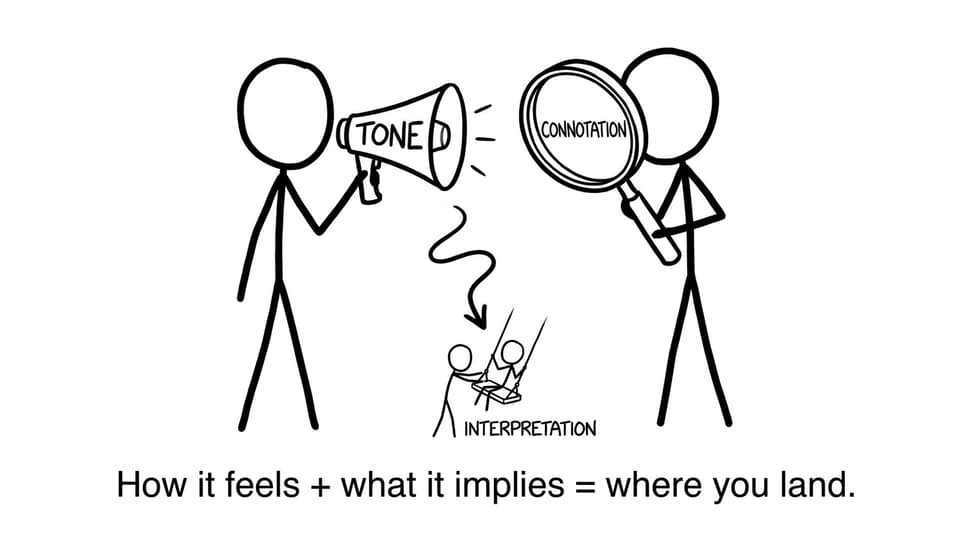
Tone is often the bridge between information and interpretation. A media text can make outrage feel like common sense simply by using:
-
Emotive diction (“epidemic,” “wave,” “flood,” “crisis”)
-
Evaluative adjectives (“reckless,” “heroic,” “naive,” “radical”)
-
Modality (“must,” “certainly,” “likely,” “perhaps”) to raise or lower certainty
In IB English, you get more marks when you connect diction to an implied worldview. What does the writer assume about the reader? What kind of reader are they trying to create?
Imagery and design: the argument you absorb without noticing
Visual choices often do persuasion while the words pretend to “report.” Look for:
-
Angle and distance: low angles can imply power; close-ups can manufacture intimacy
-
Color and lighting: warm tones can humanize; harsh contrast can villainize
-
Selection and omission: what is shown, cropped, blurred, or ignored
-
Typography: bold fonts signal urgency and authority
For IB English Paper 1, your best move is to analyze visuals as if they are sentences: they have grammar, emphasis, and subtext.
Structure and layout: what gets treated as important
Layout builds hierarchy. A reader learns what matters by what is:
-
placed first
-
enlarged
-
repeated
-
captioned
-
separated into bullet points
That is why a sensational headline can overpower a cautious article. Structure becomes meaning.
If you need more guided practice under exam conditions, RevisionDojo’s Paper 1 Questionbank for IB English A Lang & Lit is built for exactly this skill.
How media language shapes reader interpretation (the three big mechanisms)
Framing: the story before the story
Framing is what the text makes easy to think. It decides the boundaries of the debate.
A common IB English move is to show how framing works through:
-
naming (who is “a protester” vs “a rioter”)
-
focus (property damage vs causes of protest)
-
sequence (what comes first becomes the “reason”)
Your analysis becomes sharper when you can say: This framing makes one interpretation feel inevitable.
Stereotyping and representation: shortcuts that look like facts
Media language often compresses complex groups into simple images.
In IB English, you can earn strong Criterion B analysis by showing how repetition, labeling, and selective imagery produce a predictable “type” and shape empathy, blame, and authority.
Ideology and power: who sounds credible, and who sounds doubtful
A text signals power through:
-
who gets quoted
-
whose emotions are validated
-
who is described with certainty
-
who is described with speculation
A useful sentence frame for IB English:
By using [technique], the text positions the reader to view [group/idea] as [judgment], reinforcing [broader ideology].
If you’re building skills for the Individual Oral, connect these choices to a global issue and practice delivery using RevisionDojo’s Individual Oral topic hub and the IB English Individual Oral strategies guide.
Turning observations into top-band IB English analysis
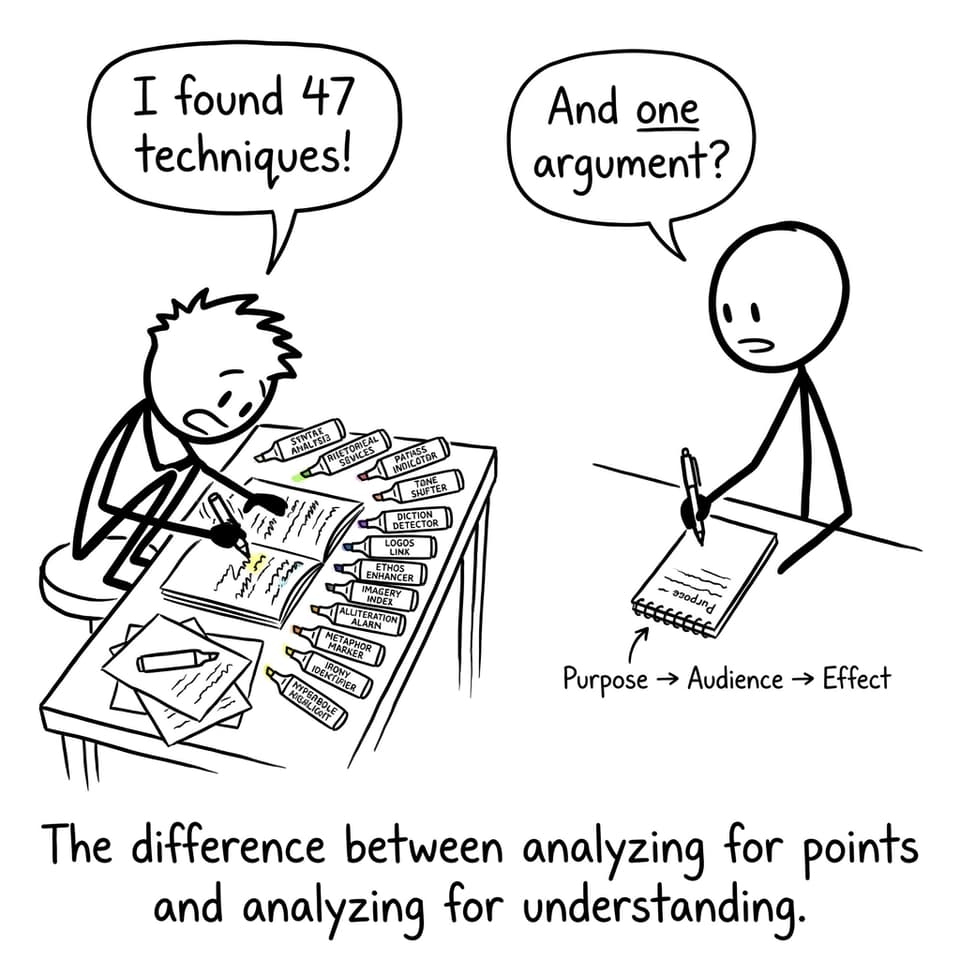
A frequent problem in IB English is listing techniques like a shopping receipt.
Instead, build each paragraph around a single chain:
choice leads to effect, then to purpose, and finally to interpretation
Example (headline + diction):
The headline’s militaristic metaphor (“battle”) escalates policy debate into conflict, prompting the reader to interpret reform as a high-stakes fight between enemies rather than a collective social negotiation.
For more structured support, RevisionDojo’s tips for writing strong IB English commentaries helps you translate “I noticed it” into “I proved its impact.”
Common mistakes IB English students make with media language
-
Describing an image or technique without explaining meaning or effect
-
Treating the text as objective instead of constructed
-
Forgetting audience (a technique only matters in relation to who is being targeted)
-
Missing the pattern (one example is weak; a repeated strategy is persuasive)
If you want a broader course map so you know where these skills fit, read What is the IB English curriculum?.
Closing: the quiet power you’re being trained to notice
The point of IB English media language analysis is not to become cynical. It’s to become precise.
When you can show how a headline frames a debate, how tone manufactures certainty, and how visuals smuggle in ideology, you stop being pushed around by the text. You start reading like a writer.
If you want the fastest path from “I noticed something” to “I can earn marks for it,” use RevisionDojo as your daily practice loop: Study Notes and Flashcards to lock in concepts, the Questionbank and Mock Exams to apply them, Predicted Papers to simulate exam pressure, and AI Chat plus grading tools to sharpen your commentary and IO delivery. IB English improves the way compounding improves money: quietly, then suddenly.