


Math rarely announces itself in the real world. It just sits underneath decisions: a loan approved, a price changed, a policy adjusted. And then, one day, you meet a question in IB Math that looks “purely academic” and realise it is the same logic that quietly runs markets.
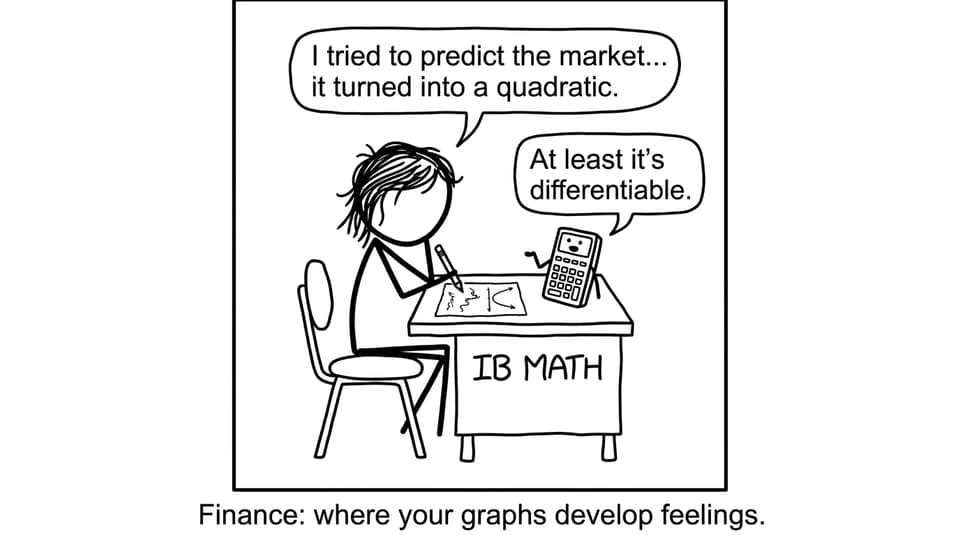
If you’re an IB student preparing for exams, that connection matters. Not because you need to become a trader or an economist, but because IB Math questions reward students who understand what a model is doing, not just which buttons to press.
A quick IB Math checklist for finance-style questions
Use this short checklist before you start a mixed set in IB Math (especially modeling-heavy questions):
-
Identify the “story”: risk, growth, optimisation, strategy, or data.
-
Name the tool: probability, regression, calculus, matrices, or numerical methods.
-
Write what the variable represents (this prevents silly interpretation errors).
-
Check constraints (domain, units, realistic ranges).
-
End with interpretation: what does your answer mean in the context?
To practise with real exam-style prompts and fast feedback, the Questionbank feature is built exactly for this loop.
Statistics and probability: pricing risk, not predicting fate
Finance isn’t about certainty. It’s about pricing uncertainty.
In IB Math, statistics and probability show up as distributions, expectation, variance, hypothesis tests, and correlation. In finance and economics, those same ideas appear as risk assessment, volatility, and confidence in a forecast.
Think of an insurer: they don’t “know” what will happen. They estimate the probability of claims, then set premiums so the business survives the unexpected. Similarly, an investor doesn’t need a perfect prediction. They need a probability model of returns that helps them compare choices.
If you’re in Math AI, lean into the interpretation side. If you’re in Math AA, don’t ignore the story behind the calculation. In both routes, IB Math rewards you for explaining what the numbers imply.
For targeted practice on the skills most connected to real-world finance, explore the Statistics and Probability Questionbank for Math AI.
Algebra and linear algebra: building models that behave
Algebra is the language of “if this, then that.”
Budgets, pricing rules, currency conversions, supply equations, compound growth models: all algebra. Linear algebra extends this into systems, with lots of variables interacting at once. In economics, that can look like input-output models across industries. In business, it can look like optimising a product mix under limited resources.
This is why rearranging, substituting, and solving systems matters in IB Math. It is not “just manipulation.” It’s learning to control a model so it reflects reality.
If your revision feels scattered, anchor your routine with a structured plan like The Ultimate IB Math Study Routine for Busy Students.
Calculus: the quiet engine of optimisation
Economics loves the question: “What is the best choice?”
Calculus is the toolkit for that question. Marginal cost, marginal revenue, rates of change, optimisation under constraints: these are calculus ideas wearing economics clothing.
In IB Math, you might differentiate to find a maximum, then justify it with a second derivative test or sign analysis. In economics, that same move becomes “maximise profit” or “minimise cost.” The marking is similar, too: method marks come from clear steps, not from guessing the final number.
If you’re studying Math AA, focus on fluency plus interpretation. Practice calculus questions in the Math AA Calculus Questionbank and ask yourself after each one: what did the derivative mean here?
Mathematical finance: when models meet messy reality
Some parts of finance are explicitly mathematical: option pricing, portfolio optimisation, and hedging. These areas use stochastic models and assumptions that simplify reality into something you can compute.
Here’s the useful exam lesson: models are powerful, but fragile. They rely on assumptions (like constant volatility or normality) that are never perfectly true. Strong IB Math answers often mention limitations: domain restrictions, reasonableness, and sensitivity to parameter changes.
RevisionDojo’s AI Chat tutoring workflow can help when you know the steps but don’t understand why the model behaves the way it does. Ask it to explain your solution in markscheme language, then reattempt.
Game theory: the math of “what will they do next?”
Game theory is where economics becomes psychological, but still precise.
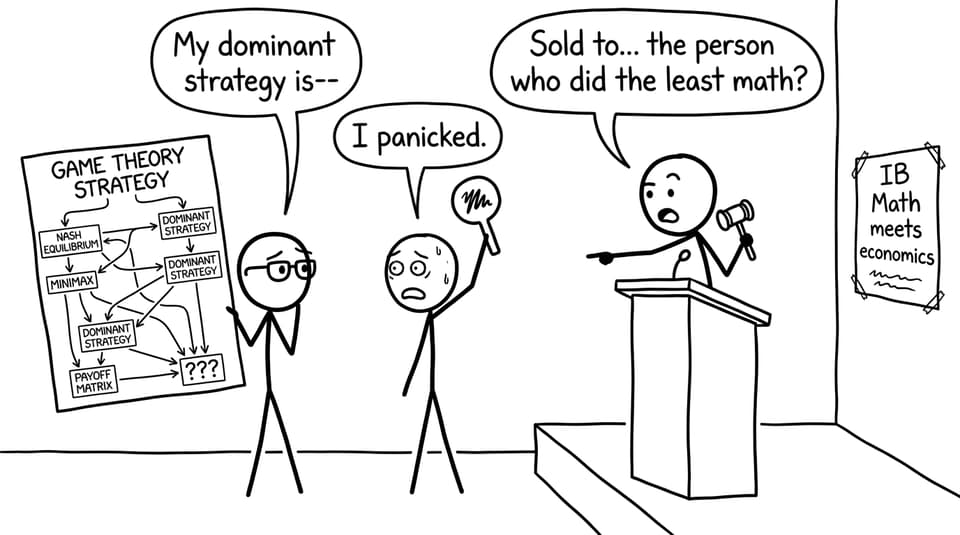
In competitive markets, outcomes depend on multiple decision-makers. Pricing wars, bidding strategies, and negotiation choices can be analysed with payoff tables and equilibrium thinking. The IB Math connection is clear: structured reasoning, careful casework, and interpreting an outcome rather than just computing it.
The biggest exam trap is treating game-style problems as pure calculation. They’re logic problems with numbers attached. State assumptions. Compare outcomes. Explain stability.
Econometrics and numerical methods: turning data into decisions
Econometrics is where statistics meets economic theory: regressions, significance, and using data to test claims. Numerical methods appear when there is no clean algebraic solution, so you simulate outcomes instead.
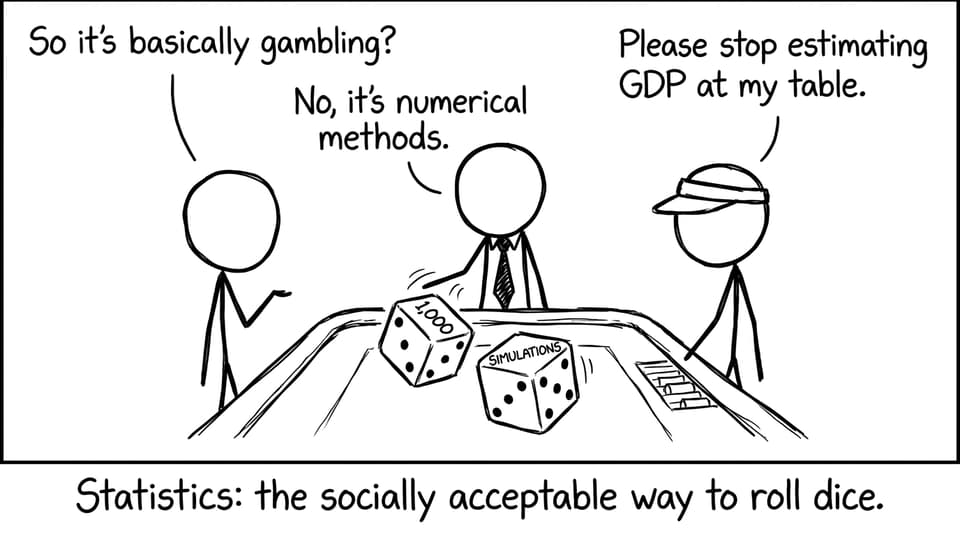
Monte Carlo simulation is a classic example: you run many random trials to estimate an expected result. In exams, you won’t always code it, but you must understand what simulation is doing: approximating a distribution when exact calculation is too hard.
To turn mistakes into progress, pair timed practice with review. The workflow in How to Use RevisionDojo to Prepare for IB Math Mock Exams is designed for that.
Bringing it back to exam day
Finance and economics look complicated from the outside because they hide their calculations in stories: risk, incentives, growth, and trade-offs. But the underlying moves are familiar: probability to quantify uncertainty, algebra to build models, calculus to optimise, and statistics to test claims.
That’s why IB Math is such a powerful subject. It teaches you to turn a messy situation into a clean model, then to admit what that model cannot capture.
If you want that skill to show up under time pressure, build a simple routine: learn with Study Notes, practise with the Questionbank, lock in memory with Flashcards, get unstuck with AI Chat, and simulate with Mock Exams and Predicted Papers. RevisionDojo ties those tools into one exam-focused system so your next IB Math session is calmer, sharper, and closer to a 7.