


If you’ve ever finished a novel and felt like the protagonist didn’t just do things but became someone else, you’ve already met the Hero’s Journey.
In IB English, that feeling matters. Examiners reward students who can explain how a text shapes transformation: the structure that pressures a character, the obstacles that reveal values, and the return that redefines “home.” The Hero’s Journey is not a template you force onto every story. It’s a lens. And when you use it calmly, it can turn a vague theme into a clean, persuasive line of analysis.
Why the Hero’s Journey matters in IB English
The quiet advantage of the Hero’s Journey is that it helps you write about change without drifting into summary. Many students can retell plot. Fewer can track transformation with precision.
In IB English, transformation is often where the marks are hiding:
-
It clarifies character arc (who the character is at the start vs. end).
-
It reveals authorial purpose (why the story is shaped this way).
-
It connects technique to theme (how structure, symbols, and voice create meaning).
If you want to strengthen your analytical method before you apply this framework, keep these RevisionDojo pages open as you practice: IB English Study Techniques That Actually Work and Close Reading Techniques for Prose and Poetry.
Quick checklist: using the Hero’s Journey without forcing it
Use this as a fast pre-writing scan (especially useful for IB English Paper 2 planning):
-
Establish the ordinary world: what feels normal, safe, or limiting?
-
Identify the disruption: what changes, threatens, or calls the hero outward?
-
Track resistance: what fear, loyalty, or flaw causes hesitation?
-
Name the tests: which obstacles reshape values or identity?
-
Locate the ordeal: the crisis that makes the old self impossible.
-
Define the return: what insight, cost, or new self comes back?
For exam alignment, cross-check your writing approach with What’s the Best Way to IB English Study for Paper 1 vs. Paper 2.
The Hero’s Journey stages you can actually use in an IB English essay
You do not need to label every stage like a flowchart. In IB English, the best approach is to select 3-5 stages that genuinely shape meaning in your chosen work.
The ordinary world: the baseline that makes change visible
The opening world is more than setting. It’s a measurement tool. It shows what the hero believes, what they lack, and what the society normalizes.
In analysis terms, ask:
-
What is presented as “normal,” and who benefits from it?
-
What restrictions exist (social, moral, economic, psychological)?
-
What patterns in language or imagery establish this baseline?
This is where close reading pays off. Tiny cues early in a text often forecast the later break.
The call to adventure: disruption as theme
The call is the moment the story demands movement. Sometimes it’s an external event. Sometimes it’s internal pressure: guilt, ambition, grief, desire.
In IB English, treat the call as a thematic signal. What problem is the text insisting we face? What question becomes unavoidable?
To build context intelligently (without turning your essay into history class), see What Is the Role of Context in IB English Text Analysis?.
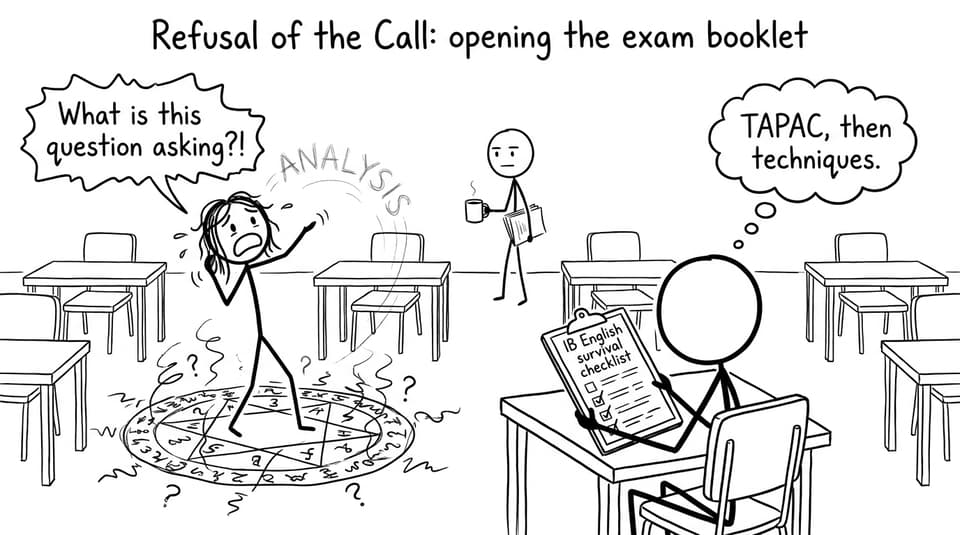
Refusal and reluctance: where the character becomes readable
Refusal is often the most human part of the pattern. It shows what the hero is protecting: comfort, identity, reputation, family, ideology.
This stage is gold for IB English because reluctance produces interpretable choices:
-
evasive dialogue
-
defensive narration
-
symbolic “stalling” actions
-
irony, contradictions, or fractured tone
Mentor or guide: help that is sometimes flawed
Mentors are not always wise elders. In world literature, guidance can be:
-
a community
-
a text within the text
-
an ancestor’s memory
-
a rival who forces clarity
In IB English, what matters is function: how does “guidance” shift the hero’s perception? And how does the author make that shift believable through voice, structure, and motif?
Trials, ordeal, and transformation: the change engine
Trials are not just exciting events. They are moral laboratories. They test loyalties and reveal costs.
The ordeal is the pivot: the moment after which the hero cannot return to who they were. Sometimes it looks like defeat. Sometimes it looks like victory that feels expensive.
For Paper 1 skill-building that helps you write about these turning points under time pressure, practice with Step-by-Step Guide to Revising IB English Paper 1 and Mastering IB English Paper 1.
The return: the ending that proves the theme
The return is where the text cashes in its meaning. A hero may return triumphant, disillusioned, enlightened, or haunted. The key is contrast: how does the ending reshape the beginning?
In IB English, you can often write a stronger conclusion by echoing an early motif, symbol, or narrative pattern and showing how it has changed.

Cultural variations: the Hero’s Journey is not one-size-fits-all
World literature often bends the framework in ways that deepen your comparative points:
-
Cyclical structures (returning to the start, but with new awareness)
-
Collective heroism (a group transforms, not a single individual)
-
Spiritual or ethical journeys (inner change matters more than conquest)
-
Unresolved returns (the “home” world is no longer safe or coherent)
This is a strong move for IB English Paper 2: instead of claiming “both texts follow the Hero’s Journey,” argue that each text uses or resists the pattern to express different cultural assumptions about selfhood, duty, or belonging.
For targeted Paper 2 planning practice, use IB English Paper 2: Essential Guide for Success and IB English Paper 2 Under Time Pressure.
How to turn the Hero’s Journey into exam-ready paragraphs
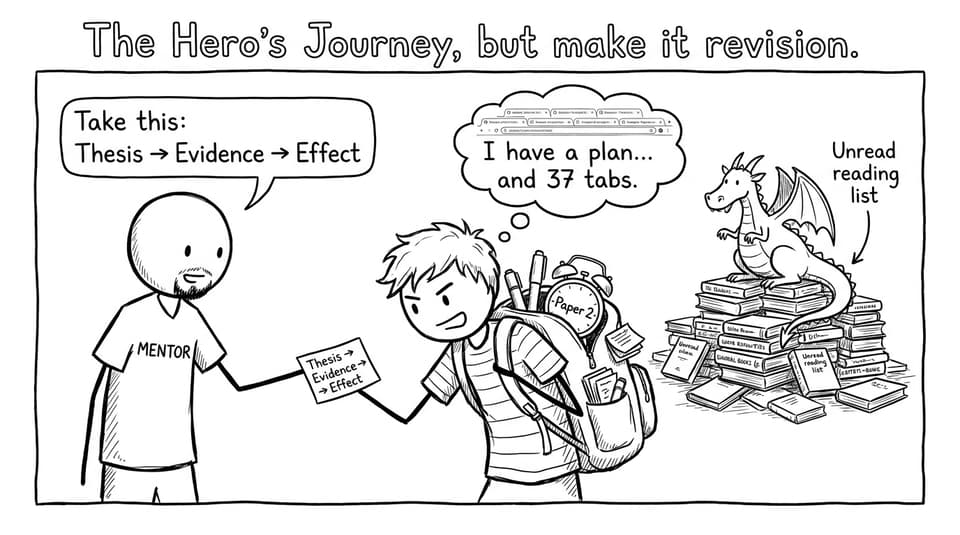
A reliable IB English paragraph structure looks like this:
-
Claim about a stage (e.g., reluctance shows fear of moral responsibility)
-
Evidence (a moment, quotation, or technique cluster)
-
Effect (what the technique does to the reader)
-
Meaning (how it builds theme or message)
-
Link back to the question (especially in Paper 2 comparisons)
To practice with feedback loops, RevisionDojo helps you do more than “write and hope.” You can revise using Study Notes, drill skills in the Questionbank, lock in patterns with Flashcards, stress-test timing with Mock Exams and Predicted Papers, and ask focused questions through AI Chat. When it’s time to polish, use the Grading tools and the Coursework Library, or work with Tutors for targeted support.
If you want a single hub for tools and practice, start here: IB English A Lang & Lit Resources and IB English A Lang & Lit Questionbank.
Conclusion: use the Hero’s Journey to write with clarity
The Hero’s Journey lasts because it describes something real: leaving what’s familiar, being tested, and returning with a different self. In IB English, that same pattern becomes a practical exam skill. It helps you track transformation without summarizing, connect structure to theme, and build paragraphs that stay analytical under pressure.
When you’re ready to turn this into marks, build your routine with RevisionDojo: practice with the Questionbank, sharpen recall with Flashcards, draft using Study Notes, get unstuck with AI Chat, and improve quickly through Grading tools, Mock Exams, Predicted Papers, the Coursework Library, and Tutors. Your next essay doesn’t need a new personality. It just needs a better structure.


