

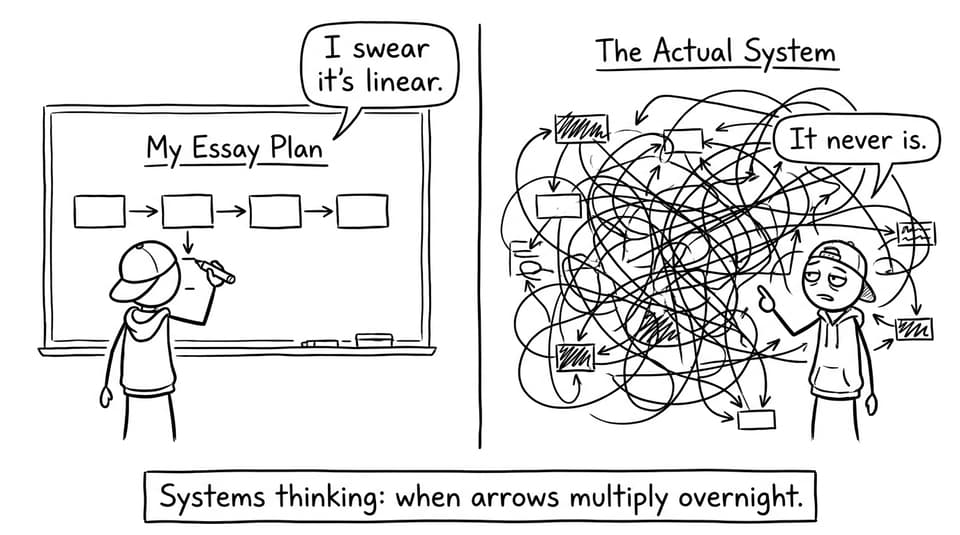
Systems thinking is the moment you realize your "simple" tech example is not simple at all.
You start with a platform. Then you notice the business model. Then the data collection. Then the recommendation engine. Then the culture that formed around it. Then the regulation that reacts two years late. Suddenly, your neat paragraph becomes a living web of cause and effect.
That is exactly why IB Digital Society rewards systems thinking. The course is not asking you to list features. It is asking you to explain how digital life behaves when people, institutions, algorithms, and values collide.
A quick systems thinking checklist for IB Digital Society
Use this as a fast scan before you write any IB Digital Society answer:
-
Define the system boundary: what is included, what is excluded.
-
Identify components (people, data, algorithms, rules, incentives).
-
Describe interactions (who affects whom, and how).
-
Spot at least one feedback loop (reinforcing or balancing).
-
Look for unintended consequences over time.
-
Analyse power: who can change the system, who cannot.
-
End with evaluation: trade-offs, perspectives, realistic interventions.
If you want the syllabus-aligned home base for this, the IB Digital Society resources hub is the cleanest starting point.
What systems thinking means in IB Digital Society
In IB Digital Society, systems thinking means treating a digital technology as part of an interconnected network, not a standalone tool.
Instead of asking, "What does this app do?" you ask:
-
What are the key parts of the system?
-
How do those parts interact across time?
-
What patterns emerge (polarization, inequality, dependence, exclusion)?
-
Who benefits, who pays, and who gets ignored?
That shift matters because many digital outcomes are not planned by a single actor. They are produced by relationships: design choices shaping behavior, behavior shaping data, data shaping algorithms, algorithms shaping society.
For a course overview that frames what the subject is actually assessing, read What is IB Digital Society?
The building blocks of a digital system (what examiners expect)
A strong IB Digital Society response usually names the same core building blocks, then focuses on how they connect.
Components you can almost always include
-
Users and communities: behaviors, norms, vulnerabilities.
-
Design features: defaults, friction, interface choices.
-
Algorithms: ranking, recommendation, scoring, moderation.
-
Data flows: collection, storage, sharing, monetization.
-
Institutions: firms, governments, schools, NGOs.
-
Rules: policies, law, enforcement, informal norms.
-
Incentives: profit, growth, political gain, convenience.
When you revise Topic 2.6, RevisionDojo lays this out directly in 2.6 Systems (SL/HL) and the companion 2.6A systems notes.
Feedback loops: the engine of digital society
Feedback loops are the secret sauce in systems thinking, and they show up everywhere in IB Digital Society.
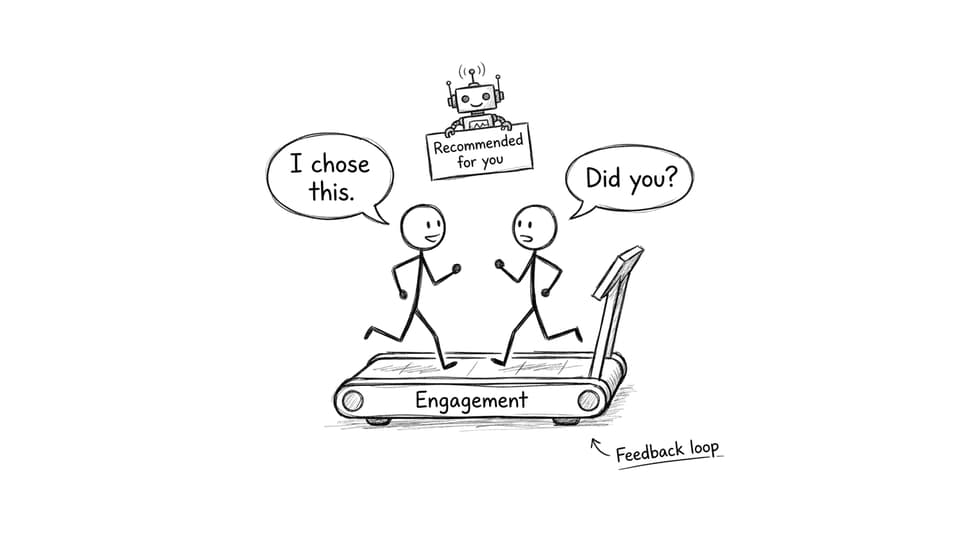
A simple reinforcing loop looks like this:
-
Users click certain content.
-
The platform records the data.
-
The algorithm increases similar recommendations.
-
Users see more of it, click more, and the cycle strengthens.
Once you can write that loop clearly, your analysis stops sounding like opinion and starts sounding like explanation.
To sharpen algorithm-related systems answers, pair this with Algorithms explained for IB Digital Society.
Unintended consequences: where marks hide
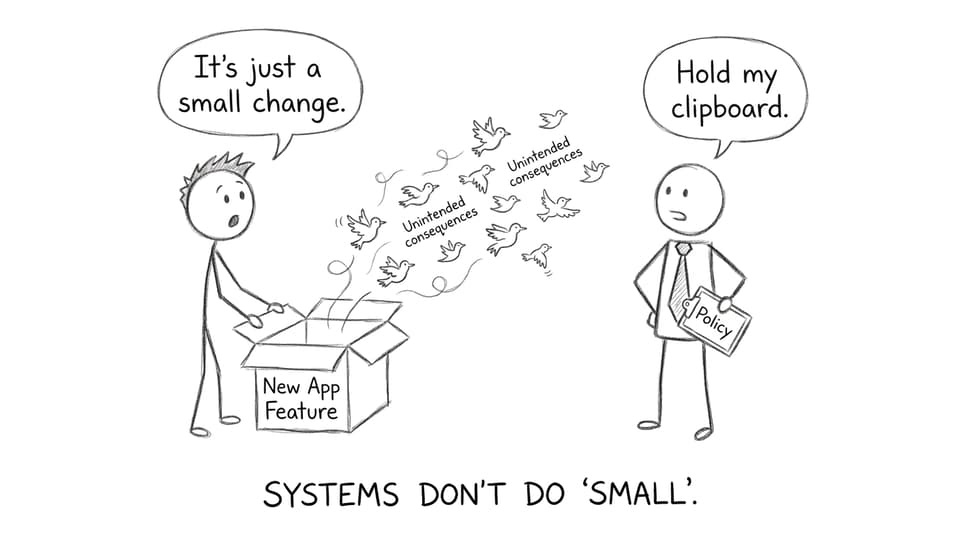
Many students lose marks in IB Digital Society because they only describe intended benefits (efficiency, connection, convenience). Systems thinking pushes you to ask what the system produces after scale, time, and adaptation.
Common unintended consequences worth discussing:
-
Normalised surveillance (because "personalization" needs data)
-
Privacy erosion (because defaults and incentives favor collection)
-
Bias and exclusion (because training data reflects history)
-
Misinformation amplification (because attention is rewarded)
Notice the pattern: the consequence is rarely caused by one "bad" user. It emerges from interactions between goals, design, and behavior.
If you want a concept lens that fits neatly with systems thinking, connect it to Understanding change in Digital Society.
Power: the question beneath the question
Systems thinking also upgrades your power analysis in IB Digital Society.
Instead of writing, "Users should be more responsible," you can ask:
-
Who sets the rules of the system?
-
Who profits from the current structure?
-
Who has the leverage to change outcomes?
-
Who bears the risks, and who can opt out?
This is where your evaluation becomes more mature. A realistic intervention usually targets incentives and structures, not just individual behavior.
For broader framing and revision structure, the Key themes in IB Digital Society guide helps you connect systems thinking to ethics, inequality, and politics.
How to use systems thinking in exams and the IA
In timed responses, systems thinking is mostly about structure.
-
Start with a one-sentence system definition.
-
Name 4--6 components.
-
Explain 2--3 interactions.
-
Include one feedback loop.
-
Evaluate a trade-off and propose one feasible change.
For coursework, systems thinking keeps your inquiry from exploding. In the IA, boundaries are everything: define what you will analyze, what evidence you will use, and what you will not claim.
If you are building your IA plan, use the IB Digital Society Internal Assessment guide and the Digital Society coursework guide as your guardrails.
To practise exam-style application fast, RevisionDojo is built around a tight loop: Study Notes for clarity, Flashcards for recall, Questionbank for mark-winning practice, AI Chat when you get stuck, and Grading tools when you want feedback that actually changes the next draft.
Closing: make your answers behave like systems
The best IB Digital Society answers feel calm because they have a quiet structure underneath them: components, interactions, feedback loops, consequences, power, evaluation.
If you want that structure to become automatic, build your revision like a system too. Use RevisionDojo to cycle between Digital Society notes and resources, targeted practice, feedback, and refinement until systems thinking stops being a concept and becomes your default way of writing.

