



Surds have a funny way of showing up when you least want extra friction: right after you finally solved the quadratic, right in the distance formula, or in that “show that” step where your neat decimals suddenly feel suspicious.
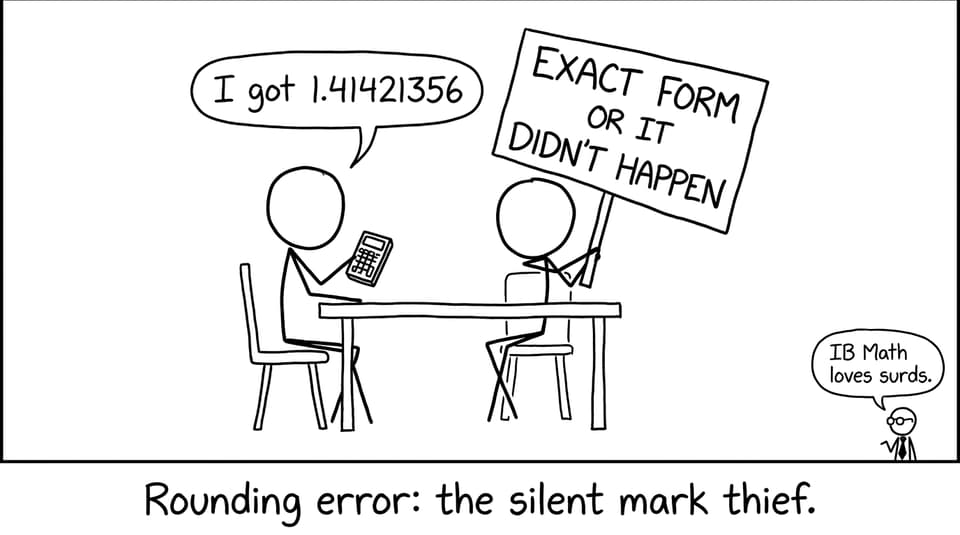
In IB Math, surds are less about memorising tricks and more about protecting exactness. They help you keep answers precise, earn method marks cleanly, and avoid tiny rounding errors that snowball into wrong final lines.
Surds in IB Math: the quick checklist
Use this as your mini warm-up before practice:
-
Identify perfect-square factors inside the root.
-
Simplify fully (pull squares out of the root).
-
Combine only like surds (same irrational part).
-
Multiply surds carefully (including coefficients).
-
Rationalise denominators when a surd sits below the fraction bar.
-
Keep answers exact unless the question asks for a decimal.
If you want a syllabus map of where surds live inside Number and Algebra, start from IB Mathematics Analysis and Approaches Resources.
What is a surd (AA SL & HL)?
A surd is an irrational number written in root form, typically like (\sqrt{2}) or (\sqrt{5}). In IB Math, surds matter because they represent exact values that do not terminate or repeat as decimals.
That “exactness” isn’t cosmetic. It’s structural. In algebraic manipulation, coordinate geometry, trigonometry, and calculus, exact values keep expressions stable across multiple steps. And stability is what your marks are made of.
For targeted practice that matches how IB asks these skills, RevisionDojo’s Number and Algebra Questionbank is the fastest way to drill surd manipulation under exam-style pressure.
Simplifying surds (the habit that saves marks)
Simplifying means rewriting the number inside the root as a product where one factor is a perfect square.
Example:
- (\sqrt{72} = \sqrt{36\cdot 2} = 6\sqrt{2})
The rule you’re using is (\sqrt{ab} = \sqrt{a}\sqrt{b}) only when (a\ge 0) and (b\ge 0). In most IB Math exam questions, you’ll be working in safe territory, but the key is the factoring step: look for the biggest perfect square factor you can.
Adding and subtracting surds
You can only combine like surds:
-
(3\sqrt{5} + 2\sqrt{5} = 5\sqrt{5})
-
(\sqrt{5} + \sqrt{2}) cannot be simplified further.
This is where many students lose easy accuracy marks: they treat surds like ordinary terms but ignore the “like terms” condition.
The mistake IB loves to catch
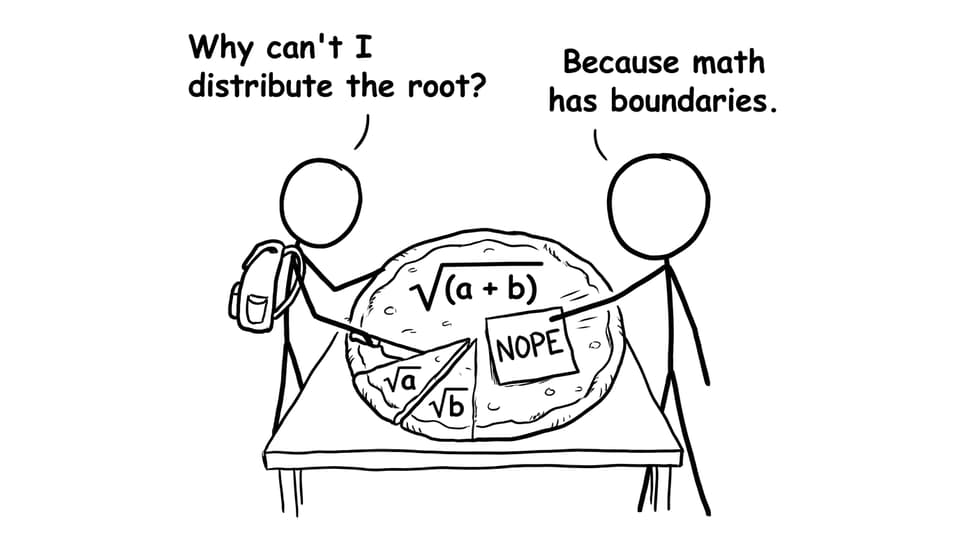
You cannot split a root across addition:
- (\sqrt{a+b} \ne \sqrt{a}+\sqrt{b})
If you remember only one “don’t do it” rule for IB Math surds, make it that.
Multiplying surds without creating chaos
Multiplication is usually friendly:
-
(\sqrt{3}\cdot\sqrt{12} = \sqrt{36} = 6)
-
((2\sqrt{5})(3\sqrt{2}) = 6\sqrt{10})
A good exam habit is to simplify after multiplying. It reduces careless slips.
If you want lots of exam-style algebra manipulation practice (including surds inside longer questions), pair RevisionDojo IB Notes with the Questionbank so you learn the method and then immediately rehearse it.
Rationalising the denominator (why it keeps returning)
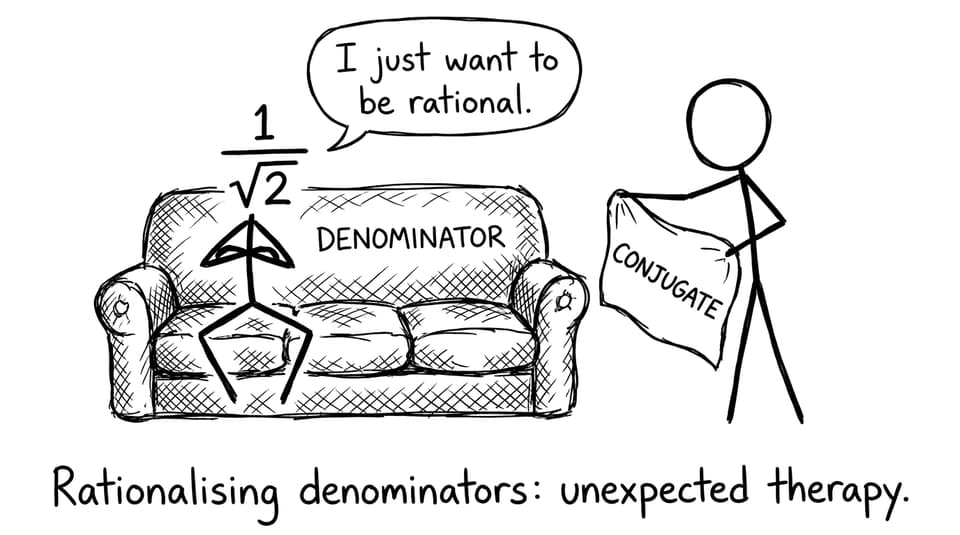
In IB Math, it’s common to present final answers with no surds in the denominator. Rationalising is the process of removing that root by multiplying top and bottom by something that clears it.
Simple case:
- (\frac{5}{\sqrt{2}}\cdot\frac{\sqrt{2}}{\sqrt{2}} = \frac{5\sqrt{2}}{2})
Conjugate case:
- (\frac{1}{2+\sqrt{3}}\cdot\frac{2-\sqrt{3}}{2-\sqrt{3}} = \frac{2-\sqrt{3}}{(2)^2-(\sqrt{3})^2} = 2-\sqrt{3})
That conjugate move shows up everywhere: it’s algebra that keeps expressions exact and tidy.
To connect surds to non-calculator expectations, read IB Math AA Paper 1: Step-by-Step Strategy to Master It. Surds are a frequent “exact values” checkpoint on that paper.
Where surds show up across AA SL & HL
Surds aren’t a stand-alone chapter in IB Math. They’re a tool inside bigger topics:
-
Quadratic formula solutions (discriminant not a perfect square)
-
Coordinate geometry distances and exact intercepts
-
Trig exact values and identities
-
Calculus limits and algebraic simplification before differentiating
For a broader revision loop that makes these connections stick, use How to Use RevisionDojo to Prepare for IB Math Mock Exams. The “simulate, diagnose, target” cycle is perfect for recurring surd errors.
Common surd mistakes (and what to do instead)
-
Stopping too early: (\sqrt{50}) left as-is instead of (5\sqrt{2}). Fix: always factor out a perfect square.
-
Combining unlike surds: (\sqrt{3}+\sqrt{12}) incorrectly turned into (2\sqrt{15}). Fix: simplify first: (\sqrt{12}=2\sqrt{3}), then add.
-
Root distribution error: (\sqrt{a+b}) split into (\sqrt{a}+\sqrt{b}). Fix: don’t. If stuck, test with numbers.
-
Denominator left irrational: acceptable mid-solution, but often not final. Fix: rationalise at the end.
When you want instant feedback on exactly which mistake type you’re making, RevisionDojo’s AI Chat and Grading tools are ideal: you can paste your working, get markscheme-style guidance, and convert the error into a Flashcard.
Bringing it home: make surds a strength in IB Math
Surds are one of those IB Math skills that feel small until they quietly decide your final method marks. When you simplify fully, combine only like surds, and rationalise with confidence, your working becomes calmer and your results become more reliable.
If you want a clean system: learn the rule in Study Notes, drill it in the Questionbank, fix mistakes with AI Chat, lock it in with Flashcards, and pressure-test it with Predicted Papers and Mock Exams. Start from the main hub: IB Mathematics Analysis and Approaches Resources, and build your surds fluency from there.