

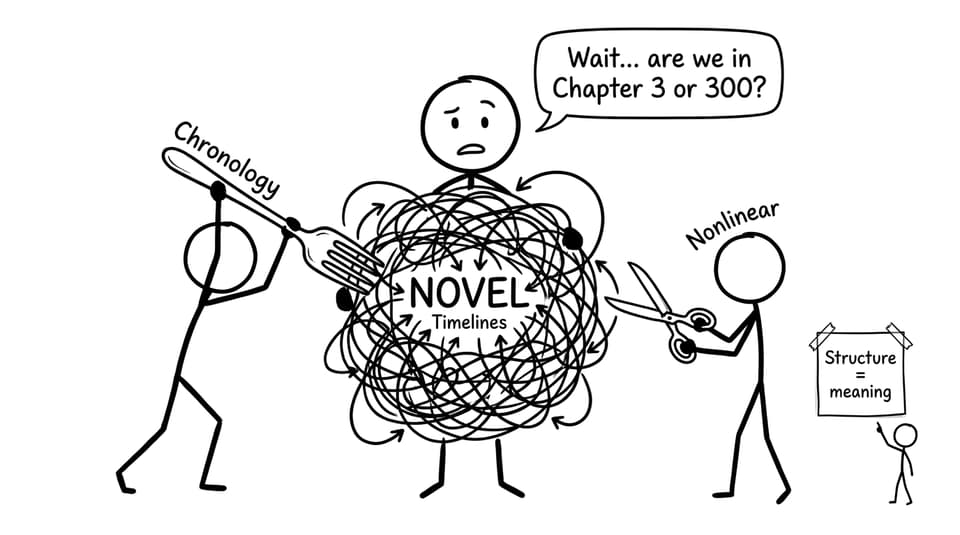
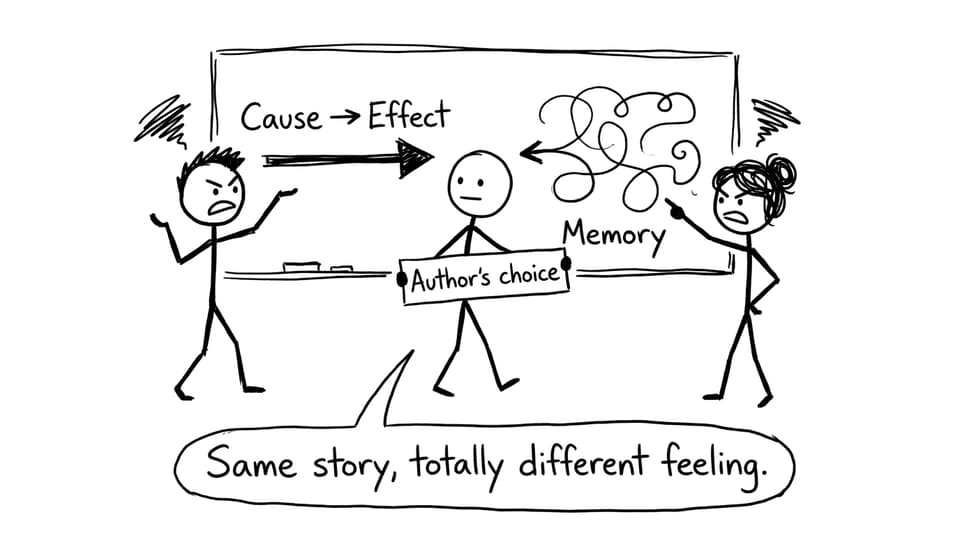
Structure is the quiet superpower of storytelling. You can read the same set of events in two different orders and walk away with two different feelings: certainty vs suspicion, calm vs dread, sympathy vs distance.
That’s why IB English rewards structural analysis so heavily. When you notice how time is arranged, you’re no longer chasing the plot. You’re tracking authorial control. And in Paper 1 and Paper 2, that shift is often what separates a “good explanation” from a top-band interpretation.
IB English structural analysis: a fast checklist
Use this quick scan before you start writing. It keeps IB English commentary focused on effect.
-
Name the timeline pattern: chronological, framed, cyclical, fragmented, parallel.
-
Identify the key time moves: flashback, flashforward, withheld reveal, time compression, time expansion.
-
Track what the reader knows vs what the character knows.
-
Explain why this order (tension, irony, intimacy, confusion, inevitability).
-
Link structure to theme (memory, identity, fate, trauma, power).
If you want a broader toolkit for structure and pacing, keep Notes for Structure in Prose open while you practise.
Chronology in IB English: what linear order does best
Chronological narrative is the “straight road” approach: events appear in the order they happen. In IB English, it can look simple, but it’s rarely accidental. Linear structure often helps authors create three exam-friendly effects.
Chronology builds clarity and momentum
When time moves forward cleanly, the reader spends less effort orienting themselves and more effort feeling the stakes. That clarity can accelerate tension because cause-and-effect is visible. Small choices become turning points. Consequences land with a satisfying weight.
Chronology makes development measurable
Linear structure lets you chart character change step-by-step. That’s useful when a text wants growth (or decline) to feel earned rather than sudden. In IB English essays, you can often argue that chronology creates a moral or psychological “trail” the reader can follow.
Chronology can create inevitability
A steady march forward can feel like fate. Even if the protagonist resists, the structure can imply that outcomes are approaching like weather. That’s a strong angle for Paper 2 comparisons when one work feels “destined” and another feels “shattered.”
For writing control in Paper 2, pair this idea with Structuring Your IB English Paper 2 Essay.
Nonlinear narrative in IB English: why writers break time
Nonlinear narrative disrupts sequence: flashbacks, flashforwards, fragmented scenes, parallel timelines, montage-like jumps. For IB English, the big question isn’t “what happened when?” It’s “what does the disruption do?”
Nonlinear structure turns reading into investigation
When information is withheld or rearranged, the reader becomes an active participant, assembling meaning rather than receiving it. This often produces suspense, but the deeper effect is interpretive pressure: the text forces you to judge what matters.
A practical companion here is IB English: Foreshadowing and Flashback for Depth, especially for spotting time signals quickly under exam conditions.
Nonlinear structure mirrors memory and psychology
Many texts use broken chronology to imitate how humans actually recall: in fragments, triggered by objects, looping around pain, skipping what’s unbearable. In IB English, that becomes a clean analysis line: form imitates mind. You can connect time-jumps to trauma, denial, guilt, or identity conflict.
Nonlinear structure can shift the question from “what” to “why”
If an ending is revealed early, or a key event is hinted at repeatedly, the narrative stops being a mystery plot and becomes a meaning plot. The reader watches motives, patterns, and responsibility. That’s a high-value structural claim for Paper 1.
For a reliable Paper 1 routine that includes structure, use Mastering IB English Paper 1: A Complete Guide.
How to write about chronology and nonlinear narrative (without summarising)
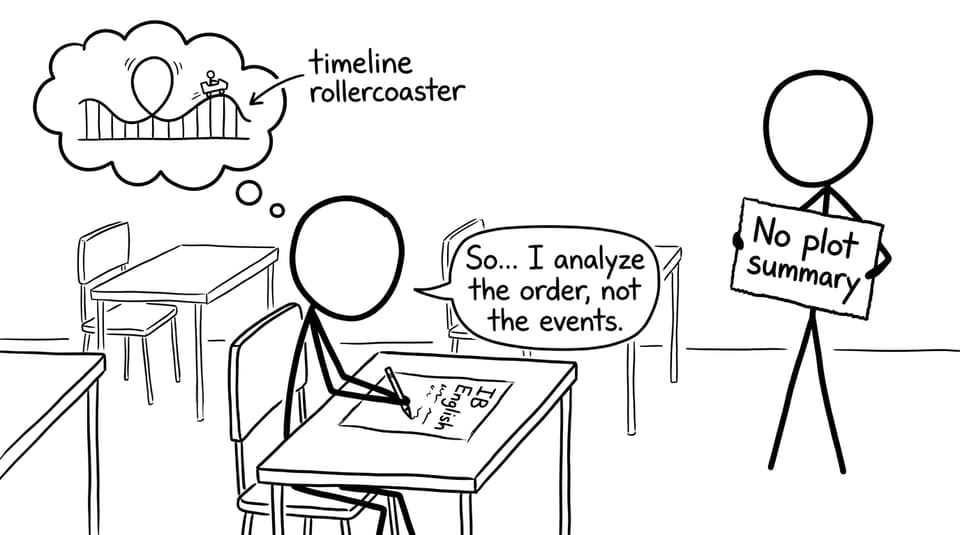
A structural paragraph in IB English should feel like a mini-argument, not a timeline recap. A simple formula:
Structural choice -> evidence -> reader effect -> thematic purpose
Example moves you can adapt:
-
By delaying the full context of the protagonist’s decision through intermittent flashbacks, the writer converts sympathy into uncertainty, forcing the reader to experience memory as a contested space rather than a record.
-
The chronological progression compresses years into brief transitions, implying that external change is easy while internal change remains stalled.
When you practise, it helps to grade your own work against exam expectations. RevisionDojo’s Grading tools and AI Chat can help you test whether your paragraph explains effect and purpose, not just technique.
To build targeted practice, use the IB English A Lang & Lit Resources hub alongside the Questionbank, Study Notes, and Flashcards. Then scale up with Mock Exams and Predicted Papers for timed pressure, and check models in the Coursework Library when you need exemplars.
The biggest structural effects examiners love
In IB English, structural analysis scores well when you tie it to what the reader experiences.
Tension and release
Chronology can tighten tension steadily; nonlinear order can create “delayed impact” where a later reveal rewrites earlier scenes.
Reliability and doubt
Time jumps can make narration feel unstable. If the story is told in fragments, the text invites questions about who controls the fragments and what they omit.
Contrast and parallel meaning
Parallel timelines can turn structure into argument: the past contradicts the present, or two characters mirror each other across time.
If you want planning support for organization, The Importance of Structure in IB English Analytical Writing pairs well with this.
Bringing it home: use structure as your advantage
Chronology and nonlinear narrative are not just “ways to tell a story.” In IB English, they are arguments about how life is remembered, how truth is revealed, and how meaning is built. When you write about structure, you’re showing the examiner that you can see the machinery behind the emotion.
If you want that skill to become automatic, build a small weekly loop on RevisionDojo: practise with the Questionbank, clarify concepts in Study Notes, convert patterns into Flashcards, and pressure-test your writing with Mock Exams, Predicted Papers, and the Grading tools. When you need a human nudge, Tutors can help you turn “I noticed a flashback” into “I proved a purpose.” That’s the leap that lifts IB English marks.