

Stream of consciousness feels like stepping into someone else’s head mid-sentence. Not the tidy version of thinking we pretend to have in class, but the real thing: half-formed memories, sensory flickers, sudden dread, an image that makes no sense until it does. For IB English students, that messiness can be intimidating in an exam setting. But it’s also a gift: when a writer lets thought spill onto the page, they leave behind a trail of craft choices you can track, explain, and turn into marks.
Below, you’ll get a clear way to recognise stream of consciousness, explain its purpose, and write about it with confidence in IB English Paper 1, Paper 2, and the HL Essay.
Stream of consciousness in IB English: what it is
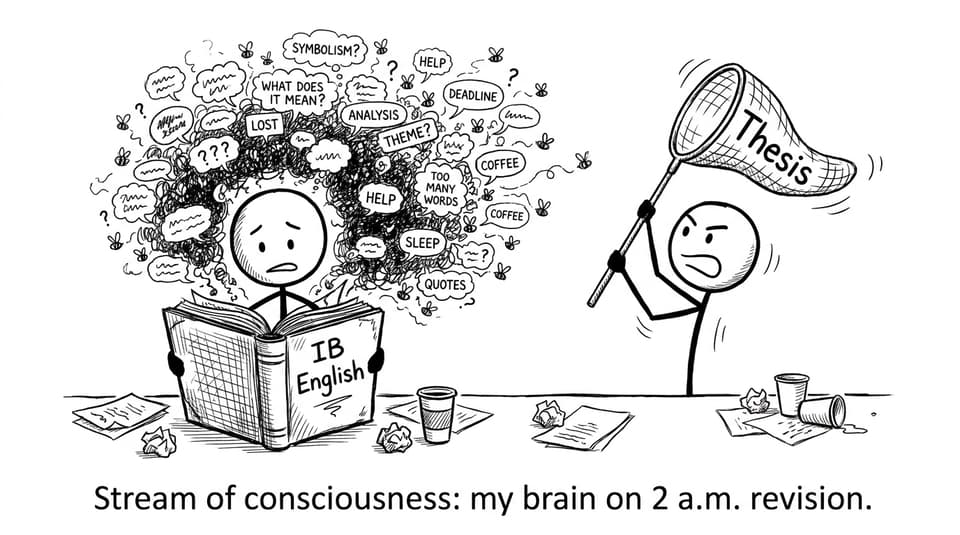
Stream of consciousness is a narrative technique that aims to imitate the flow of a character’s mind in real time. Instead of presenting thoughts as polished sentences, the writing often mirrors how thinking actually works: associative, fragmented, repetitive, sensory, and sometimes contradictory.
In IB English, that means you’re not just analysing what a character thinks. You’re analysing how the text simulates thinking through language, structure, and style.
If you want a strong Paper 1 foundation for technique-based analysis, pair this with RevisionDojo’s guide on Mastering IB English Paper 1.
Quick checklist: spotting stream of consciousness fast
When you’re under time pressure in IB English, you need cues you can trust. Look for:
-
Nonlinear movement (present moment suddenly sliding into memory)
-
Long, running sentences or abrupt fragments (or both)
-
Minimal punctuation or unusual punctuation choices
-
Free association (one detail triggers another unrelated thought)
-
Sensory detail mixed with inner commentary
-
Repetition of a word, phrase, or image (like a thought looping)
To practise identifying these features in exam-style extracts, use the English Paper 1 topic page and the Paper 1 Lang & Lit Questionbank.
What it looks like on the page (and why that matters)
Stream of consciousness often creates a reading experience that feels slightly unstable. That instability is usually the point.
Syntax: when sentences behave like thoughts
Writers might use run-on sentences to mimic momentum, or fragments to mimic interruption. In IB English commentary, don’t stop at “fragmented syntax.” Push one step further: what kind of mind-state does that fragmentation suggest?
-
Panic can appear as clipped phrases and sudden stops.
-
Obsession can appear as rhythmic repetition.
-
Dissociation can appear as drifting, floaty clauses that avoid certainty.
Punctuation and rhythm: the hidden steering wheel
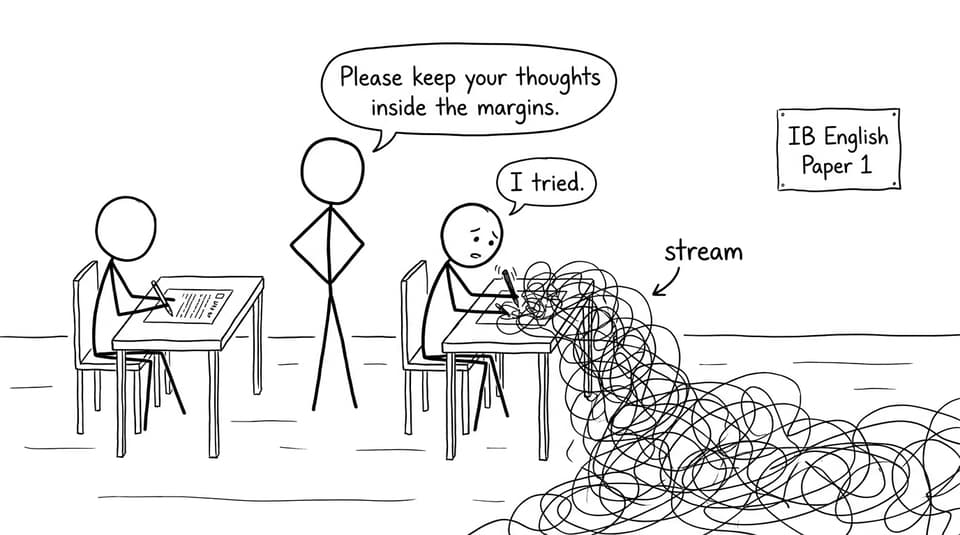
A lack of full stops can create breathlessness. Excess commas can create a rushing, piling-on effect. Dashes or parentheses can mimic interruption and self-correction (in your essay, describe the effect; you don’t need to dramatise it).
If you want a structured method for writing about these choices, RevisionDojo’s step-by-step Paper 1 revision guide fits well with stream-of-consciousness passages.
Purpose: why authors use stream of consciousness
In IB English, “purpose” is where analysis becomes interpretation. Stream of consciousness is rarely used just to sound artistic. It usually serves one (or more) of these goals.
To reveal interior conflict without explaining it
A character might never say “I’m conflicted.” But the writing shows it: looping thoughts, self-interruptions, contradictions, sudden mood-swings in diction.
To explore memory and time as lived experience
Instead of treating time like a straight line, stream of consciousness treats it like a mind treats it: one smell can pull ten years into the room. This is a powerful way to show trauma, nostalgia, regret, or identity formation.
To create intimacy (and sometimes unreliability)
When readers are inside a mind, they feel close. But closeness doesn’t guarantee truth. A mind can rationalise, repress, distort. That tension gives you excellent IB English angles on narrative voice and perspective.
If you’re revising broader narrative methods and definitions, build a base with RevisionDojo’s Study Notes feature and English A Lang & Lit resources.
Stream of consciousness vs interior monologue
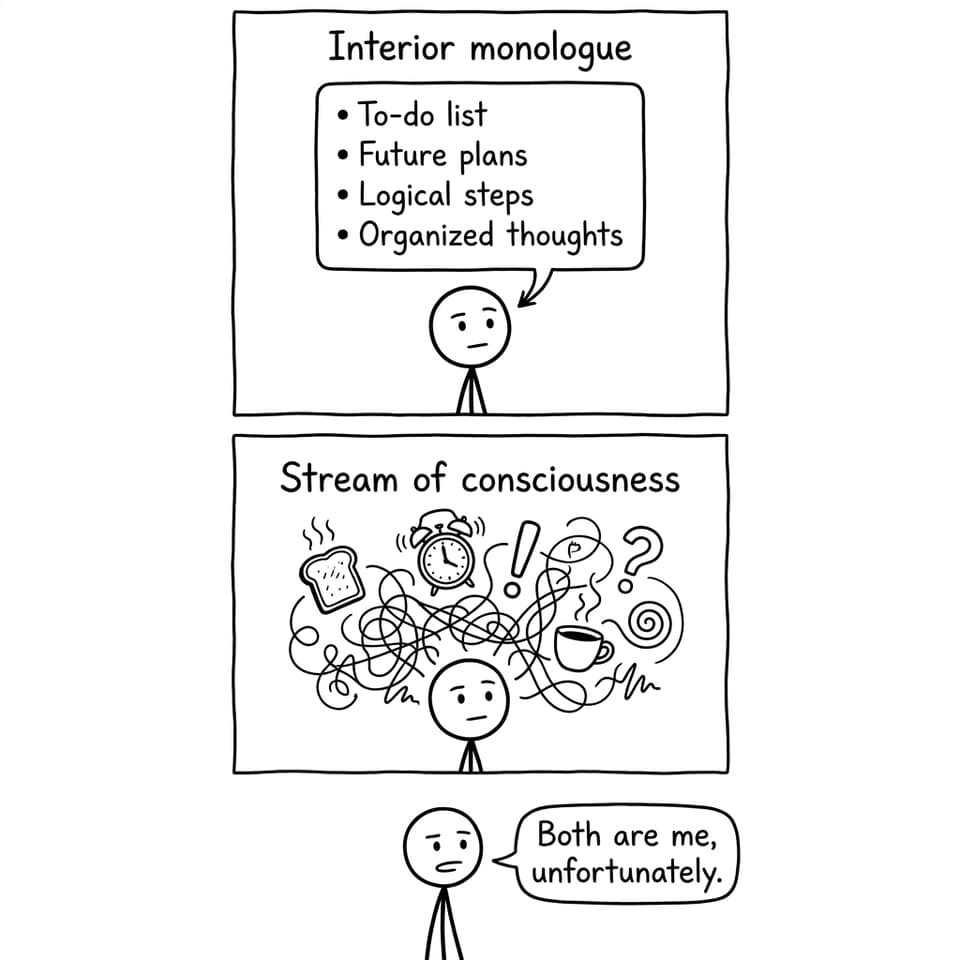
These terms are related, but not identical.
-
Interior monologue is the character’s thoughts presented more coherently, often in complete sentences.
-
Stream of consciousness includes subconscious leaps, sensory fragments, and unfiltered associations that may feel less “written” and more “heard.”
In IB English, the distinction helps you avoid vague commentary. If the passage is orderly and rhetorical, call it interior monologue. If it’s messy and associative, stream of consciousness is usually the better label.
How to write about it in IB English exams
A useful rule: describe the pattern, then explain the effect, then link to a theme.
Try this mini-template:
-
Technique + evidence: “The syntax fragments into brief clauses…”
-
Effect: “…mirroring a mind that cannot sustain a stable train of thought…”
-
Meaning: “…which reinforces the text’s concern with fractured identity / anxiety / grief.”
To test your paragraphs quickly, run them through RevisionDojo’s tools: practise with the Questionbank, then refine your writing using the platform’s AI Chat and grading flow (especially helpful when you’re trying to make “effect” and “meaning” more precise).
For stamina and timing before finals, you can also rehearse under real conditions using RevisionDojo’s Mock Exams strategy blog.
Closing: turn the “mess” into marks
Stream of consciousness can feel like a writer dared you to follow a mind in motion. But in IB English, that motion is exactly what you can analyse: syntax that rushes, punctuation that slips, memory that interrupts the present, repetition that reveals what a character can’t release.
If you want to turn this technique into reliable exam points, build a simple routine with RevisionDojo: read technique notes, drill with the Questionbank, create Flashcards for the patterns you keep missing, and practise under timed Mock Exams conditions. The goal isn’t to tame the chaos. It’s to show you can explain why the chaos is there, and what it does.