
IB SEHS Self-Talk: the voice that shows up mid-performance
The moment pressure arrives, your brain starts narrating.
It happens in sport: a missed shot, a shaky start, a crowd that suddenly feels loud. It also happens in exams: a command term you half-recognise, a data table that looks unfamiliar, the clock that seems to speed up. In IB SEHS, that narration matters because it shapes confidence, attention, and emotional control, which is exactly what “self-talk and performance” questions are really testing.
Self-talk is not magic. It is a skill. And like any skill, it becomes reliable only when you train it.
Quick checklist: what to write for IB SEHS self-talk questions
When an IB SEHS exam asks about self-talk, aim to hit these marks fast:
-
Define self-talk as internal dialogue (spoken or silent) before/during/after performance
-
Explain effects: confidence, focus, emotional control, persistence, anxiety
-
Distinguish positive vs negative self-talk
-
Distinguish instructional vs motivational self-talk
-
Add a short sporting application (one scenario, one mechanism)
-
Keep phrases short, specific, practised
For syllabus-aligned examples, use RevisionDojo’s B.4.5 self-talk techniques page and the matching B.4.5 notes.
What self-talk means in IB SEHS (and why it affects performance)
In IB SEHS, self-talk is a psychological skill because it can be learned, practised, and controlled. The key idea is simple: your thoughts influence your emotional state, and your emotional state influences attention and decision-making. Under pressure, attention becomes narrow and mistakes feel “louder” than successes. Self-talk can either stabilise that system or shake it.
If you want broader context on how examiners treat mental techniques, connect this topic to psychological skills in sport and the wider C.5 Psychological skills topic hub.
Positive vs negative self-talk in IB SEHS
Positive self-talk is constructive and performance-supporting. It does not have to be cheerful, it just has to be useful.
Examples:
-
“Breathe. Slow.”
-
“One step at a time.”
-
“I’ve trained this.”
Negative self-talk is critical and self-defeating. It usually feels “true” in the moment, which is why it spreads quickly.
Examples:
-
“I always mess this up.”
-
“Everyone is faster than me.”
-
“I’m going to fail this.”
In IB SEHS, you earn marks by linking negative self-talk to mechanisms: increased anxiety, reduced confidence, attentional distraction, and performance decline.
Want extra exam technique for writing clean explanations fast? Use IB SEHS essays: command terms, content, clarity.
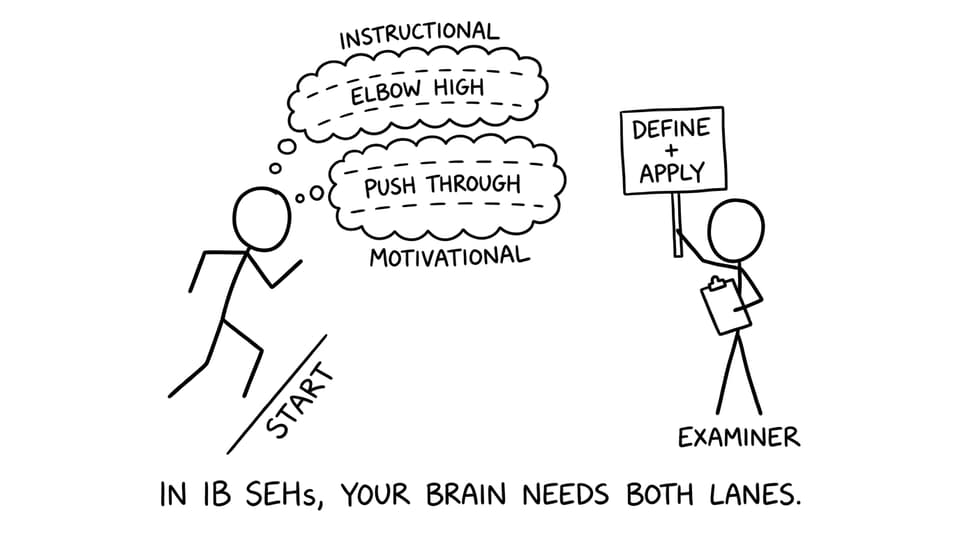
Instructional vs motivational self-talk (two jobs, two outcomes)
Self-talk is also classified by purpose:
Instructional self-talk
This gives a technical cue that directs attention.
-
“Elbow high.”
-
“Eyes on the ball.”
-
“Drive the knees.”
It is often linked to skill learning and fine adjustments.
Motivational self-talk
This boosts effort, confidence, and persistence.
-
“Push through.”
-
“Stay composed.”
-
“You can hold this pace.”
In IB SEHS, your best answers show that athletes can use both, depending on the task and pressure level.
How to train IB SEHS self-talk like a practical skill
Self-talk works best when it is prepared in calm moments, not invented in stressful ones.
-
Make it short: one phrase you can repeat without thinking.
-
Make it specific: task cues beat vague optimism.
-
Make it neutral if needed: “Next point” can outperform “I’m amazing.”
-
Practise under pressure: use timed questions, not just reading.
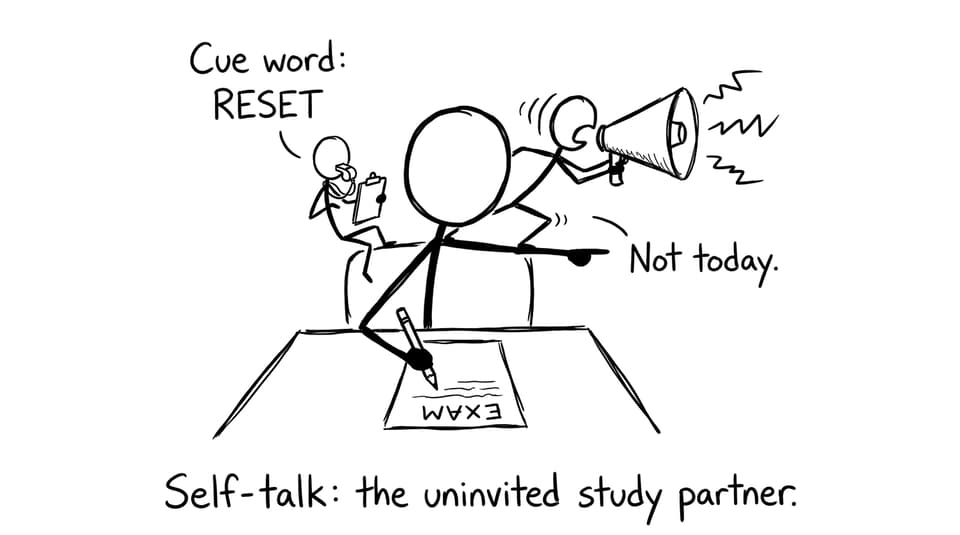
A good method is to pair self-talk practice with realistic exam conditions. Try a timed set from the SEHS Questionbank (Stress and coping) and use the same cue word every time you feel panic rising: “Reset.” Then answer anyway.
For more on stress-control links, see the C.4.2.1 coping strategies notes.
Build exam-proof self-talk with RevisionDojo
In IB SEHS, your performance is partly content knowledge and partly what you say to yourself when the question feels difficult. RevisionDojo helps you train both. Use Study Notes to lock in definitions, Flashcards for fast recall, AI Chat to refine wording, and the Grading tools to see what examiners reward. Then pressure-test it with the Questionbank, Mock Exams, and Predicted Papers until your self-talk becomes automatic: calm, specific, and useful.