
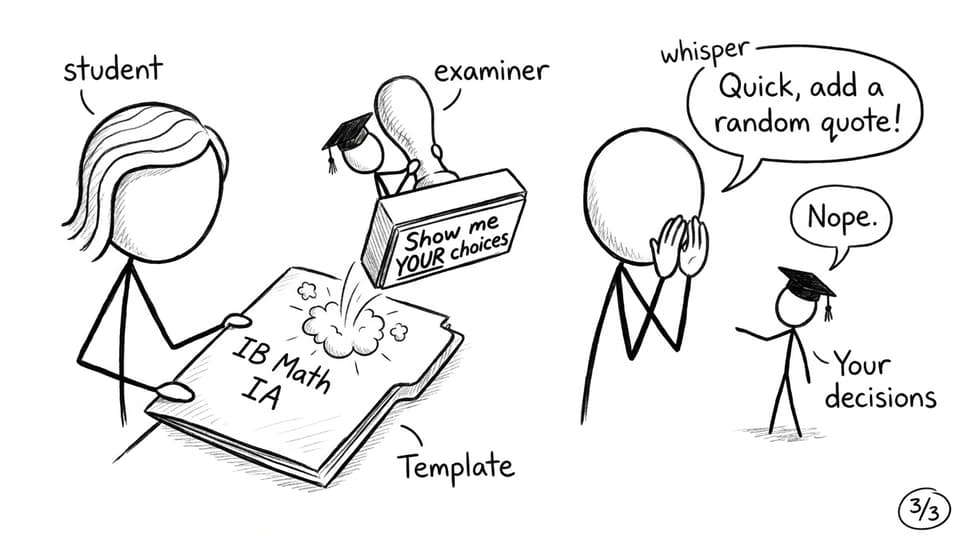
When an examiner reads your IB Math IA, they’re not hunting for a “cool personality.” They’re hunting for fingerprints.
Not literal ones, obviously. But the academic kind: evidence that a real student made real choices, hit real obstacles, and adjusted like a mathematician instead of copying a template.
That’s why Criterion C (Personal Engagement) is quietly powerful. It’s only 3 marks, yet it can be the difference between an IA that feels alive and one that feels like it could belong to anyone.
IB Math: What Criterion C is actually rewarding
Criterion C asks one simple question:
Does this investigation clearly belong to you?
In IB Math, full marks in personal engagement show up as:
-
Ownership: you explain why the topic and approach make sense for you
-
Decision-making: you justify methods, variables, assumptions, and revisions
-
Active problem-solving: you respond to issues instead of hiding them
-
Reflection with math: you evaluate results, limitations, and next steps
If you want to anchor this in the official criteria language, start from RevisionDojo’s hub on Unpacking the IB Math IA Assessment Criteria.
A fast checklist to reach 3/3 in IB Math Criterion C
Before you rewrite anything, scan your draft and check if you can point to these on the page:
-
A one-sentence reason you chose the topic (not generic, not dramatic)
-
At least two moments where you made a choice (method, model, data, assumptions)
-
At least one moment where something didn’t work, plus what you changed
-
Short, specific reflection sentences after key results
-
A voice that sounds like you explaining your thinking, not an instruction manual
For structure support, compare your flow to How to Structure the IB Math IA for Maximum Clarity and How to Structure Your IB Math IA Logically.
Personal engagement in IB Math starts with ownership (not originality)
A common trap in IB Math is thinking personal engagement means you must have a never-before-seen topic.
You don’t.
You can investigate regression, optimisation, modelling, probability, or calculus and still score 3/3. The key is to show that the investigation didn’t happen to you. It happened because of you.
A strong ownership sentence sounds like:
-
“I chose this because I noticed X in my training data and wanted to test whether Y model actually fits.”
-
“I tried a linear model first, but the residuals suggested curvature, so I switched to…”
If you’re still picking a direction, use idea frameworks from IB Math IA Ideas or Best IB Math IA Topics for 2025 to find a topic you can genuinely steer.
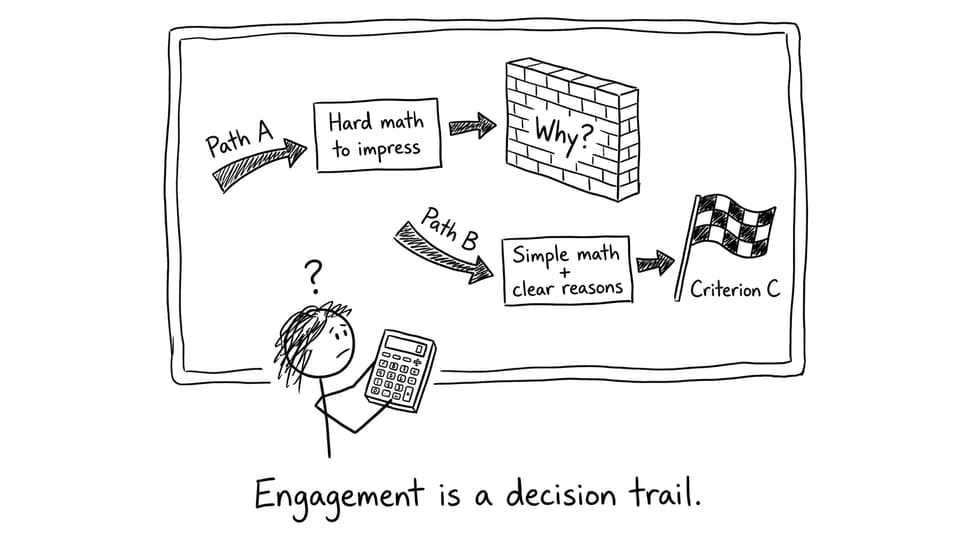
IB Math engagement is a trail of decisions, not “harder math”
Examiners don’t award Criterion C because your mathematics looks intimidating.
They award it because your writing proves you’re making mathematical judgements.
So instead of adding advanced content to “sound HL,” do this:
Show the decision before the method
In IB Math, don’t just present regression/calculus/probability. Tell the reader why it’s the right tool:
-
Why this model and not another?
-
Why these variables?
-
Why these constraints or assumptions?
Show the revision after the result
Even one change can signal strong personal engagement:
-
“The first model overestimated values at high x, so I limited the domain and explained why.”
-
“The data had outliers; I tested results with and without them and compared the conclusions.”
For extra guidance on writing that “decision trail,” RevisionDojo’s IB Math: 10 Tips for a Strong IA Commentary is a useful reference.
Small creative moves that signal real IB Math personal engagement
Creativity in IB Math doesn’t mean inventing new mathematics. It usually looks like one of these examiner-friendly moves:
-
Using your own data (even a small dataset) or explaining why the data source is credible
-
Adapting a known model to your context, then checking how well it behaves
-
Comparing two methods briefly and defending your final choice
-
Stress-testing assumptions (what happens if you tweak a parameter?)
If you’re unsure how to connect mathematics to reality without becoming descriptive, read How to Use Real-World Applications in Your IB Math IA.

Reflection: the easiest way to “prove” personal engagement in IB Math
Reflection is where many students accidentally go silent. They give results, they conclude, and they stop.
But in IB Math, reflection is where you demonstrate that you can evaluate mathematics like a thinker.
Add short reflection sentences after key steps:
-
“This matters because…”
-
“This limitation exists because…”
-
“A better model might be… since…”
-
“If I repeated this, I would…”
To build this skill, lean on How to Write a Perfect IB Math IA Reflection and How to Write a High-Scoring IB Math IA Reflection.
Closing: make your IB Math IA feel like yours
Criterion C in IB Math is not a creativity contest. It’s a visibility test.
If the examiner can trace your decisions, see you respond to problems, and watch you evaluate the mathematics honestly, 3/3 becomes realistic.
When you’re ready to polish, RevisionDojo is built for this stage: use the Coursework Library for exemplars, the Grading tools to check rubric alignment, AI Chat to strengthen decision-based explanations, and Tutors if you want feedback that feels like an examiner reading.
Make the choices clear. Make the reasoning yours. That’s the fastest path to full marks in IB Math Criterion C.