

The replication fork is calm until it isn’t
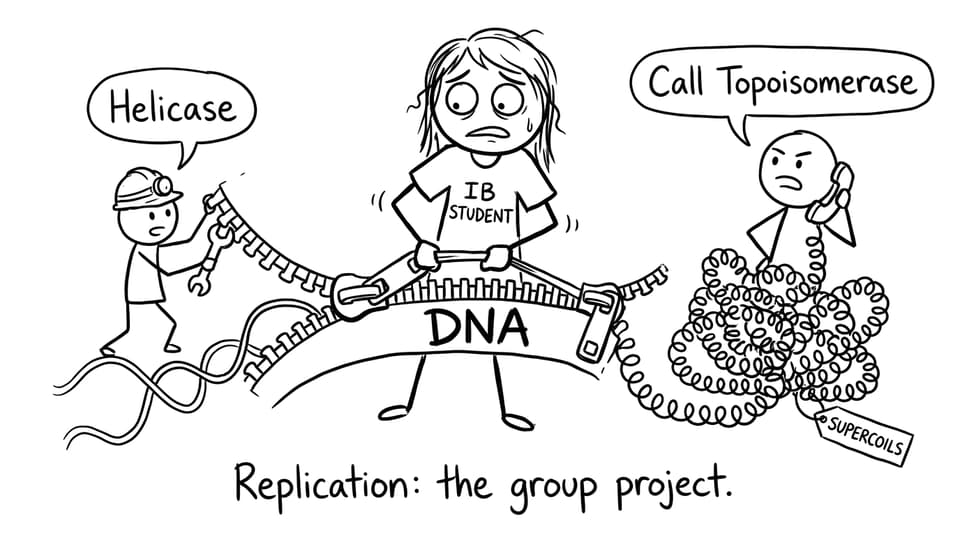
In IB Biology, DNA replication is often taught like a tidy diagram: two strands open, new strands appear, and the cell moves on. But if you imagine the DNA molecule as a real, physical object, replication becomes a small engineering crisis. Unzipping a twisted ladder creates tension, knots, and strain that can stop the whole process.
That is why helicase and topoisomerase matter so much in IB Biology exam answers. One opens the helix. The other stops that opening from snapping the DNA like an overwound rubber band.
IB Biology quick checklist: what to write for marks
When a question asks about enzyme roles at the replication fork, keep this compact checklist ready:
-
Helicase breaks hydrogen bonds between base pairs and separates the strands.
-
This creates a replication fork (two single-stranded templates).
-
Unwinding causes supercoiling (torsional strain) ahead of the fork.
-
Topoisomerase relieves that strain by cutting and rejoining DNA.
-
Without topoisomerase, replication can stall or DNA can break.
For syllabus-aligned practice, anchor your revision in the D1.1 DNA replication hub and the D1.1 DNA replication notes.
Helicase in IB Biology: the enzyme that opens the story
Helicase is the enzyme that “starts the noise.” In IB Biology, you describe helicase as unwinding DNA by breaking the hydrogen bonds between complementary bases (A-T and C-G). This separation produces two exposed template strands so that DNA polymerase can read them.
A useful way to phrase it in an exam is:
- Helicase unzips the double helix at the replication fork, producing single-stranded templates.
If you want a focused syllabus match for this wording, see D1.1.3 Role of helicase and DNA polymerase in DNA replication (videos) and practise with the D1.1.3 Questionbank.
Why topoisomerase is the quiet hero (supercoils are the villain)
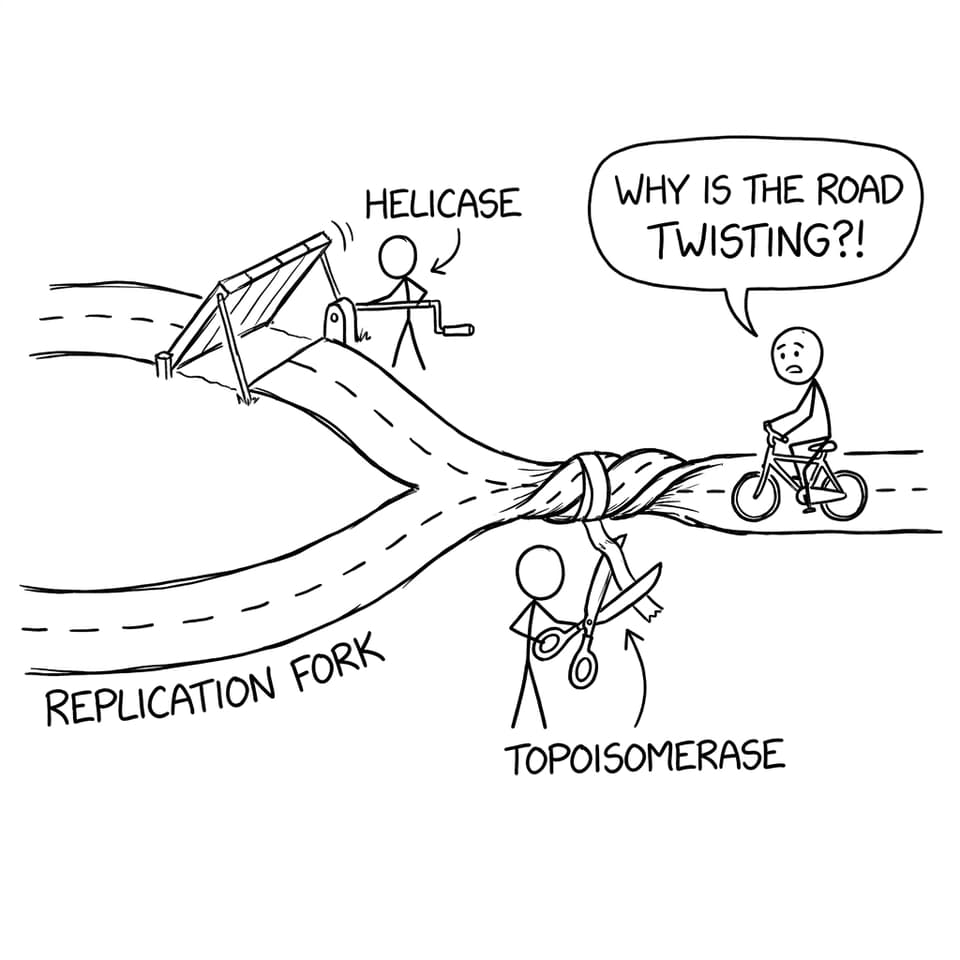
Here is the physical problem that IB Biology questions love: when helicase unwinds DNA, the DNA ahead of the replication fork becomes overwound. The helix cannot magically untwist itself fast enough. That overwinding creates torsional strain and supercoiling.
Topoisomerase solves this by doing something that sounds dangerous but is incredibly controlled: it cuts the DNA, allows it to rotate or pass through itself to release tension, and then reseals the sugar-phosphate backbone.
In prokaryotes, a well-known version is DNA gyrase, which helps counteract overwinding. In eukaryotes, topoisomerase I typically cuts one strand, while topoisomerase II can cut both strands for more complex untangling.
The teamwork sentence that earns IB Biology marks
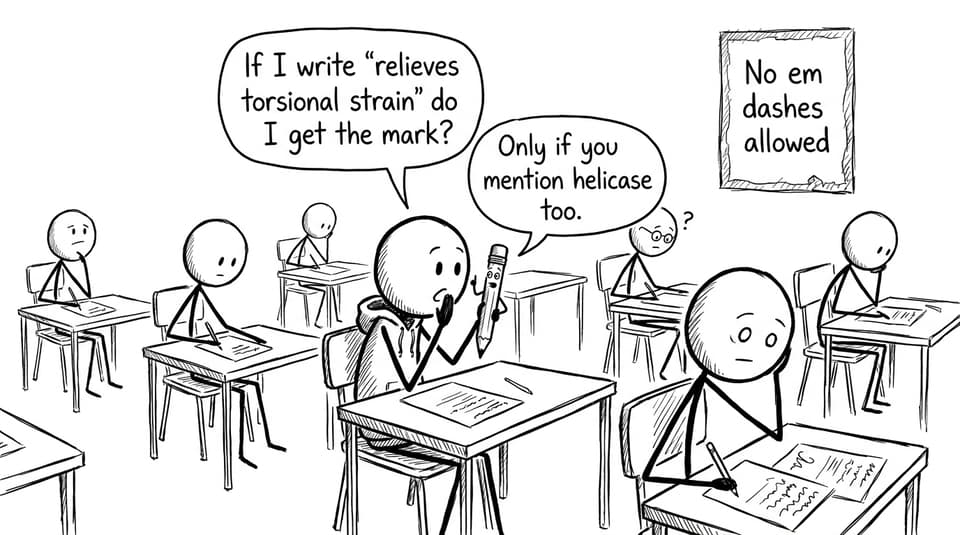
Many students describe helicase correctly and then forget to connect it to topoisomerase. A strong IB Biology sentence links cause and effect:
- Helicase unwinds DNA at the replication fork, which creates supercoiling ahead of the fork, and topoisomerase relieves torsional strain by cutting and rejoining DNA.
If you want to see how this fits into the full “enzyme team,” read How Enzymes Coordinate DNA Replication. For a wider unit context, use 2.7 DNA replication, transcription and translation (notes).
A quick RevisionDojo study plan (so this sticks)
To make helicase and topoisomerase automatic under exam pressure:
-
Read the core explanation in D1.1.1 DNA Replication notes.
-
Drill definitions using RevisionDojo Flashcards and Study Notes from the topic hub.
-
Use the Questionbank to practice command terms and get feedback.
-
Ask AI Chat to mark your explanation and suggest a higher-mark version.
-
Finish with a timed Mock Exam or Predicted Papers set for replication-style questions.
RevisionDojo also supports deeper linking topics like enzymes in general via 2.5 Enzymes (notes), which helps when questions ask about how enzyme action depends on structure.
Closing: the simplest way to remember it
If you remember one line for IB Biology, make it this: helicase opens the DNA, topoisomerase keeps it from fighting back. The replication fork is a moving problem, and these enzymes are the two tools that stop the problem from becoming damage.
To lock the wording in, revise the topic in RevisionDojo’s IB Biology resources hub, then use the Questionbank, Grading tools, and AI Chat to turn your explanation into a full-mark paragraph. When you can write that cause-and-effect sentence quickly, you are ready for exam questions on helicase, topoisomerase, and replication in IB Biology.