
Respiratory Responses to Increasing Exercise Intensity
As exercise intensity increases, the respiratory system responds immediately to meet the body’s rising demand for oxygen and the need to remove carbon dioxide. In IB Sports, Exercise and Health Science (SEHS), respiratory responses explain how breathing adjusts during physical activity to support energy production and performance.
These changes occur rapidly and increase progressively as exercise intensity rises, allowing muscles to continue producing ATP efficiently.
Increase in Breathing Rate
One of the first respiratory responses to exercise is an increase in breathing rate. As soon as physical activity begins, the body detects rising levels of carbon dioxide and acidity in the blood.
Key points include:
- Breathing rate increases with exercise intensity
- More air is moved in and out of the lungs per minute
- Carbon dioxide is removed more quickly
In IB SEHS, students should understand that breathing rate increases to maintain stable blood gas levels during exercise.
Increase in Tidal Volume
Tidal volume refers to the amount of air inhaled and exhaled in one breath. During exercise, tidal volume increases alongside breathing rate.
This occurs because:
- Deeper breaths allow more oxygen to enter the lungs
- Greater volumes of carbon dioxide can be removed
- Gas exchange becomes more efficient
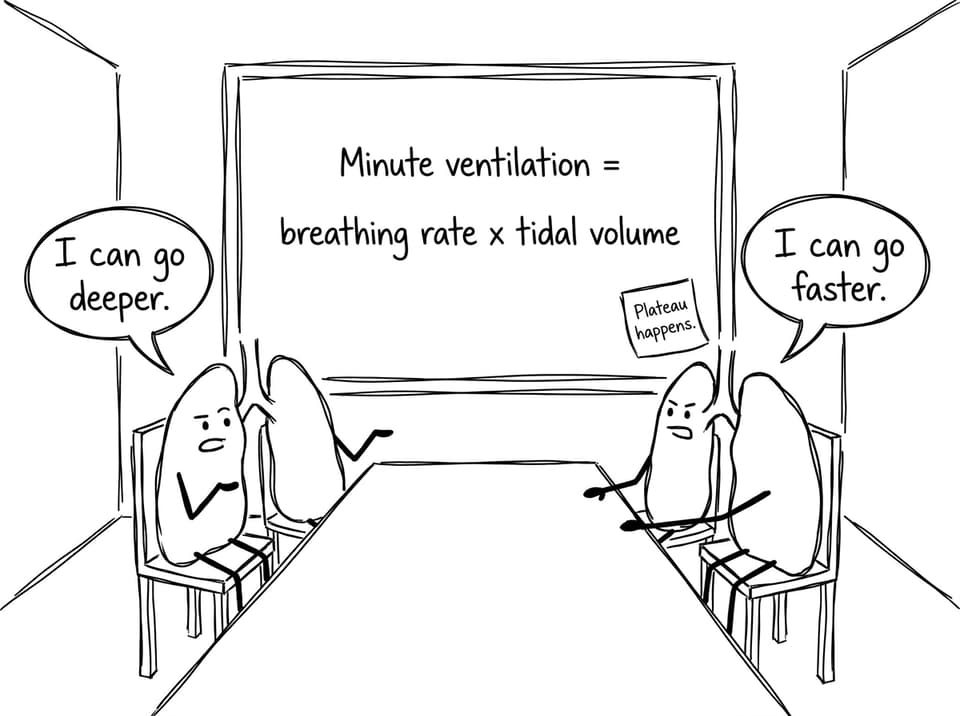
At moderate intensities, increases in tidal volume play a major role in improving ventilation. At higher intensities, tidal volume may plateau, and further increases rely mainly on breathing rate.
Ventilation and Exercise Intensity
Ventilation is the total volume of air moved in and out of the lungs per minute. It is calculated by multiplying breathing rate by tidal volume.
As exercise intensity increases:
- Ventilation rises significantly
- Oxygen uptake increases
- Carbon dioxide removal accelerates
In IB exams, students are often required to explain how changes in breathing rate and tidal volume combine to increase ventilation during exercise.
Importance for Performance
Efficient respiratory responses are essential for sustaining exercise intensity. Without increased ventilation, oxygen delivery would be insufficient, and fatigue would occur rapidly.
During high-intensity exercise, the respiratory system works near its maximum capacity. Any limitation in respiratory function can reduce performance and increase perceived effort.
Exam Relevance for IB SEHS
Respiratory response questions often require structured explanations using correct terminology. High-mark answers clearly define breathing rate, tidal volume, and ventilation and link them to increasing exercise intensity and performance demands.
RevisionDojo Call to Action
If respiratory response questions feel repetitive or difficult to explain clearly, RevisionDojo provides IB SEHS-focused explanations and exam-style practice to help you master applied physiology with confidence.
Frequently Asked Questions (FAQs)
Why does breathing rate increase during exercise?
Breathing rate increases to supply more oxygen to the body and remove carbon dioxide produced by working muscles.
What happens to tidal volume as exercise intensity rises?
Tidal volume increases as breaths become deeper, allowing more efficient gas exchange during exercise.
How are respiratory responses tested in IB SEHS exams?
Questions often ask students to explain how breathing rate, tidal volume, and ventilation change with exercise intensity and support performance.