Join 650k+ students breezing through the IBReady to breeze through the IB?
Referencing interviews in a World Religions investigative study requires more than adding a name and date after a quotation. You must show where the evidence came from, how it was collected, why it matters, and whether the participant should be identified or protected.
The safest approach is to choose one consistent citation system, keep a fieldwork record, label interview and observation evidence clearly, and connect every quotation to analysis. Your school may prescribe a referencing style, so confirm its requirements with your teacher before formatting the final report.
This matters because fieldwork can make an IB IA feel vivid while also making it vulnerable. A memorable quotation is not automatically reliable evidence. It becomes academically useful only when the reader can understand its context, limitations, and relationship to your research question.
A quick fieldwork and referencing checklist
Before submitting your investigation, check that you have:
obtained informed consent before interviewing or observing people
explained how information may be used in your written analysis
recorded the interview date, format, location, and participant role
agreed whether the participant will be named, described, or anonymized
distinguished direct quotations from paraphrases
cited field notes and observations, not just formal interviews
connected every piece of fieldwork to the research question
used one consistent citation style throughout
included supporting material only when it helps document the method
kept the written analysis within 1,500-1,800 words
The investigative study is worth 30 marks. RevisionDojo's guide to the World Religions IA criteria provides the broader mark scheme, while the steps below focus specifically on fieldwork and interview evidence.
Criterion
Assessment focus
Marks
Fieldwork priority
A
Rationale and preliminary research
8
min read
min read
min read
min read
Justify why fieldwork is appropriate
B
Plan for study
3
Explain how evidence will be collected ethically
C
Summary of significant findings
6
Present selected findings accurately
D
Critical reflection and evaluation
10
Interpret and evaluate the evidence
E
References and compliance with format
3
Cite consistently and follow the required structure
Criterion A: Build the investigation before the interview
Criterion A is worth 8 marks, making preliminary research more than a warm-up. Reading should help you form a focused question and decide whom to interview. Going into the field first and researching later often produces broad questions, superficial answers, and evidence that does not address the investigation.
Suppose your question explores how participation in langar expresses Sikh understandings of sewa. Before interviewing a volunteer, you would investigate the relevant religious concepts, primary religious material, and scholarly interpretations. That preparation allows you to ask about the relationship between belief and practice rather than simply asking, “Why do you volunteer?”
Follow this sequence:
Define a narrow aspect of religious experience, belief, or practice.
Complete preliminary reading from appropriate primary and secondary sources.
Identify what published sources cannot reveal about lived experience.
Choose participants who can provide relevant perspectives.
Explain why interviews, observation, or another fieldwork method suits the question.
Criterion B is worth 3 marks. A concise plan should identify what you intend to do, where the evidence will come from, and how the method supports the research question.
Your plan might state that you will conduct a semi-structured interview with a community member, observe one religious practice where permission has been granted, and compare those findings with scholarly literature. “Semi-structured” means preparing core questions while allowing relevant follow-up questions. This approach gives the interview direction without turning it into a rigid questionnaire.
Create an interview record containing:
the participant's name or agreed pseudonym
the participant's relevant role or perspective
the date and location or online format
consent for note-taking or recording
agreed conditions for quotation and attribution
the prepared questions and significant follow-up questions
Never record secretly. Explain the purpose of the study, participation should be voluntary, and allow the participant to decline questions. If a participant is a minor or the topic is sensitive, follow your school's safeguarding and consent procedures. You should also seek permission before observing a private space, ceremony, or interaction.
RevisionDojo's notes on ethics, permissions, and representing religions fairly offer a useful review before contacting participants. Ethical fieldwork is not a formality. It shapes what evidence you may responsibly collect and publish.
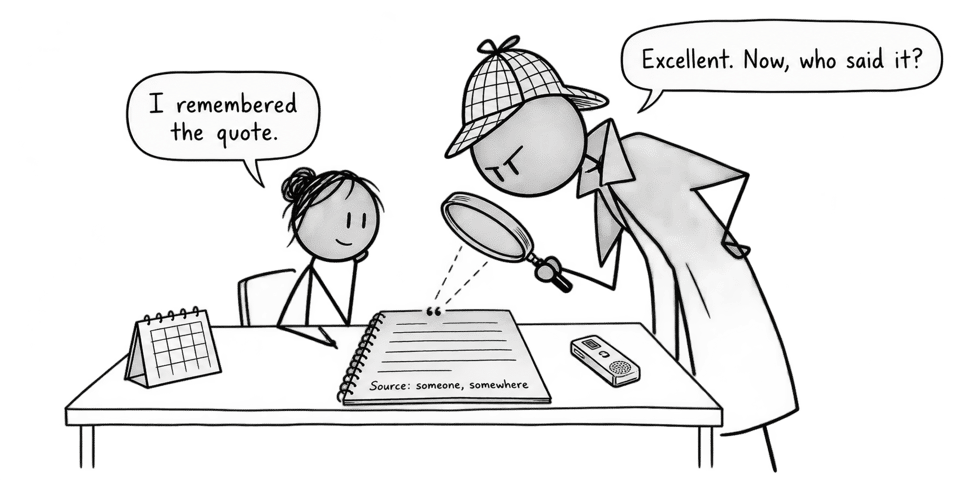
A student faces a detective investigating a quotation whose source details were never recorded
Criterion C is worth 6 marks and concerns the significant findings produced by your investigation. The goal is selection, not transcription. A long interview may produce only two or three findings that directly answer the research question.
For each finding, give the reader enough context to understand the evidence. A practical in-text form might look like this:
One volunteer described sewa as “a responsibility that becomes ordinary through repetition” (Participant A, interview, 14 September 2026).
If the participant has consented to identification, you might use the person's name and relevant role instead. If anonymity was promised, use a stable label such as “Participant A” throughout. Do not alternate between labels or include contextual details that accidentally reveal the person's identity.
Field observations need attribution too. For example:
Volunteers rotated between food preparation and serving roles during the observed period (field notes, gurdwara visit, 14 September 2026).
A paraphrase still needs acknowledgement because the idea came from another person. Your exact format will depend on the citation style required by your school. Some systems treat unpublished interviews as in-text or footnote-only communications, while others permit an interview entry in the reference list. Consistency with your selected standard is more important than combining incompatible conventions.
Criterion D: Move from quotation to critical reflection
Criterion D carries 10 marks, the largest share of the investigation. This is where interview evidence must become analysis.
A useful paragraph follows four moves:
Make a claim that addresses the research question.
Introduce a short, relevant quotation or field observation.
Interpret what the evidence suggests about religious experience or practice.
compare it with preliminary research and acknowledge limitations.
For example, a participant's description of volunteering as routine might suggest that religious commitment is expressed through repeated communal action, not only through exceptional spiritual experiences. You could then compare that account with scholarly explanations of sewa. Finally, you would acknowledge that one volunteer's interpretation may be shaped by age, family background, length of community involvement, or the interview setting.
This final step matters. Referencing interviews establishes the origin of a statement, but evaluation establishes its evidential weight. Ask:
Was the participant describing personal experience or making a general claim?
Could the wording of my question have influenced the response?
Did the presence of a recorder change the conversation?
Does observation support or complicate the interview account?
Do published sources present a different interpretation?
What perspectives remain absent from the investigation?
Do not treat disagreement as a problem to hide. A difference between scholarship and lived experience can become one of the strongest analytical moments in a World Religions investigative study. It may reveal diversity within a tradition or the distance between formal teaching and everyday practice.
Criterion E: Use consistent references and the required format
Criterion E is worth 3 marks. The report should follow the five-heading structure and consistently apply a standard referencing format. The established written-analysis limit is 1,500-1,800 words. Titles, citations, references, and appendices are excluded from that count under the subject guide, but confirm the applicable submission instructions with your teacher.
Your reference system should allow the reader to distinguish among books, articles, websites, interviews, and field observations. If your chosen style and school guidance call for an interview entry, an anonymized model might include:
Participant A. Interview by the author. Location withheld, 14 September 2026.
An appendix can contain an interview schedule, consent documentation where appropriate, or selected transcript material. It should not become a storage area for analysis that belongs in the main report. Examiners assess the written analysis, so your main argument must remain understandable without requiring the reader to reconstruct it from raw notes.
Protect the word limit without weakening the evidence
The 1,500-1,800 word limit rewards selection. Do not reproduce complete answers when one sentence would support the point. Quote the distinctive wording, paraphrase background details, and reserve most of the paragraph for interpretation.
A sensible working allocation is approximately:
Section
Suggested working range
Rationale and preliminary research
300-400 words
Plan for study
150-200 words
Summary of significant findings
300-400 words
Critical reflection and evaluation
650-750 words
These are planning ranges, not official section limits. Adjust them to your investigation while keeping the complete report within 1,500-1,800 words. The important principle is to protect enough space for Criterion D, where your evidence is interpreted and evaluated.
Turn fieldwork into an argument
A strong IB IA does not earn value merely because a student conducted an interview. Its value comes from the disciplined chain connecting preliminary research, ethical planning, accurate reporting, critical interpretation, and transparent referencing.
RevisionDojo brings that process into one IB-focused workspace. You can use the Coursework Library to study structure, Study Notes and Flashcards to strengthen subject understanding, and Jojo AI to question your reasoning without surrendering authorship. Grading tools and Tutors can support feedback, while the Questionbank, Predicted Papers, and Mock Exams help connect coursework discipline with wider exam preparation.
The interview may give your investigation a human voice. Careful referencing makes that voice trustworthy, and thoughtful analysis makes it matter.