
Power online rarely announces itself.
It arrives quietly, disguised as convenience: an app that “helps,” a feed that “knows you,” a dashboard that “optimizes outcomes.” Then one day you notice your choices feel narrower. Your attention feels guided. Your options feel pre-sorted.
That moment of noticing is exactly what IB Digital Society wants you to practice. In IB Digital Society, power and control are not abstract political words. They are practical lenses for explaining why digital systems shape people and communities differently--and why those effects can be hard to see until they compound.
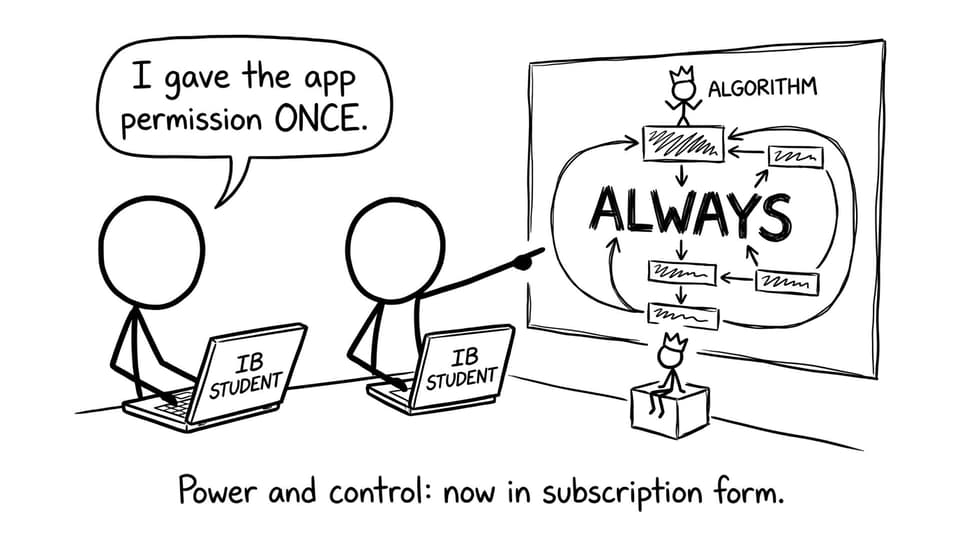
A quick IB Digital Society checklist for “power and control” questions
Use this short checklist whenever a stimulus mentions platforms, algorithms, data, moderation, surveillance, or “policy changes”:
-
Name the system (specific platform feature, policy, model, database, device).
-
Identify who holds power (company, government, school, users, third parties).
-
Spot the control mechanism (defaults, ranking, access, monitoring, rules, pricing).
-
Explain impacts on individuals and communities (short-term and long-term).
-
Evaluate (fairness, accountability, transparency, consent, ability to challenge).
If you want a home base for the course, start with IB Digital Society Resources and then jump into the relevant topic area when you practice.
What “power” and “control” mean in IB Digital Society
In IB Digital Society, power is the ability of an actor (an individual, organization, or institution) to influence decisions, behavior, access, and outcomes through digital systems.
Control is how that power is implemented and maintained--sometimes through visible rules, but often through invisible design.
A helpful way to phrase it in essays is:
-
Power answers: Who can shape outcomes?
-
Control answers: By what mechanism does the system shape outcomes?
For the core concept connections, see IB Digital Society: How All the Core Concepts Fit Together.
Why power and control matter in digital systems
Digital power scales fast. A single interface choice can guide millions of people without a single conversation. A single policy can change what is visible, what is profitable, and what feels “normal.”
This is why IB Digital Society treats power as something that can be:
-
Automated (algorithmic decisions, auto-moderation)
-
Borderless (platform effects across countries)
-
Hard to contest (limited transparency and appeal)
-
Unevenly experienced (different communities carry different risks)
For an exam-ready way to turn concepts into analysis, read How to Apply IB Digital Society Concepts Effectively.
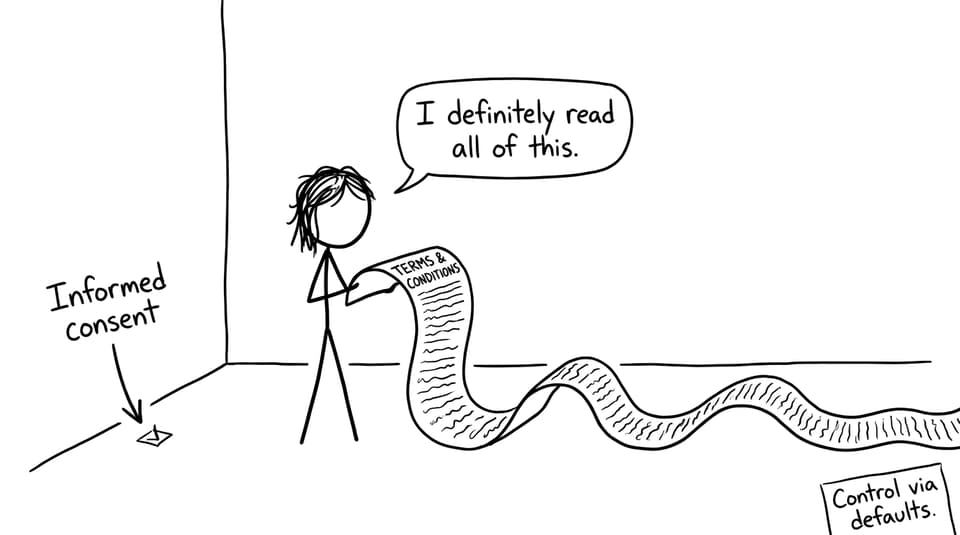
Common forms of power in IB Digital Society case studies
Strong IB Digital Society responses separate types of power instead of treating power like one vague force.
Structural power
Structural power sits in the architecture: who gets access, whose language is supported, who can afford devices or subscriptions, and who is excluded by design.
If you want syllabus-aligned language for this, RevisionDojo’s Notes for 2.4A Power and Types of Power help you keep definitions precise.
Informational power
Informational power comes from controlling data: collecting it, storing it, analyzing it, and deciding what becomes visible. Visibility is a form of influence. So is invisibility.
This is also where privacy, consent, and data protection become more than “ethics add-ons”--they become core power questions.
Algorithmic power
Algorithmic power is the system’s ability to rank, recommend, filter, flag, or score--often with limited transparency.
To revise this properly (without drifting into “it’s just code”), use IB Digital Society: Algorithms Explained for Exams. Then drill the idea with RevisionDojo’s Questionbank so you can apply it under time pressure.
Institutional and political power
Governments, schools, and institutions can use digital systems to regulate, monitor, communicate, or restrict. Sometimes that strengthens safety and coordination. Sometimes it raises concerns about rights, due process, and accountability.
This pairs naturally with Digital Rights and Responsibilities in IB Digital Society.
How control works: the quiet mechanisms examiners love
Control in digital systems is often “soft.” It does not always feel like force, even when it shapes behavior.
Look for control through:
-
Defaults (opt-in vs opt-out, privacy settings)
-
Interface nudges (notifications, streaks, frictionless sharing)
-
Rules and moderation (what is removed, demoted, or amplified)
-
Access gates (verification, paywalls, geography, device requirements)
-
Surveillance and monitoring (tracking, profiling, scoring)
In IB Digital Society, the highest marks come when you connect the mechanism to the consequence: how the design choice becomes a social outcome.

People vs communities: the perspective shift that boosts marks
A frequent weak spot in IB Digital Society exam answers is staying at the “individual user experience” level.
A stronger approach is to compare:
-
Individuals: convenience, personalization, entertainment, efficiency, safety
-
Communities: inequality, exclusion, polarization, chilling effects, long-term dependence
One person might love personalization. A community might experience it as reduced autonomy, narrowed information environments, or biased outcomes.
To practise connecting perspectives cleanly, see Connecting Multiple Concepts in IB Digital Society Inquiries.
How to use power and control in exams (without sounding generic)
In IB Digital Society, generic lines like “companies have power because they have data” rarely score well on their own. You need a chain of reasoning.
Try this structure:
-
Claim: Identify who holds power.
-
Mechanism: Explain the control method (ranking, defaults, moderation, data access).
-
Impact: Show effects on individuals and communities.
-
Evaluation: Consider transparency, accountability, consent, and ability to challenge.
Then rehearse the structure with RevisionDojo’s Mock Exams and Predicted Papers so you can execute it quickly, not perfectly.
If you need a broader map of what the course expects, review IB Digital Society: Key Themes Explained.
Conclusion: make IB Digital Society feel controllable
Studying IB Digital Society is partly learning content, but it’s mostly learning to see the hidden levers: who has power, how control is built into systems, and why the effects land unevenly across communities.
If you want to turn that insight into marks, build a simple loop in RevisionDojo: learn the language with Study Notes, lock it in with Flashcards, apply it with the Questionbank, get unstuck with AI Chat, and rehearse under pressure with Mock Exams and Predicted Papers. Then revisit IB Digital Society power and control again near the end of your revision cycle--because the point isn’t memorizing the definition. It’s recognizing the mechanism when it shows up in a new stimulus and explaining it calmly, on demand.
