

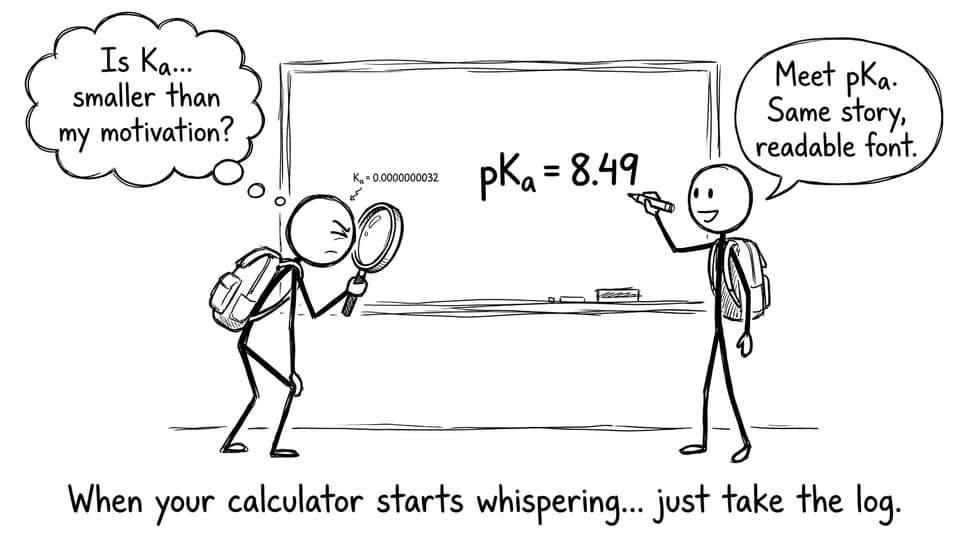
If you have ever stared at a Ka like 3.2 × 10⁻⁹ and felt your confidence quietly leave the room, you are not alone. In IB Chemistry, pKa is the moment someone turns the volume down on the noise and lets you hear the idea underneath: acid strength is an equilibrium story, and pKa is simply the most readable way to tell it.
Once pKa clicks, buffer questions stop feeling like rituals. Equilibrium arrows start to mean something. And you stop memorizing random values and start predicting trends.
pKa in IB Chemistry: the quick checklist
Keep this mini-checklist for IB Chemistry exam speed:
-
pKa = -log(Ka)
-
Lower pKa = stronger acid (larger Ka, more dissociation)
-
Higher pKa = weaker acid (smaller Ka, less dissociation)
-
At half-neutralization, pH = pKa (buffer/titration favourite)
-
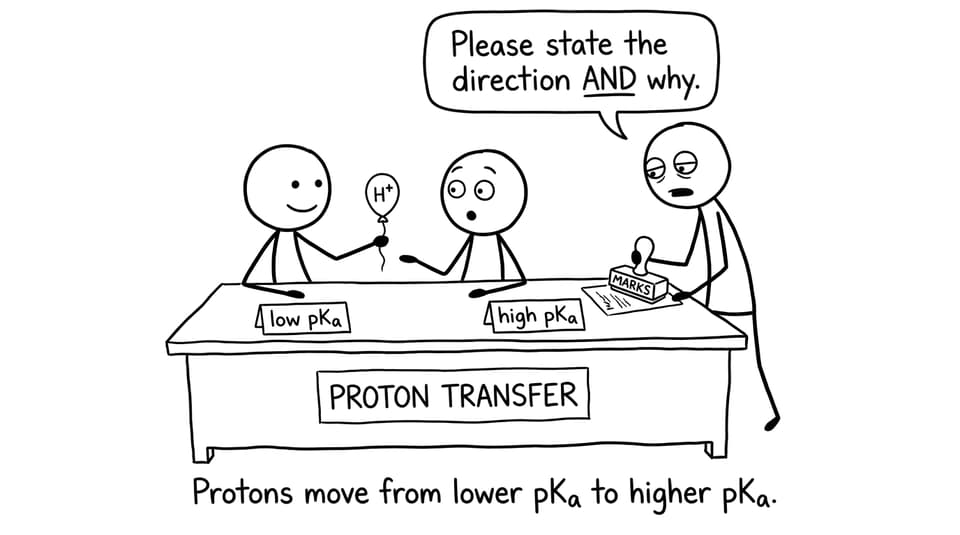
Proton transfer tends to go from lower pKa to higher pKa
If you want a structured home base for this topic, start with IB Chemistry Acids and Bases and then drill it with the Acids and Bases Questionbank.
What is pKa (and why IB Chemistry loves it)
In IB Chemistry, pKa is defined as the negative logarithm (base 10) of the acid dissociation constant, Ka:
pKa = -log(Ka)
For a weak acid:
HA ⇌ H⁺ + A⁻
Ka = ([H⁺][A⁻]) / [HA]
Ka values are often tiny, which makes them awkward to compare quickly. pKa converts those tiny Ka numbers into friendlier values on a log scale. It is not a new concept -- it is the same equilibrium information, just in a format your brain can rank faster.
To connect this idea to broader equilibrium thinking in IB Chemistry, the intuition from IB Chemistry: Dynamic Equilibrium, Finally Clear is especially useful.
Ka vs pKa in IB Chemistry: the inverse relationship
This is the relationship you must be able to say in one clean sentence in IB Chemistry:
-
Large Ka → small pKa → stronger acid
-
Small Ka → large pKa → weaker acid
That inverse link is why pKa questions are often really comparison questions. The exam is asking: which acid dissociates more at equilibrium? pKa lets you answer without wrestling with exponents.
If you want to reinforce Ka before returning to pKa, read Ka and Kb Explained for IB Chemistry.
What pKa tells you in IB Chemistry (the marks are here)
Acid strength without memorizing everything
In IB Chemistry, pKa is a direct measure of how strongly an acid holds onto H⁺.
-
Lower pKa means the equilibrium lies further right (more H⁺ produced) -- stronger acid.
-
Higher pKa means the equilibrium lies further left (less H⁺ produced) -- weaker acid.
Direction of proton transfer
A reliable rule for IB Chemistry mechanisms and explanations:
Protons move from the species with lower pKa to the species with higher pKa.
It sounds simple, but it gives you a reason, not a guess.
To strengthen your language for these explanations, pair this with IB Chemistry: Conjugate Acid--Base Pairs Explained.
pKa and buffers in IB Chemistry (HL especially)
Buffers are where pKa becomes a practical tool instead of a definition.
For a weak acid buffer:
pH = pKa + log([A⁻]/[HA])
Two exam-grade consequences in IB Chemistry:
-
If [A⁻] = [HA], then pH = pKa.
-
pKa is the pH where the weak acid is half dissociated (or half-neutralized in a titration context).
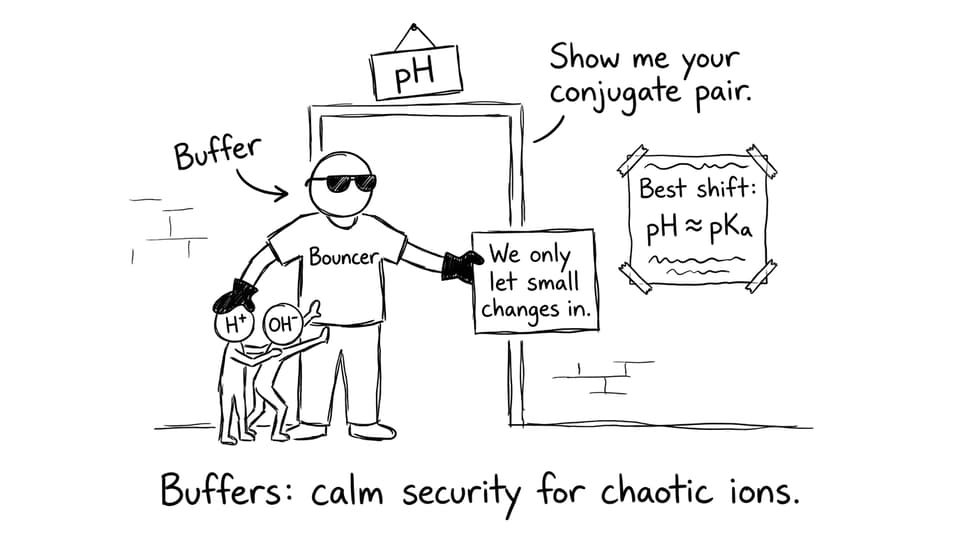
This is why buffers work best when pH ≈ pKa: the system has both HA and A⁻ available to respond to small additions of acid or base.
For clearer buffer intuition and wording that fits markschemes, use IB Chemistry Buffers Explained (Without the Panic) and the syllabus-aligned note R3.1.17 The pH of a buffer solution (Higher Level Only).
Common IB Chemistry mistakes with pKa
Students lose easy marks in IB Chemistry by mixing up these pairs:
-
pKa vs pH: pH describes a solution; pKa describes an acid (an equilibrium tendency).
-
Strength vs concentration: a concentrated weak acid is still weak; strength is about dissociation.
-
Ka vs pKa direction: if Ka increases, pKa decreases (inverse relationship).
If you keep falling into the strength vs concentration trap, review IB Chemistry: Strong vs Weak Acids Explained.
Bring pKa back to marks (and use RevisionDojo to drill it)
pKa in IB Chemistry is not a trivia value to memorize -- it is a compact way to see equilibrium, compare acid strength, and handle buffers with confidence. The exams reward students who can move smoothly between Ka, pKa, and a clear explanation of what the equilibrium arrow implies.
To turn this into automatic marks, use RevisionDojo as your daily practice loop: learn the idea with syllabus-aligned notes, lock it in with Flashcards, then prove it under time pressure with the Questionbank and Mock Exams. When you get stuck, AI Chat can help you debug the exact step where your reasoning drifted, and the Grading tools help you tighten explanation style. Start with the IB Chemistry Resources hub and make IB Chemistry pKa one of the easiest points on your paper, not the one you hope does not show up.