
If you have ever stared at an acid-base equation and felt like the proton is playing hide-and-seek, you are not alone. In IB Chemistry, the fastest way to stop guessing is to learn one calm idea: conjugate acid-base pairs. They show up everywhere that matters: buffers, pH changes, weak acid equilibria, and titration logic. And once you can spot conjugate pairs quickly, a lot of exam questions start to read like short stories instead of puzzles.
The 20-second checklist (exam-speed)
When you see an equation in IB Chemistry, use this checklist before doing any calculations:
-
Find the species that loses H+ (that is the acid).
-
Find what it becomes after losing H+ (that is the conjugate base).
-
Find the species that gains H+ (that is the base).
-
Find what it becomes after gaining H+ (that is the conjugate acid).
-
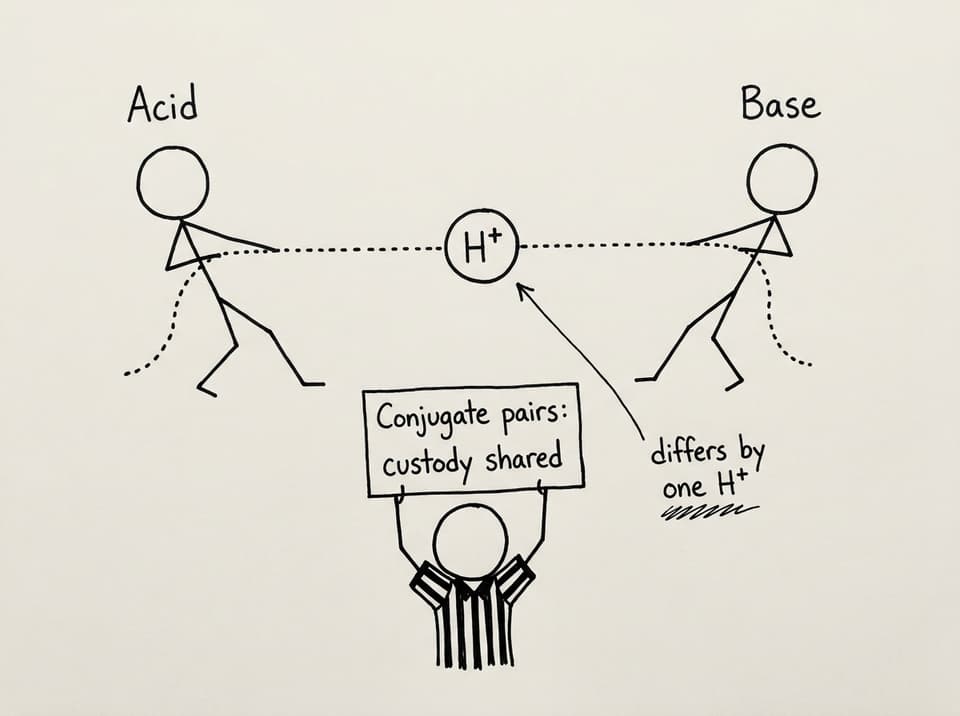
Confirm the pair differs by exactly one proton.
If you want targeted practice on this specific skill, the syllabus-aligned hub for R3.1.2 Conjugate acid-base pairs is built for quick repetition using RevisionDojo’s Questionbank and Flashcards.
What a conjugate acid-base pair actually is
A conjugate acid-base pair is simply two species separated by one H+.
-
Acid (donates H+) (\rightarrow) conjugate base
-
Base (accepts H+) (\rightarrow) conjugate acid
This is the Brønsted-Lowry model, which is the model that dominates IB Chemistry proton transfer reactions. If you want the broader foundation, start with R3.1.1 Brønsted-Lowry acid-base theory.
A memory anchor that actually sticks
Think of the proton like a “hat.”
-
If a species loses the hat, it becomes “less H-like” and is the conjugate base.
-
If a species gains the hat, it becomes “more H-like” and is the conjugate acid.
That is it. One proton difference, every time.
Core IB Chemistry examples (the ones examiners love)
You do not need dozens. You need a few that train your eyes.
HCl / Cl⁻
- HCl donates H+ (\rightarrow) Cl⁻ is the conjugate base.
NH₃ / NH₄⁺
- NH₃ accepts H+ (\rightarrow) NH₄⁺ is the conjugate acid.
H₂CO₃ / HCO₃⁻
- H₂CO₃ donates H+ (\rightarrow) HCO₃⁻ is the conjugate base.
HCO₃⁻ / CO₃²⁻ (amphiprotic behavior)
-
HCO₃⁻ can donate H+ again (\rightarrow) CO₃²⁻.
-
HCO₃⁻ is amphiprotic, meaning it can act as an acid or base depending on the reaction.
For a clean set of notes you can revise from in one sitting, use Notes for R3.1.2 Conjugate acid-base pairs.
How conjugate acid-base pairs appear inside real reactions
Consider:
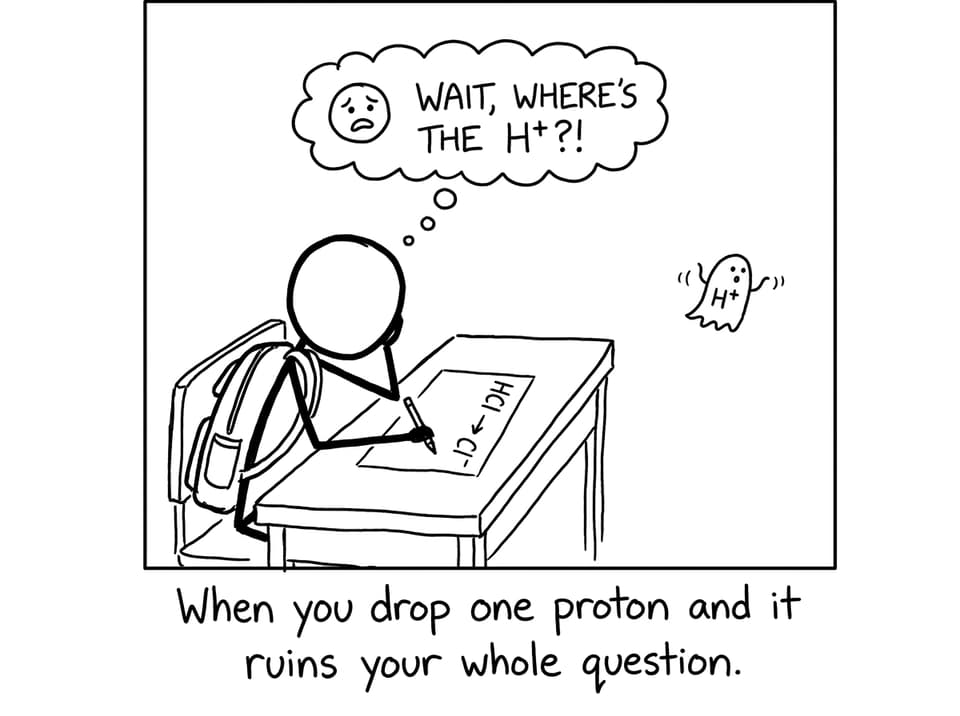
Identify the transfer:
-
HCl donates H+ (\rightarrow) HCl/Cl⁻ is one conjugate acid-base pair.
-
H₂O accepts H+ (\rightarrow) H₂O/H₃O⁺ is the other conjugate acid-base pair.
This is why conjugate pairs are secretly an equilibrium skill. If you are also revising equilibrium generally, Dynamic equilibrium explained for IB Chemistry ties the “reversible arrow thinking” together.
Strength: why strong acids have weak conjugate bases
Here is a high-yield line for IB Chemistry:
-
Stronger acid (\rightarrow) weaker conjugate base
-
Stronger base (\rightarrow) weaker conjugate acid
Reason: if an acid is very willing to donate H+, then its conjugate base is very unwilling to take H+ back.
If strength vs concentration still feels slippery, RevisionDojo’s R3.1.6 Strong and weak acids and bases Notes is worth a focused 15 minutes.
The Ka/Kb bridge (HL-friendly, SL-useful)
For any conjugate acid-base pair:
This is why conjugate thinking powers calculation questions. Pair it with Ka and Kb explained for IB Chemistry when you are ready to connect concepts to numbers.
Buffers: conjugate pairs in their natural habitat
A buffer is basically a conjugate acid-base pair doing its job under pressure.
-
Weak acid + conjugate base, or
-
Weak base + conjugate acid
When you add acid, the conjugate base removes H+. When you add base, the conjugate acid donates H+. The buffer “absorbs” the change, so pH shifts less.
For the full story (including what exam questions usually test), see Buffers explained for IB Chemistry and, for HL calculations, R3.1.17 The pH of a buffer solution (HL) Notes.
Common mistakes IB Chemistry students make
-
Forgetting the “one proton only” rule: conjugate pairs differ by exactly one H+. Charge often changes too, but the H+ change is the defining feature.
-
Assuming water is always neutral: H₂O can act as an acid or base depending on what it meets.
-
Mixing up strength direction: stronger acid means weaker conjugate base (and vice versa).
If you want the “why” behind proton donation and acceptance, Why do acids donate protons while bases accept them? is a helpful conceptual reset.
Closing: the small idea that unlocks big marks
Conjugate acid-base pairs are the quiet engine behind acid-base logic in IB Chemistry: one proton moves, two pairs appear, and equilibrium suddenly has a clear direction. If you want to turn this into marks, build the habit with RevisionDojo: revise with Study Notes, test yourself in the Questionbank, lock definitions with Flashcards, and use AI Chat when a mechanism or pair identification feels fuzzy. When exam pressure rises, it helps to have Predicted Papers, Mock Exams, and Grading tools that tell you exactly what to fix next. Make conjugate pairs your default lens, and a lot of Topic 8 starts to feel surprisingly predictable.