
If you have ever stared at an acid-base question and felt like the letters were staring back, you are not alone. In IB Chemistry, Ka and Kb can feel like tiny symbols with an outsized impact: they decide whether your pH calculation is elegant or chaotic, whether a buffer question feels obvious or impossible, and whether a titration curve makes sense or looks like abstract art.
The good news: Ka and Kb are not “extra formulas” to memorize. They are just a way of describing one quiet idea in IB Chemistry: weak acids and weak bases do not fully react, so we measure how far they go.
Ka and Kb in IB Chemistry: a quick checklist
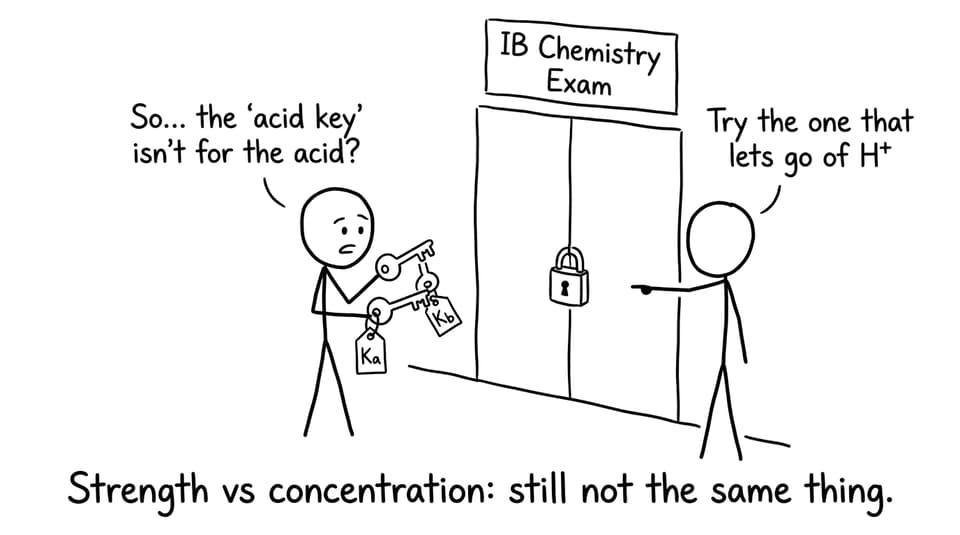
Before you dive into calculations, run this quick mental checklist (it saves marks in IB Chemistry):
-
Are you dealing with a weak acid or weak base? (Ka and Kb matter most here.)
-
Can you write the equilibrium equation correctly?
-
Do you know the Ka expression or Kb expression from the equation?
-
Are you mixing up strength and concentration?
-
Is it a conjugate pair where you can use Ka × Kb = Kw?
If you want the full topic map, start with the syllabus-aligned hub: IB Chemistry Acids and Bases.
What is Ka in IB Chemistry?
In IB Chemistry, Ka is the acid dissociation constant. It measures how much a weak acid ionizes in water.
For a generic weak acid:
HA ⇌ H⁺ + A⁻
The Ka expression is:
Ka = ([H⁺][A⁻]) /
What Ka is really telling you is simple: at equilibrium, how much of HA has “let go” of H⁺?
-
Large Ka (or small pKa) means a stronger weak acid.
-
Small Ka means a weaker acid with little ionization.
For a deeper HL-friendly explanation, the notes here connect strength to equilibrium position: Acid and base strength and constants (HL).
What is Kb in IB Chemistry?
In IB Chemistry, Kb is the base dissociation constant. It measures how much a weak base reacts with water to produce OH⁻.
For a generic weak base:
B + H₂O ⇌ BH⁺ + OH⁻
The Kb expression is:
Kb = ([BH⁺][OH⁻]) /
Interpretation:
-
Large Kb means a stronger weak base (more OH⁻ produced).
-
Small Kb means a weaker base.
Conjugate thinking matters a lot here; if you need to refresh that idea, use Conjugate acid-base pairs.
Strength vs concentration: the IB Chemistry trap
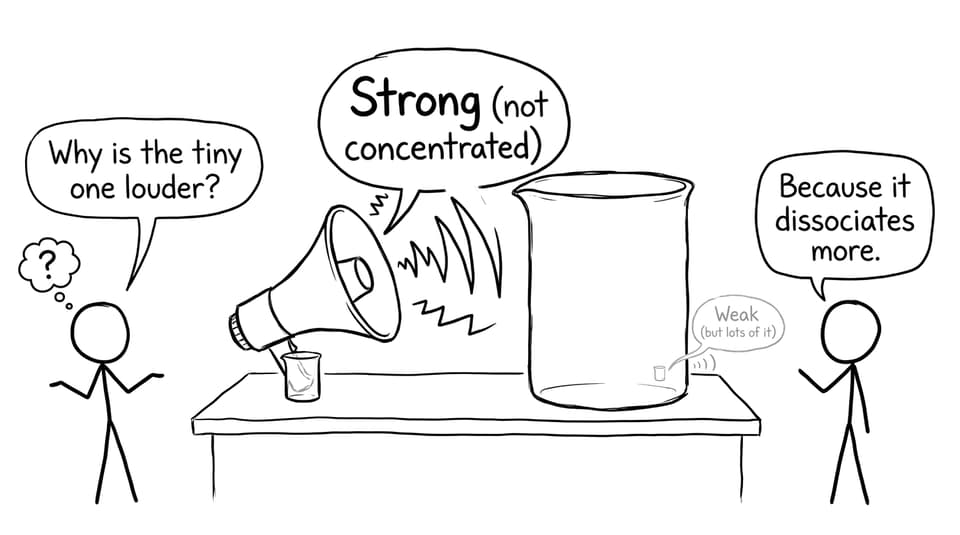
A classic IB Chemistry mistake is treating “weak” as if it means “dilute.” They are not the same.
-
Strength describes the degree of ionization (measured by Ka or Kb).
-
Concentration is how much acid/base you added (mol dm⁻³).
A dilute strong acid can still create more H⁺ than a concentrated weak acid, because strength is about how completely it dissociates.
If you want the clearest syllabus phrasing, these notes hit the misconception directly: Strong and weak acids and bases.
The Ka and Kb relationship in IB Chemistry: Ka × Kb = Kw
For a conjugate acid-base pair in IB Chemistry:
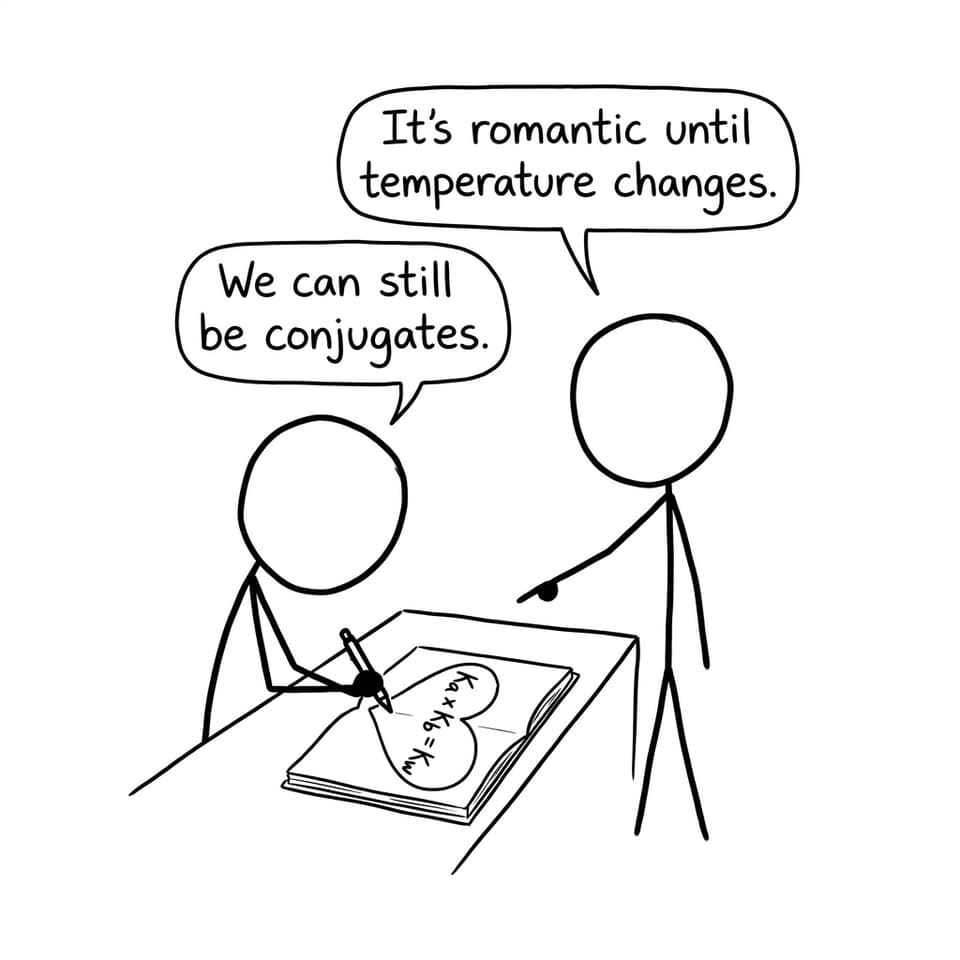
Ka × Kb = Kw
At 25°C, Kw = 1.00 × 10⁻¹⁴.
This one relationship is powerful because it turns “I don’t know Kb” into “I can find it instantly.” It also explains why strength is reciprocal:
-
A strong acid has a very weak conjugate base.
-
A strong base has a very weak conjugate acid.
To review Kw itself (and how it anchors pH and pOH), use The ion product of water (Kw) Notes.
Using Ka and Kb for pH in IB Chemistry (the quick way)
In many IB Chemistry exam questions, you are expected to set up equilibrium properly, but you are also rewarded for efficient approximations when they are valid.
For a weak acid HA with initial concentration , if dissociation is small:
[H⁺] ≈ √(Ka × )
For a weak base B:
[OH⁻] ≈ √(Kb × )
Then:
-
pH = −log[H⁺]
-
pOH = −log[OH⁻]
-
pH + pOH = 14 (at 25°C)
If you need support with equilibrium expressions in general (the “write K correctly” skill), this is the cleanest reference: The equilibrium law and constant.
pKa and buffers: where IB Chemistry starts to feel connected
pKa is just a friendlier way to write Ka:
pKa = −log(Ka)
Lower pKa means stronger acid. This becomes especially useful in buffer questions, where IB Chemistry expects you to connect equilibrium to pH stability.
For HL, the Henderson-Hasselbalch equation:
pH = pKa + log([A⁻]/)
Buffers are one of the most “story-like” topics in IB Chemistry: a solution quietly resists change because the equilibrium system pushes back. If that idea is still fuzzy, read Buffers Explained for IB Chemistry and then reinforce it with The pH of a buffer solution (HL).
Closing: make Ka and Kb feel automatic in IB Chemistry
Ka and Kb in IB Chemistry are not just definitions; they are your shortcut to understanding acid-base strength, conjugate pairs, buffers, and pH calculations with confidence. Once you treat them as “how far does equilibrium go?” the topic stops being a set of disconnected formulas.
To lock this in for exam day, use RevisionDojo as your daily system: practise acid-base set-ups in the Questionbank, drill definitions with Flashcards, clarify steps with AI Chat, and validate your working with Grading tools. When you are ready to stress-test your understanding, use Predicted Papers and Mock Exams, and for HL depth (buffers, pH curves, equilibrium), lean on the Study Notes and Tutors. In IB Chemistry, consistency beats cramming, and Ka and Kb reward the students who practise them a little at a time.