


When your pH calculation is going fine, it feels like calm. Then one extra line in the question appears: “small amount of acid is added.” In IB Chemistry, that sentence is the equivalent of someone nudging a perfectly stacked tower of beakers.
Buffers are the reason the tower usually doesn’t fall.
They show up everywhere in IB Chemistry: acids and bases, equilibrium, titration curves, data-based questions, IA-style setups, and those longer explanations where the examiner wants mechanism, not vibes. If you can explain buffers clearly, you’re not just learning a topic; you’re learning how the course thinks.
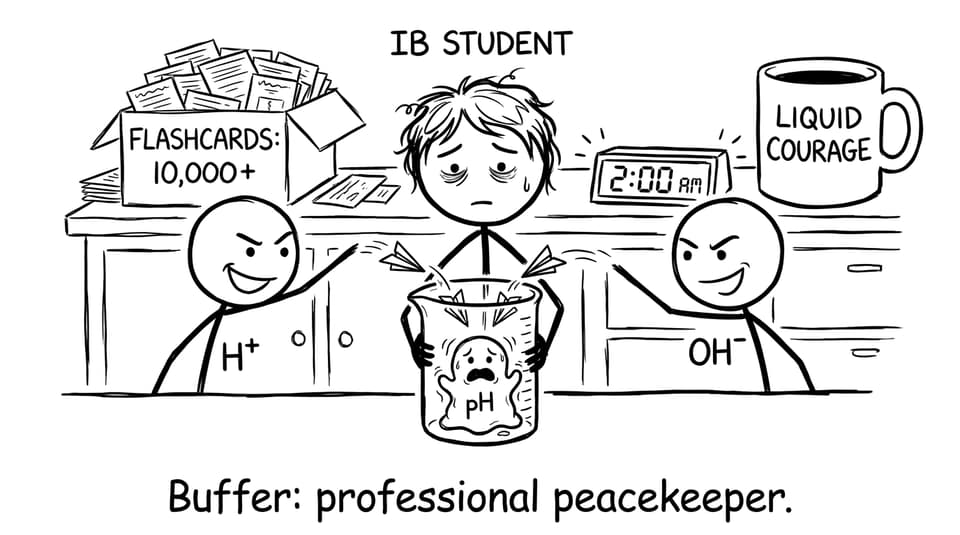
Quick buffer checklist (exam-ready)
Use this as your 30-second reset before practice:
-
A buffer resists changes in pH when small amounts of acid/base are added.
-
It contains a weak acid + conjugate base OR a weak base + conjugate acid.
-
It works because equilibrium shifts remove added H⁺ or OH⁻.
-
A buffer has limited capacity (it can be overwhelmed).
-
Buffers are most effective when pH is close to pKa.
For quick definition language that matches exam phrasing, keep the IB Chemistry Key Definitions nearby while revising IB Chemistry.
What is a buffer in IB Chemistry?
A buffer is a solution that minimizes pH change (not eliminates it) when small quantities of acid or base are added.
In IB Chemistry, the “secret” is that buffers are built from substances that don’t fully react in one direction. They sit in a dynamic balance, ready to absorb disruption. Most commonly:
-
Weak acid buffer: weak acid (HA) + its conjugate base (A⁻), often from a salt
-
Weak base buffer: weak base (B) + its conjugate acid (BH⁺), often from a salt
If the difference between strong/weak still feels fuzzy, review Strong vs Weak Bases Explained to avoid the classic “strength vs concentration” trap that costs marks in IB Chemistry.
How buffers work (the equilibrium story)
A buffer works because it contains a pair that can react with either added acid or added base.
Take a weak acid buffer:
If you add acid (H⁺)
The conjugate base removes most of the added H⁺:
So the pH falls only slightly.
If you add base (OH⁻)
The weak acid neutralizes most of the added OH⁻:
So the pH rises only slightly.
This is pure equilibrium thinking, so it pairs perfectly with Dynamic Equilibrium Explained for IB Chemistry. The best IB Chemistry answers often connect buffer behavior to Le Chatelier-style shifts in concentration.
Buffer capacity (why buffers “fail”)
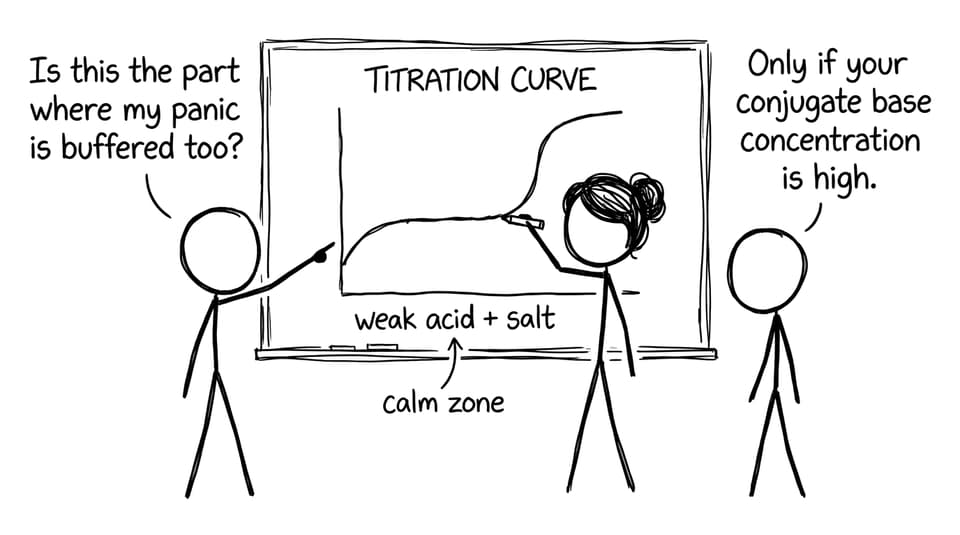
Every buffer has a breaking point. In IB Chemistry, that’s called buffer capacity: how much acid/base you can add before pH starts changing sharply.
Capacity depends on:
-
Total amount of HA and A⁻ present (more particles, more neutralizing ability)
-
Ratio (/) (controls pH and effectiveness)
-
Strength of the weak acid/base (linked to Ka, Kb, and pKa)
A nice way to remember it: pH is about the ratio, capacity is about the quantity.
To practice exam-style questions that test this idea directly, use the Buffer solutions Questionbank (R3.1.16) and then lock the language with the matching Buffer solutions Flashcards. That combo is underrated for IB Chemistry.
pKa and the “best buffer” idea
In IB Chemistry, buffers work best when they can respond to both added acid and added base. That happens most cleanly when:
-
( \approx )
-
therefore (\mathrm{pH} \approx \mathrm{p}K_a)
At that point, the buffer has maximum flexibility. It’s not “running out” of one partner in the pair.
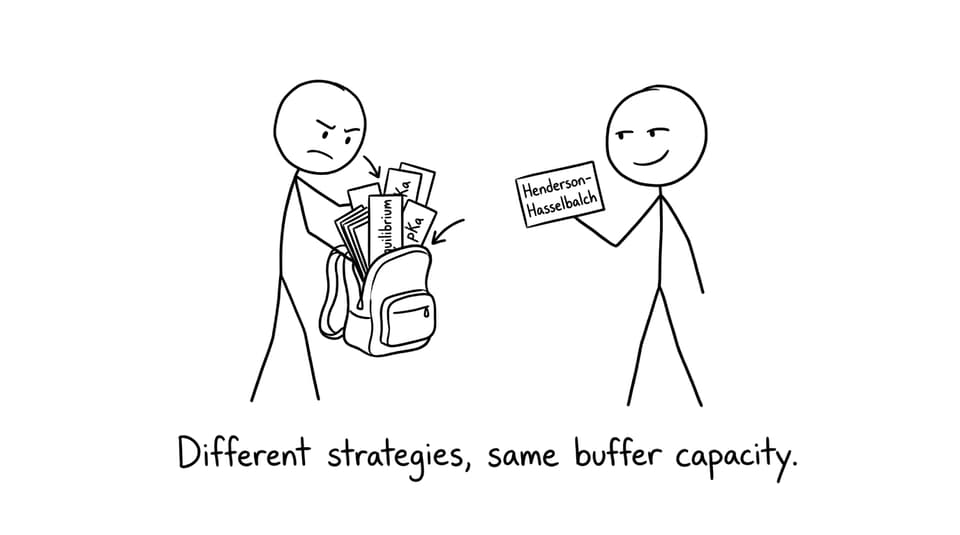
HL questions may also reference the Henderson-Hasselbalch equation. If you’re revising that, read pKa Explained for IB Chemistry and the syllabus-aligned note The pH of a buffer solution (R3.1.17).
Where buffers appear in IB Chemistry exam questions
Buffers rarely announce themselves with a big label. Instead, they sneak in through familiar formats:
-
Titration curves (the flatter region before/around equivalence)
-
Data-based questions on biological pH stability (blood, enzymes)
-
Short calculations about small additions of acid/base
-
Extended responses asking you to “explain why pH changes only slightly”
A strong revision loop is: learn concept, do targeted questions, get feedback, correct explanation style. RevisionDojo makes this faster using Questionbank + Study Notes + Flashcards, and you can pressure-test your understanding by asking the AI Chat to mark your explanation for command-term precision.
If you want broader practice across the whole unit, the Acids and Bases Questionbank is a clean place to build stamina for IB Chemistry.
Closing: Make buffers a scoring topic, not a stressful one
Buffers in IB Chemistry are less about memorizing and more about telling a consistent story: a weak acid/base equilibrium sits ready to react, shifting to remove added H⁺ or OH⁻ until capacity runs out. Once you can explain that calmly, titration curves, pKa logic, and application questions start to feel connected.
To turn that understanding into marks, use RevisionDojo’s Study Notes, Questionbank, Flashcards, AI Chat, and Grading tools, then finish with Mock Exams and Predicted Papers when you want timed pressure. If you’re stuck on how to phrase the explanation, ask a RevisionDojo Tutor to review your buffer paragraph like an examiner would; it’s one of the fastest ways to level up in IB Chemistry.