


A classic story never really stays still.
It gets retold in a new accent. It gets dressed for a different decade. Sometimes it gets gently honored. Other times it gets playfully dismantled in public.
That quiet tug-of-war with the past is one of the most useful things to notice in IB English. Because exams rarely reward you for simply recognizing a reference. They reward you for explaining why an author borrowed a voice, a plot shape, or a familiar character and what changes when the “old” becomes “new.”
This article breaks down parody and pastiche as modern reimaginings of classics, with practical moves you can use for IB English Paper 1, Paper 2, the IO, and the HL Essay.
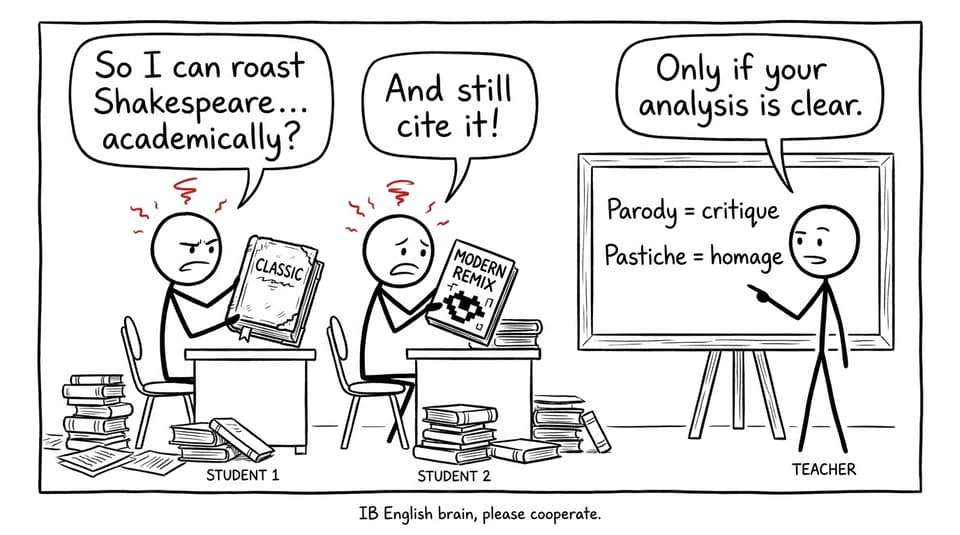
A quick checklist for IB English analysis
When you suspect parody or pastiche, run this fast check (it saves you from vague paragraphs):
-
Identify the source being echoed (a specific text, genre, or “classic” style).
-
Decide the attitude: is it critique (parody) or admiration (pastiche)?
-
Track the borrowed features: diction, syntax, narrative voice, archetypes, plot beats.
-
Explain the purpose: cultural commentary, social critique, homage, or reinvention.
-
Tie it to reader effect: what does recognition make us feel or realize?
For technique practice, pair this with RevisionDojo’s Notes for English Paper 1 so your observations become examiner-ready analysis.
Parody in IB English: imitation with a raised eyebrow
Parody copies a style or text while quietly (or loudly) exposing something about it. In IB English, that “something” is usually one of these:
-
a convention that no longer fits modern values
-
a bias hidden inside a supposedly “universal” classic
-
a genre habit (melodrama, heroic narration, perfect endings) that collapses under exaggeration
Parody often uses humor, but the point is rarely “just comedy.” The point is a shift in power: the new text puts the old one on a stage and rearranges what we’re allowed to admire.
What to write in an IB English paragraph about parody
A strong IB English paragraph on parody usually follows this shape:
-
Technique: What is being imitated (voice, structure, genre expectations)?
-
Twist: Where does exaggeration or irony appear?
-
Message: What convention or assumption gets questioned?
-
Effect: What does the reader newly see about the original tradition?
If you want targeted practice, the RevisionDojo topic page on Parodies and Satire is a clean way to revise definitions, features, and typical exam angles.
Pastiche in IB English: imitation as tribute (with intent)
Pastiche also imitates, but it doesn’t arrive with the same bite. It’s closer to literary admiration: a writer steps into an older style to celebrate it, preserve it, or see what happens when it is used for a new story.
In IB English, pastiche is valuable because it proves something subtle: tradition isn’t only a museum. It’s a toolkit. A modern text can borrow an older form to:
-
create a feeling of continuity (as if the past still breathes)
-
revive a neglected genre or voice
-
blend multiple styles to signal complexity or hybridity
-
make a modern theme feel “mythic” or timeless
What to write in an IB English paragraph about pastiche
Instead of asking “what is being mocked?” ask:
-
What is being preserved? (rhythm, diction, structure, archetypes)
-
What is being renewed? (new contexts, new politics, new identities)
-
Why this style now? (nostalgia, legitimacy, contrast, cultural memory)
To build speed, use the Parodies and Satire Flashcards and turn each definition into a micro-example you could drop into a Paper 1 or IO.
Intertextuality: the engine behind parody and pastiche
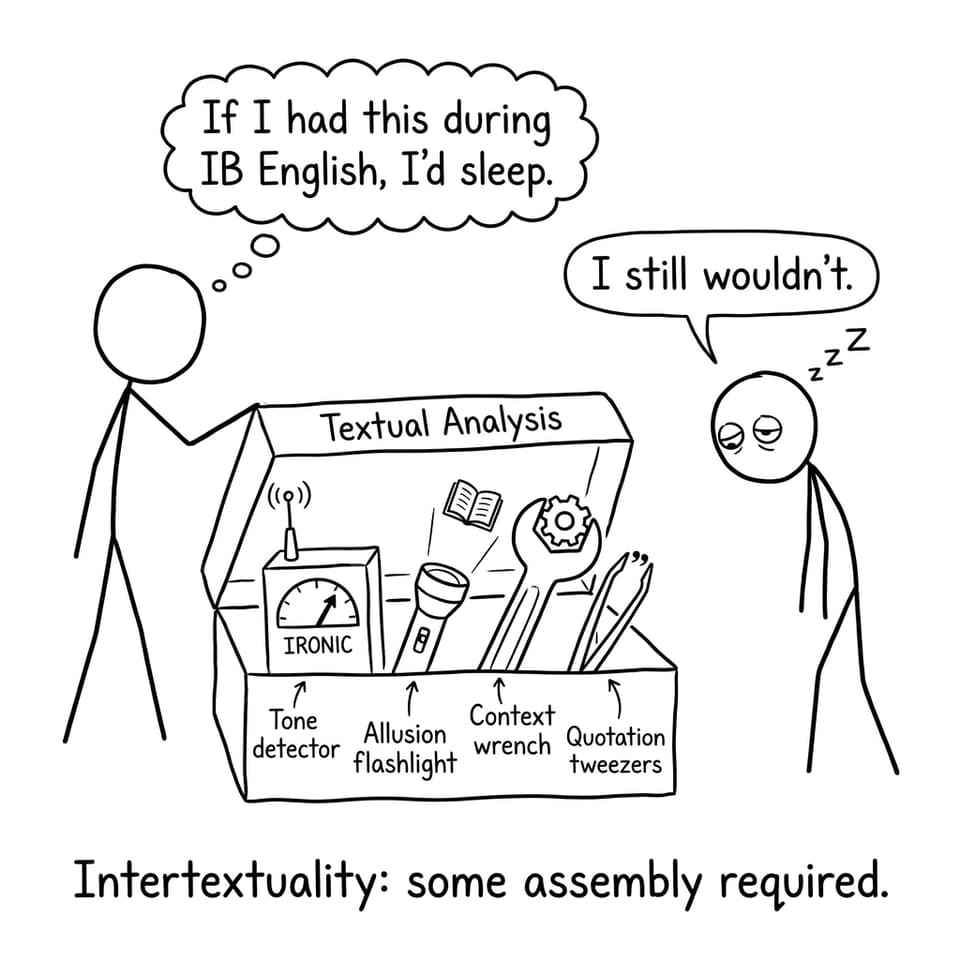
Both parody and pastiche rely on intertextuality: meaning created through relationship.
A modern reimagining of a classic often works like a split-screen. You read the new text, but the old one flickers underneath. That “double vision” is where exam-worthy analysis lives.
In IB English, try phrasing intertextuality as a choice with consequences:
-
Why does the author want you to remember the older text?
-
What emotions come from recognition (comfort, suspicion, embarrassment, grief, joy)?
-
What changes when the same plot is told from a different perspective?
If your analysis is getting stuck at “this references X,” switch to: “This reference positions the reader to…” It forces purpose and effect.
For broader course alignment and practice routines, keep a tab open to English A Lang & Lit - RevisionDojo or, if you take Literature, IB English A Lit Resources.
How this shows up in exams (without naming specific texts)
Parody and pastiche can appear in many forms you might meet in IB English:
-
a modern essay that mimics an “authoritative” classical voice to expose its blind spots
-
an advertisement that borrows epic language to sell something trivial (parody by contrast)
-
a short story that adopts a Victorian narrative tone as homage, but uses it to tell a contemporary identity conflict (pastiche with modern purpose)
To train for this, use RevisionDojo’s Questionbank for timed practice. Then check your responses with Grading tools and AI Chat to see whether your paragraph explains purpose, not just technique.
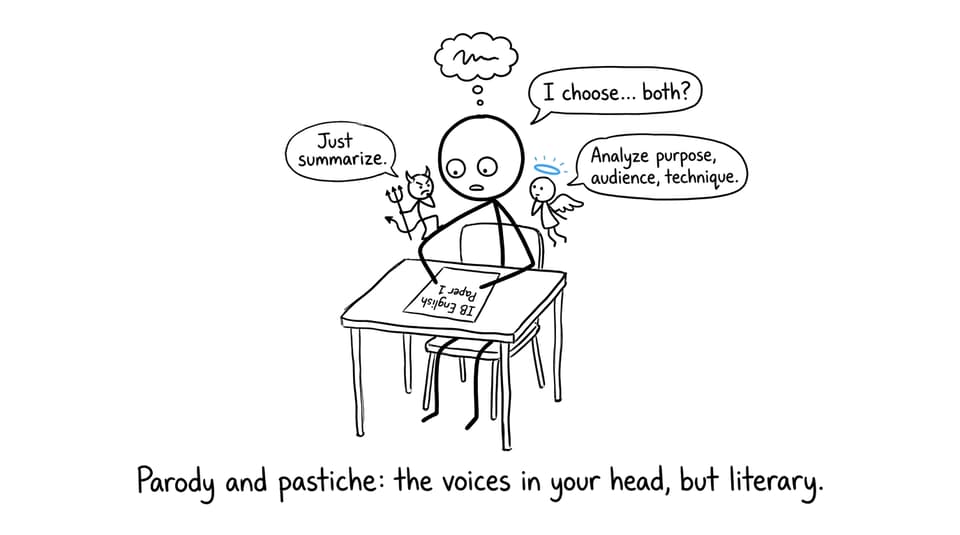
A mini workflow you can copy this week
Here’s a calm, repeatable routine for IB English when you revise parody and pastiche:
-
Pick one modern text extract (or a short passage) and identify 3 “borrowed” features.
-
Label the attitude: parody, pastiche, or a blend.
-
Write one thesis sentence linking imitation to cultural purpose.
-
Build one paragraph using: technique -> evidence -> effect -> authorial intention.
-
Get feedback fast: RevisionDojo’s Mock Exams, Predicted Papers, and Grading tools make it easier to practice under pressure and still learn from it.
If Paper 2 structure is your weak spot, anchor your planning with IB English A Lang & Lit English Paper 2 Questionbank so you can practice comparisons that actually match what examiners reward.
Closing: let the “remix” do the work for you
Parody and pastiche are not just clever literary tricks. They are ways modern writers keep classics alive: sometimes by honoring them, sometimes by challenging them, often by doing both at once.
When you revise IB English, treat every reimagining like a conversation across time. Ask what the new text borrows, what it changes, and what it wants you to notice about the world you live in now.
If you want this to feel less abstract, build a routine with RevisionDojo: practice with the Questionbank, tighten definitions with Flashcards, draft with Study Notes, pressure-test with Mock Exams and Predicted Papers, then refine using AI Chat and the Grading tools. That’s how IB English analysis turns from “I kind of get it” into “I can prove it in 40 minutes.”


