
If you're reading this with a tight chest and a phone that suddenly feels heavier than it should, you're not alone.
Most IB students imagine results day as a single moment: a number appears, and life either opens or closes. But real life rarely behaves like that. It's messier. A score can disappoint you and still lead somewhere good. A score can land exactly where you wanted and still feel strangely flat. The truth is: your IB result is information, not identity.
The next 48 hours matter, not because you must "fix everything," but because small, calm decisions create options. Options are oxygen.
The calm checklist (do this before you do anything dramatic)
Here's a quick, practical checklist for any IB student who didn't get the score they wanted:
- Confirm you're reading your IB results correctly: total points, subject grades, and core points.
- Take a screenshot and write the numbers down somewhere offline.
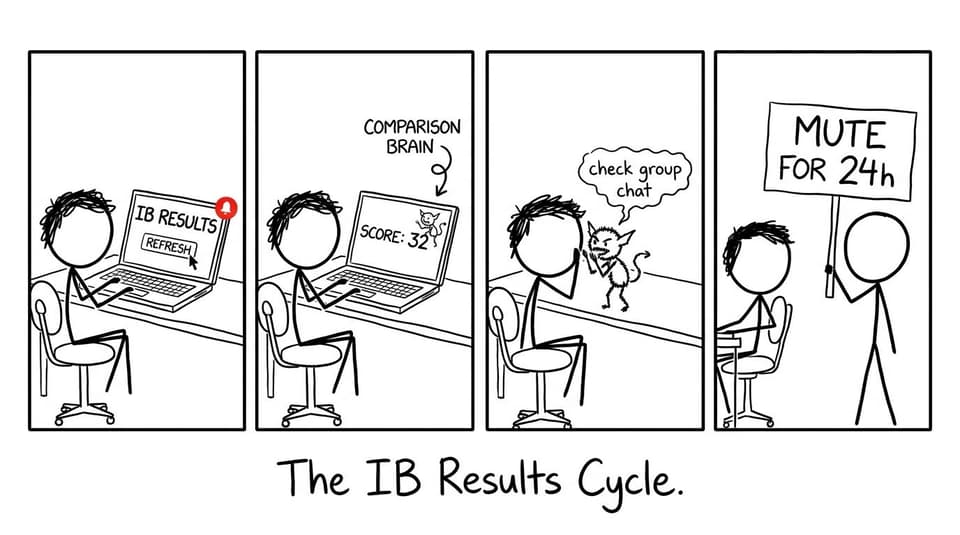
- Mute group chats for 24 hours.
- Contact your IB coordinator and request component marks and boundary proximity.
- If university offers are involved, draft a short email today.
- Decide between: enquiry upon results (EUR), retake, or alternate pathway.
- Build a two-week plan that turns emotion into action.
If you need a results-day-specific walkthrough, keep this open in another tab: What Should I Do on the IB Results Day? (Survival Guide).
Step one: make your IB result legible (numbers first, story later)
The fastest way to spiral is to turn a score into a personality trait.
Instead, treat your IB result like a lab report. No moral language. No "I'm a failure." Just data:
- Total points (including core)
- Each subject grade
- TOK and EE results (and the core points)
- Diploma status (met requirements or not)
Then ask a better question than "What's wrong with me?" Ask: Where did I lose marks, specifically?
RevisionDojo is built for that style of thinking. The platform nudges you away from vague motivation and toward measurable feedback: Questionbank practice, Study Notes that match syllabus points, Flashcards for daily recall, and AI Chat (Jojo) for fast explanations when confusion hits.
If you want the more detailed "worst-case scenario" guide, this one is steady and practical: IB Results Day: What If Everything Goes Wrong?.
Step two: decide if an enquiry upon results (EUR) makes sense
An IB remark (EUR) can help, but it's not a lottery ticket. It's a decision.
Ask your coordinator for component marks and how close you are to the next grade boundary in each subject. You're looking for "small movement, big impact." For example:
- You're 1-2 marks away from a higher grade in a subject that changes your university condition.
- The subject has written components where marking can be more subjective.
- You have a clear reason to believe something was under-rewarded (not just "I thought I did better").
If you're far from the boundary, an EUR is usually expensive hope. Your energy may be better spent on a retake plan or a university conversation.
For results-day timing expectations and logistics, this is useful context: IB Results Day 2025: Exact Date, Key Timings, and What to Expect.
Step three: if university is involved, send the email earlier than you want to
Most students wait because they're embarrassed. Universities interpret silence as disorganization, not humility.
A good "I missed my offer" email is short and adult:
- Your name and applicant ID
- Your IB score and the condition you missed (one line)
- Your next step (EUR request, retake registration, or updated documentation)
- A polite question: what options are available?
If you don't know what to say, draft it, then show it to your coordinator. The point is to create a bridge, not to justify your life.
Step four: if you retake, don't rebuild your entire life, rebuild your loop
Retaking IB exams can feel like you're walking back into a room where you already got hurt. The emotional instinct is to "work harder." That's usually not the problem.
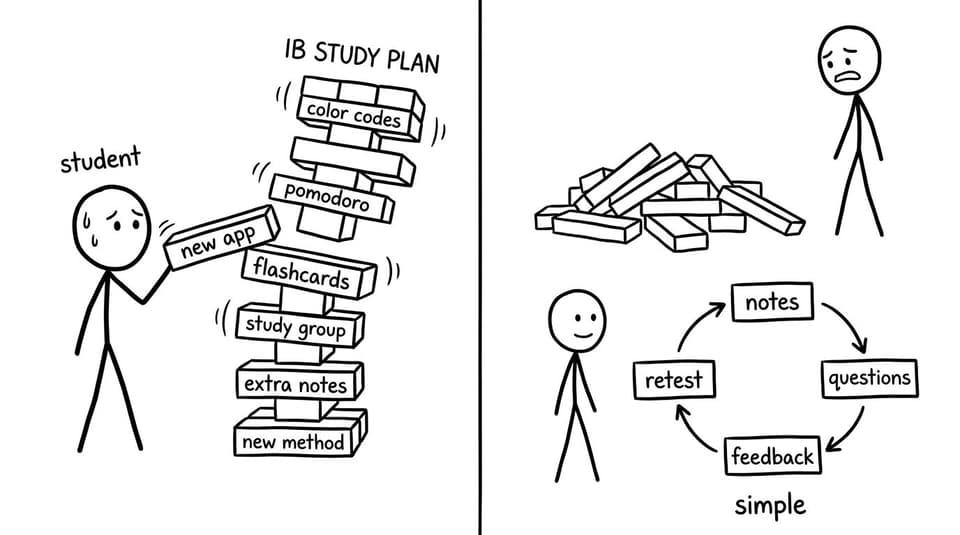
Most retakes fail because the student repeats the same approach with more hours.
What you want is a better loop:
- Learn the smallest slice of content needed
- Practice exam-style questions on that slice
- Get feedback that matches marking logic
- Retest the same weakness 48 hours later
That's exactly what RevisionDojo's tool stack is designed to support.
- Study Notes help you rebuild understanding without rewriting a whole textbook.
- Flashcards keep daily recall alive so your memory doesn't reset.
- The Questionbank turns "revision" into marks, quickly.
- AI Chat (Jojo) helps you fix misconceptions in minutes, not hours.
- Mock Exams and Predicted Papers make timing feel normal again.
- Grading tools and the Coursework Library reduce the background stress from IA/EE/TOK work that often spills into exam prep.
- Tutors add a human diagnosis when you've plateaued.
If you want a structured, step-by-step method to rebuild, use: How to Study for IB Exams: Step-by-Step Guide.
A two-week IB comeback plan (small enough to actually follow)
Two weeks won't magically transform everything, but it will produce something more important: evidence. Evidence that you can improve.
Week 1: diagnosis and rebuild
- Day 1: Choose one subject to rescue first. Do a short Questionbank set, then list your top 5 error patterns.
- Day 2-3: Use Study Notes to patch the biggest concept gap. Then reattempt similar Questionbank questions.
- Day 4: Convert mistakes into Flashcards (definitions, steps, common traps).
- Day 5: Ask AI Chat to explain your most common wrong-answer pattern, then do a mini retest.
- Day 6-7: One timed section (not full length yet). Review like an examiner: content vs technique vs time.
Week 2: pressure and repeatability
- Run two timed sessions (section or full paper depending on your stamina).
- After each timed attempt, write an "error rule" list: 5 bullets max.
- Drill those rules using targeted Questionbank practice.
If you feel behind rather than "bad," this guide matches the mindset: How to Study for IB Exams When You Feel Behind.
How to stop the emotional noise (without pretending it doesn't exist)
A disappointing IB score hits more than academics. It hits identity. And identity makes people do strange things: doomscrolling, comparing totals, rewriting their entire personality in a night.
You don't need toxic positivity. You need boundaries.
- Mute group chats for 24 hours.
- Don't negotiate your future at 2 a.m.
- Choose one person who can hear the full story.
- Go for a walk without your phone (yes, really).
The goal isn't to "feel fine." The goal is to keep your nervous system stable enough to make good decisions.
Practice like you're training for a specific paper (not "the whole IB")
A common IB mistake is revising at the subject level: "I'm revising Biology." That's too big to be actionable.
Train for the next paper you'll sit:
- Which paper is it?
- Which question types keep costing you marks?
- Which three topics are highest-yield for that paper?
Then build sessions around that. This guide helps you do it even when time is tight: IB: How to Study in the Last 24 Hours (No Panic).
Use the IB tools that remove friction (so consistency becomes possible)
On paper, most study advice sounds easy. In reality, the hard part is repeating it when you're tired.
That's why "one platform" matters. The less you context-switch, the more you practice.
If you're rebuilding after a rough IB result, these pages are worth bookmarking:
- Questionbank for exam-style practice with feedback.
- Study Notes to rebuild understanding quickly.
- Flashcards for daily recall and spaced repetition.
- RevisionDojo App: The Smarter Way to Prep for IB Exams for the full workflow.
The point is not to "use more resources." It's to create one repeatable routine.
Closing: your next IB chapter is built in small moves
A disappointing IB score can feel like the end of a story you worked hard to write. But it's usually just a plot twist you didn't expect.
Your job now is not to become "more motivated." It's to become more precise. Get the facts. Choose the best lever (EUR, retake, university conversation, or alternate route). Then build a routine you can repeat without heroic willpower.
If you want one place to run that routine, make RevisionDojo your control panel for IB: start with Study Notes for clarity, keep daily recall alive with Flashcards, turn effort into marks with the Questionbank, get unstuck fast using AI Chat, train realism with Mock Exams and Predicted Papers, and use Grading tools, the Coursework Library, and Tutors when you need sharper feedback.
Your IB result is a data point. What you do next is the story.

