


Introduction
The night before an exam, your brain becomes a strange museum. It displays the quadratic formula proudly, then hides the sine rule behind a locked door, then pretends it has never heard of conditional probability.
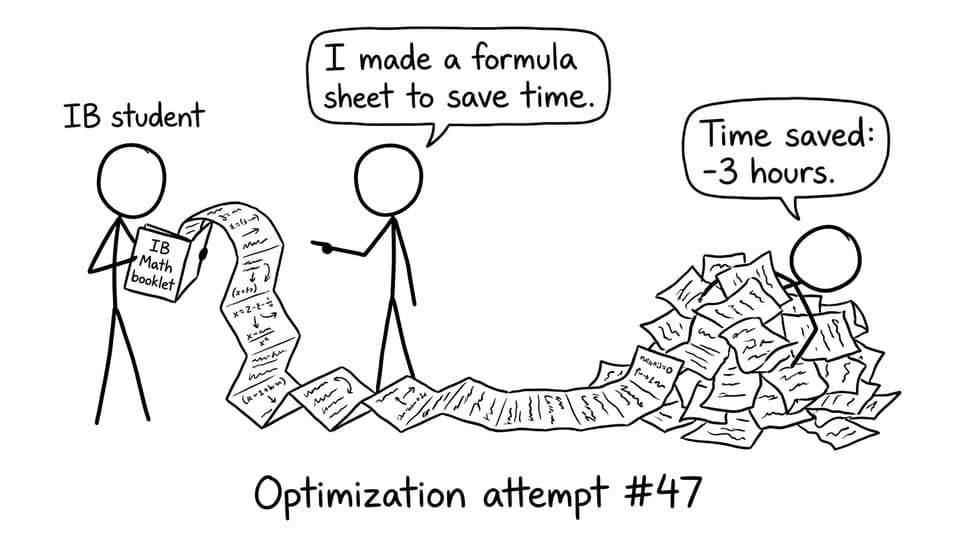
That is why an IB Math formula sheet is less about collecting equations and more about building calm. Yes, you will receive the official booklet in the exam. But making your own sheet forces you to notice the formulas you actually use, the ones you forget under pressure, and the ones you keep looking up when time is running.
If you want a fast starting point, pair your sheet with RevisionDojo’s official-style booklets for AA and AI, then customize from there: IB Mathematics Analysis and Approaches Data Booklet and IB Mathematics Applications & Interpretation Data Booklet.
Quick checklist: build your IB Math formula sheet in 20 minutes
-
Choose your track first: AA or AI, SL or HL.
-
Split one page into 5 sections: Algebra/Functions, Trig/Geometry, Calculus, Probability/Stats, Vectors (HL).
-
Add only formulas you have used in real questions this month.
-
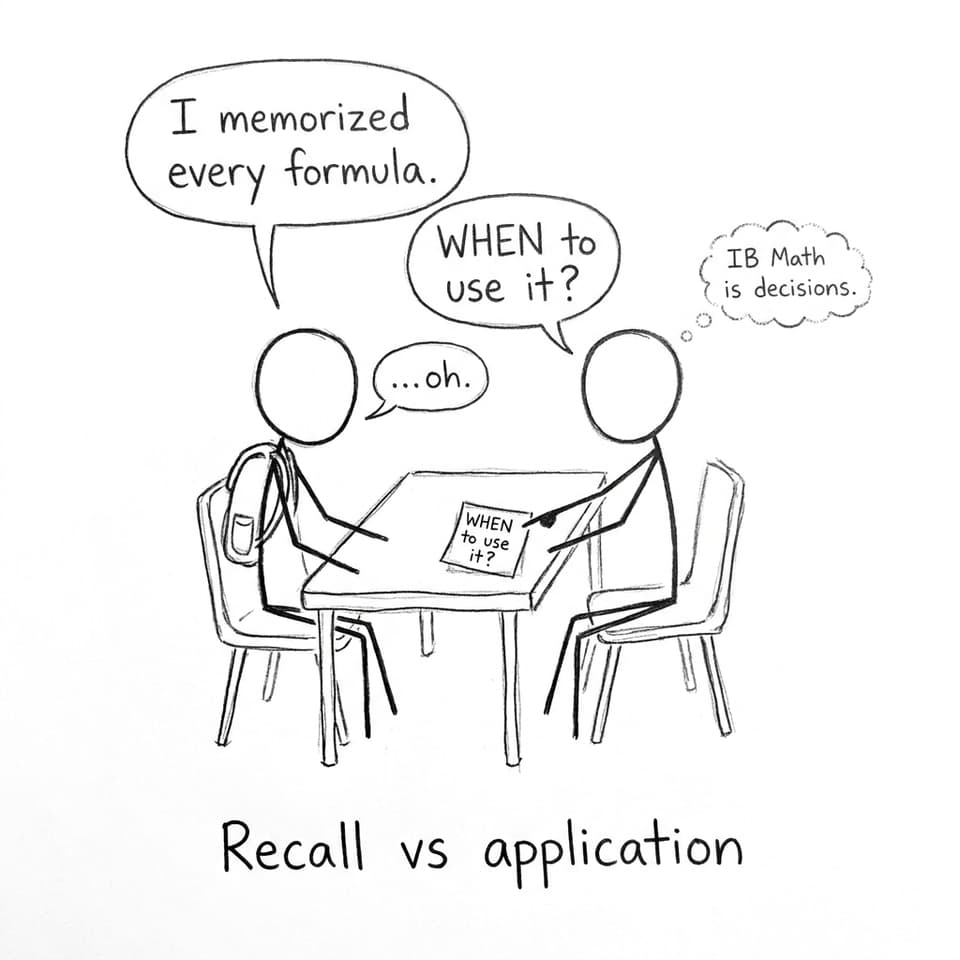
Under each formula, write one “trigger phrase” (when to use it).
-
Train with it using timed practice and markscheme-style feedback.
For practice that matches the sheet, use the Questionbank feature and pull topic sets that force repeated application.
Why an IB Math formula sheet still matters (even with the booklet)
The official booklet is permission to stop memorizing everything. But IB Math exams reward speed of judgment: knowing which formula applies, and how to deploy it without hesitation.
A personal formula sheet helps because it turns passive familiarity into active recall. When you write “P(A ∪ B) …” from memory, you expose gaps. When you add a tiny note like “only if events overlap,” you reduce silly errors. And when you keep trimming the sheet over weeks, you’re practicing the real skill: choosing the simplest tool that works.
If you want a full strategy for doing this without overwhelm, the mindset is captured well here: How to Revise IB Math Formulas Without Overwhelming Yourself.
What to include on your IB Math formula sheet (HL and SL)
Keep it simple: your sheet is a revision tool, not a textbook.
Algebra and functions (HL and SL)
-
Quadratic formula and discriminant reminders.
-
Binomial expansion patterns you keep using.
-
Sequence and series formulas you can apply quickly.
To anchor these, study the topic layout in the IB Mathematics Analysis and Approaches Resources hub and link each formula to a specific subtopic you’ve practiced.
Trigonometry and geometry (HL and SL)
-
Sine rule, cosine rule, and area of triangle forms.
-
Core identities like (\sin^2\theta + \cos^2\theta = 1).
If trig is a frequent time sink, revise the “why” and the common identity moves using: IB Math: Cosine Rule & Trigonometric Identities.
Calculus (HL and SL)
-
Derivatives of sin/cos and basic integration pairs.
-
Any methods you personally forget (substitution triggers, product rule setups).
Then drill with targeted sets so you learn the decision-making, not just the symbols: AA Calculus Questionbank.
Probability and statistics (HL and SL)
-
Addition rule, conditional probability structure, and binomial form.
-
For AI students especially, keep distribution parameters and interpretation cues.
AI students can practice these skills directly here: AI Statistics and Probability Questionbank.
Vectors (HL emphasis)
HL students should include vector magnitude, dot product meaning, and angle relations. If vectors are a known weak spot, build a “micro-sheet” just for that unit and retest weekly.
How to use your IB Math formula sheet so it actually improves marks
An IB Math formula sheet works when it becomes part of a loop:
-
Active recall first: cover the right side and rewrite formulas from memory.
-
Immediate application: do 5-10 questions that force those formulas.
-
Feedback that teaches: use RevisionDojo’s AI Chat when you get stuck, and Grading tools to see where method marks are leaking.
-
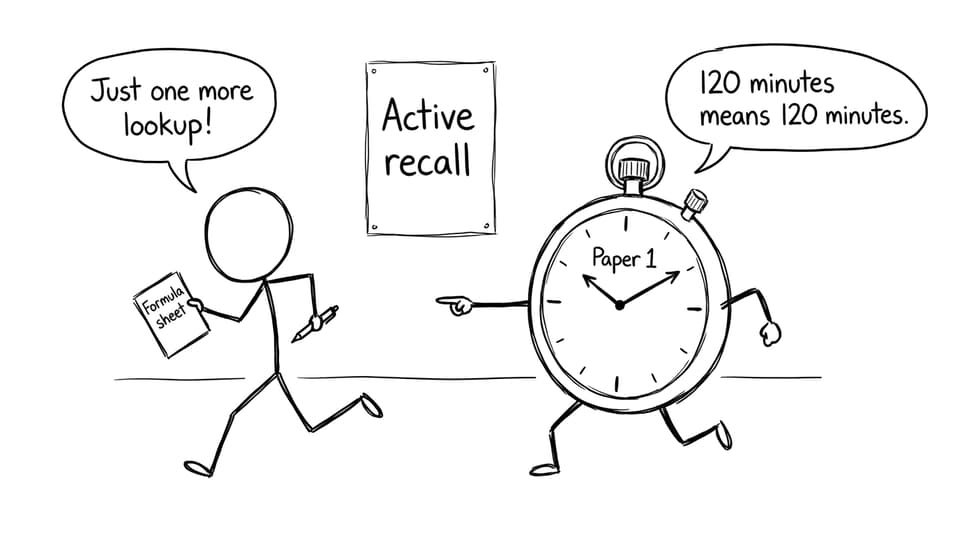
Timed rehearsal: use Mock Exams to practice lookup speed and composure.
If you want a clean plan for the final stretch, combine sheet practice with exam simulation and reflection: How to Revise IB Math AA and AI Effectively.
Common mistakes students make with an IB Math formula sheet
-
Overstuffing: more formulas usually means slower decisions.
-
Copying without testing: neat handwriting is not understanding.
-
No triggers: if you do not write “when to use it,” you will freeze anyway.
-
Never timing it: speed is a skill, and IB Math is timed performance.
A good fix is to build your sheet alongside RevisionDojo’s Flashcards (one card per formula + one card per trigger) and then test with the Questionbank right after.
Conclusion: make IB Math feel predictable
A strong IB Math formula sheet is a small promise to your future self: “When panic shows up, I will still have a system.” Build it, test it, trim it, and let practice questions pressure-test it.
When you are ready to turn the sheet into scores, RevisionDojo gives you the full toolkit: Study Notes to learn fast, Flashcards for recall, Questionbank for targeted drilling, AI Chat for stuck moments, Grading tools for precision, plus Predicted Papers and Mock Exams to rehearse the real experience. Start with the official-style booklet, then personalize until your IB Math revision feels calm and repeatable.