


Literary movements look tidy on a classroom poster. In the exam, they feel messier: a poem that is “mostly Romantic” but oddly self-aware, a novel that looks Realist until it suddenly fractures into Modernist interiority. In IB English, that mess is not a problem to fix. It’s the point to interpret.
The best students don’t use movements as labels. They use them as explanations for why writers choose certain techniques, and why readers react the way they do. If you can connect Romantic emotion or Postmodern irony to specific lines, you write commentary that feels inevitable, not generic.
Why literary movements matter in IB English
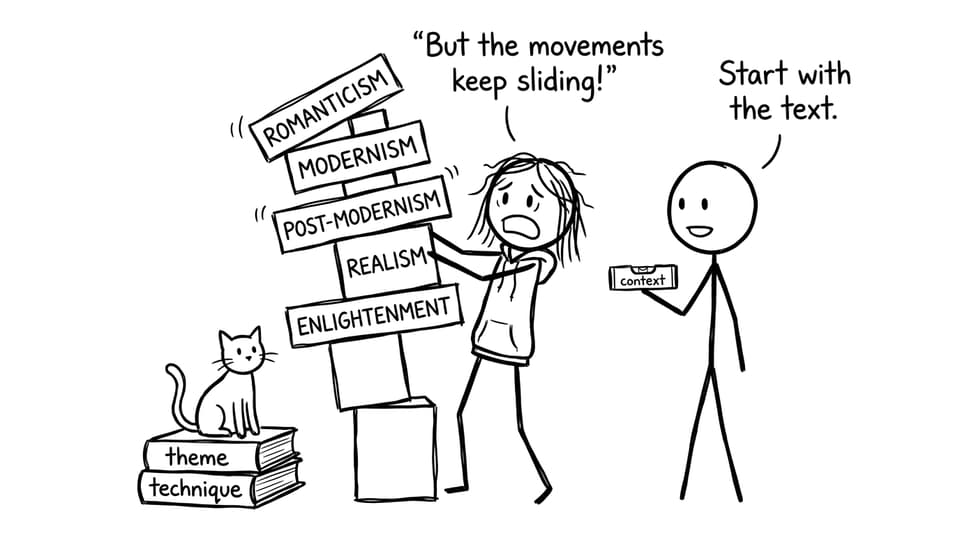
Literary movements are basically shared habits of mind. Writers inherit them, resist them, remix them. When you name those patterns in IB English, you gain three exam advantages:
-
Context with control: you can frame authorial choices without drifting into history essays.
-
Sharper comparison: movements give you a ready-made contrast engine for Paper 2.
-
Faster analysis: recognizing “Modernist fragmentation” or “Realist social critique” helps you prioritize what to write about.
If you want the movement knowledge to translate into marks, pair it with technique-first analysis. RevisionDojo’s guide on Mastering Literary Devices in IB English Exams is a strong companion for turning movement awareness into device, effect, and purpose paragraphs.
A quick checklist (movement knowledge that actually scores)
Use this as a pre-writing scan for IB English Paper 1, Paper 2, or your IO:
-
Identify the dominant movement vibe (even if the text blends styles).
-
List 3 movement signals you can prove with quotations (not just “it feels like”).
-
Decide whether the writer follows the movement or pushes against it.
-
Translate context into analysis with: technique -> effect -> meaning -> wider implication.
-
Keep context brief, then return to the words on the page.
For an exam-focused close reading routine, use Close Reading Techniques for Prose and Poetry.
Romanticism in IB English: emotion with a horizon line
Romanticism arrives as a reaction: against cold rationalism, against industrial grayness, against the idea that humans are best understood like machines. Romantic writing often privileges the felt over the measured.
Romanticism signals to write about in IB English
-
Nature as sublime (beauty plus fear, awe, spiritual intensity)
-
Emotional extremity (rapture, grief, longing, ecstatic imagination)
-
Individual experience as authority (the inner life matters)
-
The mysterious or supernatural as a pressure on reality
-
Rebellion against convention or social constraint
In IB English, Romanticism gives you an easy path to high-quality analysis: track imagery patterns (light/dark, storms, seasons), then connect them to a speaker’s psychology or moral vision.
Realism and Naturalism in IB English: the world without soft focus
Realism pushes back on Romantic idealism. It asks for the ordinary, the social, the detailed. Naturalism goes one step further, stressing how environment, class, and circumstance can trap people inside systems they didn’t choose.
Realism/Naturalism signals to write about in IB English
-
Everyday settings rendered with concrete detail
-
Social critique (inequality, institutions, hypocrisy)
-
Psychological complexity grounded in plausible motives
-
Determinism (especially in Naturalism): pressures of poverty, heredity, environment
In Paper 2, Realism and Naturalism help you argue that character is not only personal, but structural. If you need a Paper 2 roadmap, RevisionDojo’s IB English Paper 2: Essential Guide for Success is a reliable structure check.
Modernism in IB English: when form starts telling the truth
Modernism shows up when old narrative confidence collapses. After rapid industrial change and global conflict, neat plots can feel dishonest. Modernist texts often make the reader work, because certainty is part of what the era questions.
Modernism signals to write about in IB English
-
Fragmented structure (jumps, montage, breaks)
-
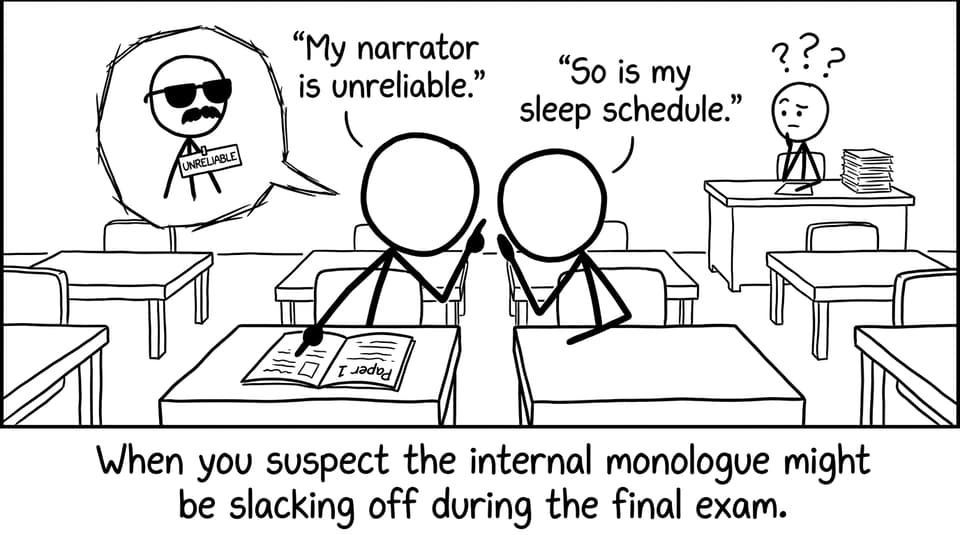
Unreliable narration or limited perception
-
Stream of consciousness and interior monologue
-
Alienation and identity tension
-
Symbolic density (objects and images doing heavy conceptual work)
Modernism can feel intimidating in IB English until you treat confusion as evidence. Ask: What does the disruption make me feel, and why would the writer want that? For targeted movement help, see Exploring Modernism and Postmodernism in IB Literature.
Postmodernism in IB English: play, parody, and the problem of truth
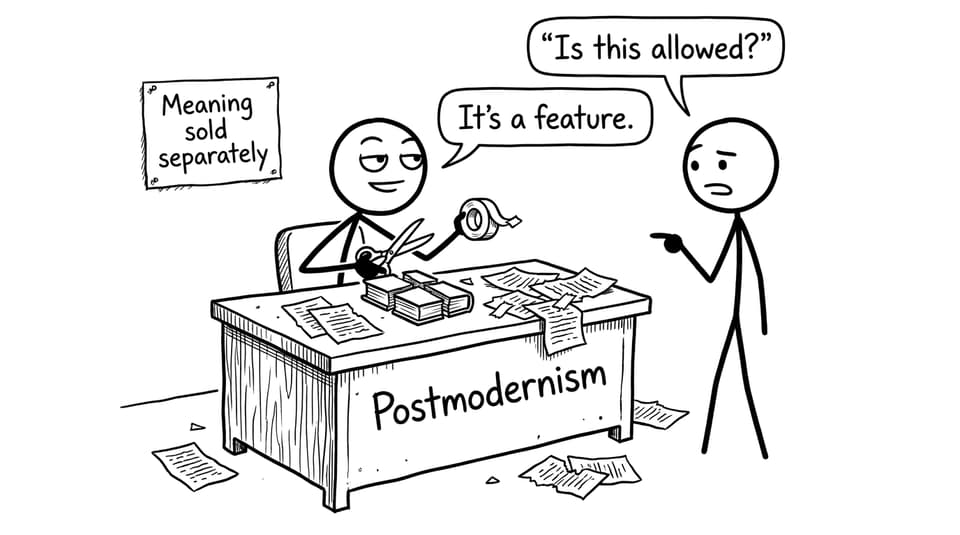
Postmodernism often arrives with a grin and a raised eyebrow. It questions the idea of one stable meaning, one authoritative story, one “final” interpretation. It can feel like the text is commenting on itself while you’re still trying to summarize the plot.
Postmodernism signals to write about in IB English
-
Metafiction and self-reference (the text knows it is a text)
-
Pastiche/parody and heavy intertextuality
-
Fragmentation without resolution
-
Irony as a default stance
-
Multiple realities or competing narratives
In IB English, Postmodernism rewards you for writing about reader positioning: how the text makes you doubt, laugh, or mistrust your own expectations.
Comparing movements for IB English Paper 2 (a simple lens)
Movements often argue with each other across time:
-
Romanticism says emotion and imagination reveal truth.
-
Realism says social reality reveals truth.
-
Modernism says truth is fractured and subjective.
-
Postmodernism says truth might be constructed, performative, or unstable.
When building a Paper 2 comparison in IB English, pick one axis and stay consistent: individual vs society, certainty vs doubt, order vs fragmentation, sincerity vs irony. Then support with techniques. For time-pressure planning, use How to Prepare for the IB English Paper 2 Exam Under Time Pressure.
How RevisionDojo helps you turn movements into marks
Knowing movements is useful, but practice makes it exam-ready. RevisionDojo is built for that last-mile conversion:
-
Use the Questionbank to drill movement-linked prompts and get faster at technique spotting.
-
Build comparison stamina with the IB English Lit English Paper 2 hub and the IB English A Lang & Lit English Paper 2 Questionbank.
-
For Paper 1 control, pair movement knowledge with structure using Mastering IB English Paper 1 and Step-by-Step Guide to Revising IB English Paper 1.
-
Turn recurring movement features (irony, fragmentation, nature imagery) into spaced repetition with Flashcards, then pressure-test them in Mock Exams.
-
Use AI Chat and Grading tools to check whether your context stays relevant to the passage, and whether your commentary is still anchored in language.
Conclusion: use movements as a lens, not a label
Literary movements are not trivia in IB English. They are shortcuts to meaning: a way to see why a writer reaches for emotion, detail, fracture, or irony. When you treat Romanticism to Postmodernism as a toolkit, your analysis becomes faster, deeper, and easier to compare under exam conditions.
If you want a clear practice loop, take one studied text this week, identify its movement signals, and write two PEEL paragraphs. Then run the same skill through RevisionDojo’s Questionbank, Flashcards, AI Chat, and Grading tools so movement knowledge turns into exam confidence in IB English.