
Irony is the moment a text quietly dares you to notice the gap.
A character says something “kind” that lands like an insult. A plan designed to save someone becomes the reason they suffer. The audience watches a hero walk toward a truth we already know will break them. In IB English, literary irony is one of the fastest ways to move from surface-level reading to the kind of layered analysis examiners reward.
Because irony isn’t just a trick. It’s a lens. It changes how we hear tone, how we judge characters, and how we understand theme. If you can track literary irony and explain its effects clearly, your IB English commentary and essays start sounding less like a list of techniques and more like an argument.
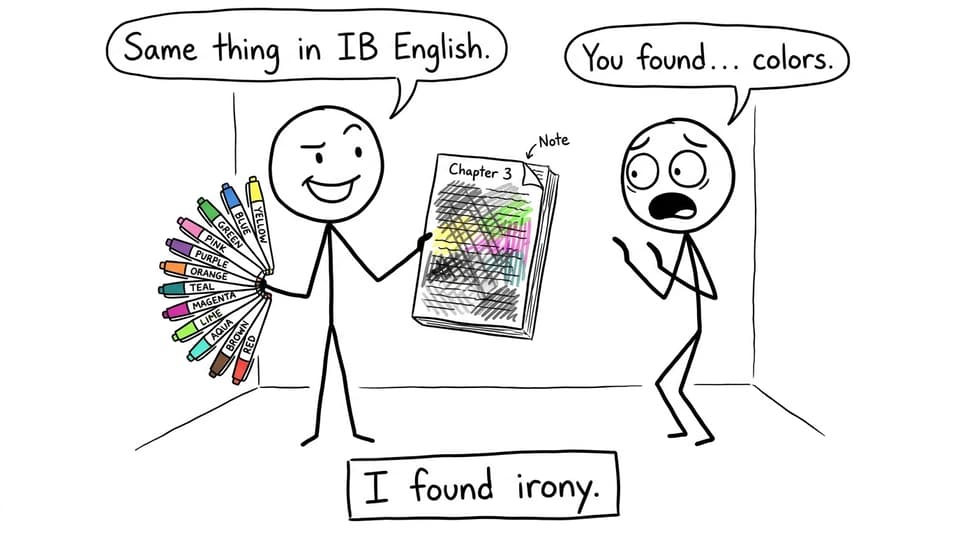
Literary irony in IB English: a quick exam checklist
Use this when you meet irony in a passage, poem, or play. In IB English, it keeps you anchored in evidence rather than guesswork.
-
Name the form of literary irony (verbal, situational, dramatic).
-
Identify the “gap” (words vs meaning, expectation vs outcome, character knowledge vs reader knowledge).
-
Pinpoint the trigger (diction, contrast, narrative voice, structure, stage directions).
-
Explain the immediate effect (humor, tension, discomfort, sympathy, critique).
-
Link the effect to something bigger (tone, characterization, theme, authorial purpose).
If you want a broader technique-to-effect method, pair this with RevisionDojo’s guide on Mastering Literary Devices in IB English Exams.
Verbal irony: when the words wear a mask
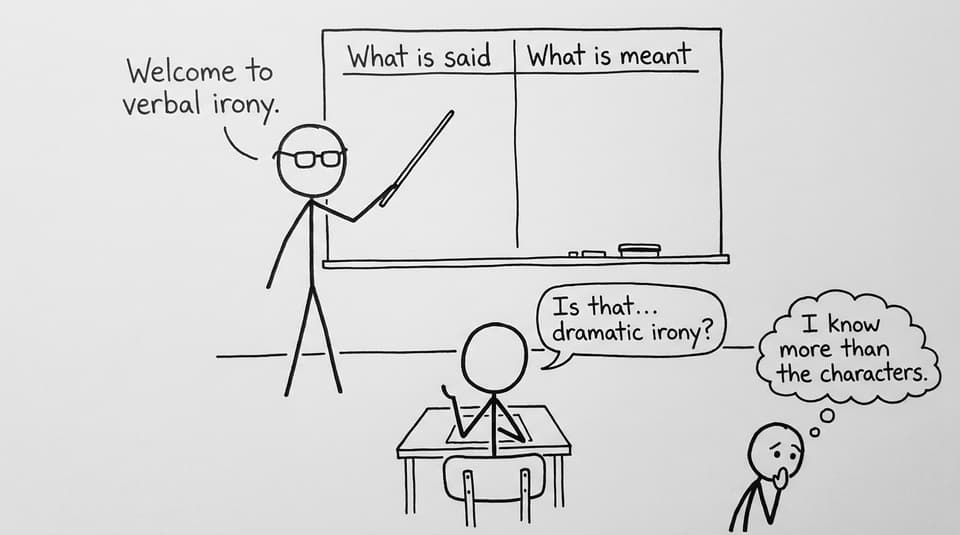
Verbal irony is the most portable form of literary irony: it can live in a single line of dialogue, a polite aside, or a narrator’s “casual” description that’s anything but casual. In IB English, it’s often where tone becomes visible.
Verbal irony happens when a speaker’s literal wording conflicts with their intended meaning. It can appear as understatement, overstatement, deadpan politeness, or sharp sarcasm. The key is that the line only makes sense when you read it against context.
What to analyze in IB English:
-
Tone calibration: Does the voice sound amused, bitter, resigned, or performatively innocent?
-
Relationship pressure: Is the irony a shield, a weapon, or a plea for connection?
-
Power dynamics: Who gets to be ironic, and who is forced to take words literally?
For a tight definition and examples you can borrow as models, see What Is Irony? | IB English Literary Device and Analysis Guide.
Situational irony: when the plot argues back
Situational irony is what happens when reality refuses to cooperate with expectation. The outcome contradicts what characters intend, what readers predict, or what a “reasonable” world would normally deliver.
In IB English, situational irony is gold because it links structure to meaning. The reversal isn’t just surprising; it often reveals the text’s worldview.
Common patterns of situational irony:
-
Reversals of fortune: success turns into loss (or loss into success) in a way that exposes values.
-
The trap of good intentions: the attempt to fix a problem deepens it.
-
Moral collision: the “right” action creates an unsettling result.
How to write it in an exam sentence (model):
The situational irony of X (expected) becoming Y (actual) reframes the text’s message about Z, pushing the reader toward discomfort rather than closure.
When you’re practicing exam-style questions that include satire, cartoons, and commentary, situational irony shows up constantly. RevisionDojo’s Parodies & Satire Questionbank is a good place to train your eye.
Dramatic irony: when the reader carries the heavier truth
Dramatic irony is the most emotionally loaded form of literary irony. It appears when the audience knows something a character does not. That knowledge becomes tension: we watch a choice being made with incomplete information, and the text makes us feel the cost.
In IB English, dramatic irony often helps you write about:
-
Tragedy: we anticipate the fall before the character sees it.
-
Sympathy: ignorance makes a character more human, not less.
-
Suspense: the text stretches time by letting us wait for recognition.
A useful angle: dramatic irony is also about control. The author decides who knows what, and when. That’s a structural choice you can analyze, especially in Paper 1 commentary.
If you’re revising Paper 1 skills, use Mastering IB English Paper 1: A Complete Guide and Step-by-Step Guide to Revising IB English Paper 1 to connect irony to thesis-building and paragraph focus.
The effects of literary irony: tone, characterization, theme
In IB English, you don’t get rewarded for simply spotting literary irony. You get rewarded for explaining what it does.
Irony and tone
Irony shapes the emotional temperature of a passage.
-
Dry verbal irony can signal distance, intelligence, bitterness, or grief held at arm’s length.
-
Dramatic irony can turn a calm scene into dread because the reader knows what is coming.
-
Situational irony can make a moral point feel earned, not preached.
To strengthen tone analysis, RevisionDojo’s Close Reading Techniques for Prose and Poetry helps you move from “this is sarcastic” to “the clipped syntax and loaded politeness create corrosive irony.”
Irony and characterization
Characters often reveal themselves most clearly when their words and actions split apart.
-
A character who speaks in constant verbal irony may be defensive, perceptive, or avoiding sincerity.
-
A character trapped in situational irony may expose pride, naivety, or misplaced faith.
-
Dramatic irony can make a character appear innocent or tragically blind, shaping how the reader judges them.
If you want a reminder of how writers build character through speech and action, see Notes for Characterization & Dialogue.
Irony and theme
Themes often live inside contradictions. Literary irony makes those contradictions unavoidable.
Irony commonly supports themes like:
-
appearance vs reality
-
social hypocrisy
-
the limits of knowledge
-
ambition and consequence
-
miscommunication and misunderstanding
This becomes especially useful in comparative writing. If Paper 2 is on your mind, RevisionDojo’s Understanding the IB English A Paper 2 Exam Structure can help you turn ironic moments into comparative claims.
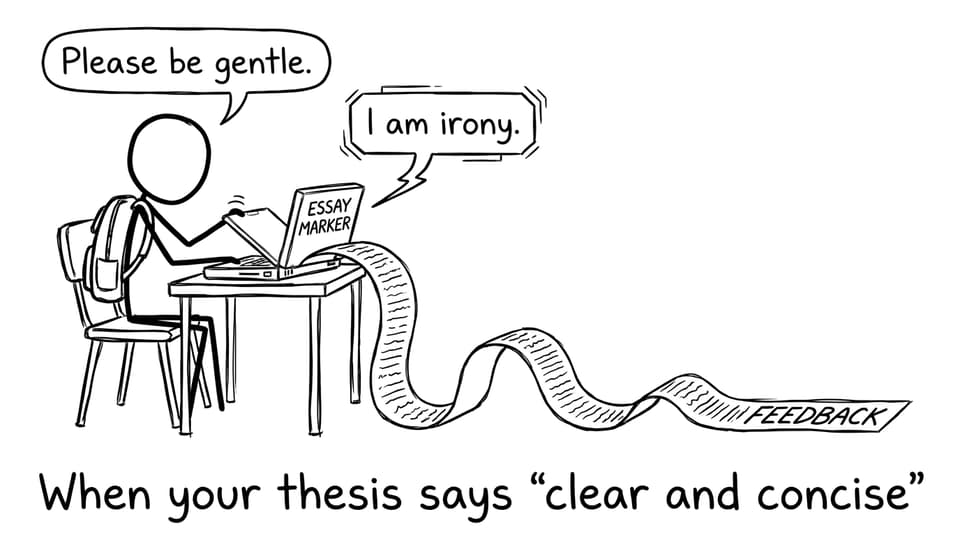
How to write about irony in IB English (without sounding generic)
A reliable IB English sentence pattern is:
Technique (form of irony) + Evidence (specific words/turning point) + Effect (tone/reader response) + Meaning (theme/authorial purpose).
Example frame you can adapt:
Through verbal irony in the speaker’s “___,” the text creates a tone of ___, positioning the reader to question ___ and reinforcing the broader theme of ___.
To practice this under timed conditions, RevisionDojo’s Questionbank and Mock Exams are built for repetition that actually changes your writing. If you draft essays, the Grading tools and AI Chat can help you test whether your irony analysis is specific enough to the passage. And if you’re building long-term retention, use Flashcards and Study Notes to keep definitions and effects sharp.
Closing: make irony your shortcut to depth
Literary irony is one of the simplest tools to recognize and one of the hardest to explain well. That’s why it matters so much in IB English. When you can name the form, prove the contradiction, and articulate the effect, you’re no longer summarizing; you’re interpreting.
If you want to turn that skill into exam confidence, build your practice loop with RevisionDojo: use the Study Notes to lock in definitions, the Flashcards to keep them active, the Questionbank to apply them in exam-style tasks, and the AI Chat plus Grading tools to sharpen your analysis until it sounds inevitable. Irony rewards the reader who pays attention. RevisionDojo helps you become that reader, consistently.