



IB Design Technology has a strange reputation.
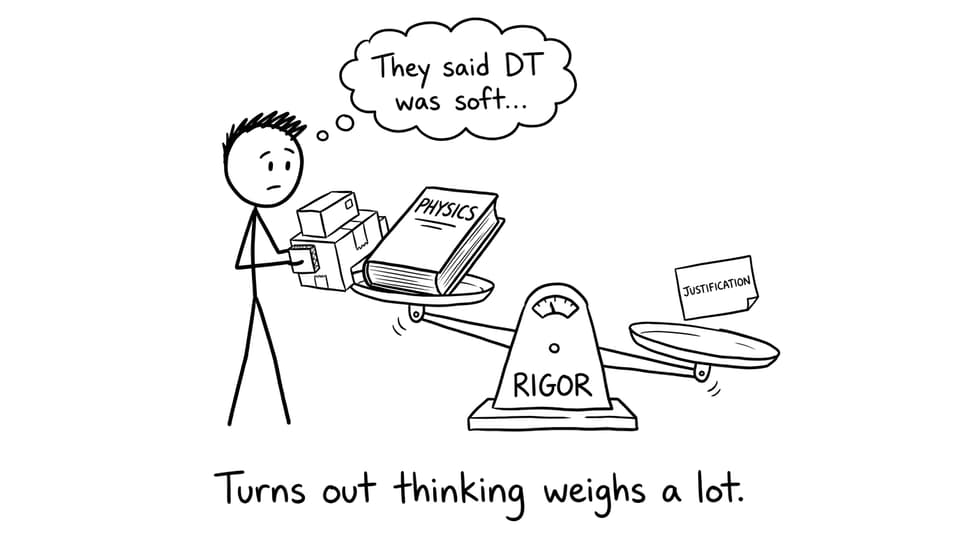
Someone will glance at the word design and imagine mood boards, glue guns, and easy marks. Then a DT student sits down to justify a material choice, evaluate conflicting test data, and write a conclusion that actually matches the evidence, and suddenly the “soft subject” label sounds like something said by a person who has never opened the rubric.
If you’re preparing for exams, it matters because confidence is part of performance. And if you’re choosing subjects, it matters because fear loves stereotypes.
In this guide, we’ll look at what IB Design Technology really demands, why it feels different from traditional sciences, and how to make the subject look as rigorous as it actually is.
A quick checklist: what makes a subject “soft” (or not)
Before anyone judges IB Design Technology, use a better test than vibes:
-
Are the assessment criteria clear and strict?
-
Is work moderated or externally assessed?
-
Do top grades require justification and evaluation?
-
Are command terms demanding (analyse, evaluate, to what extent)?
-
Can you score highly through effort alone, without understanding?
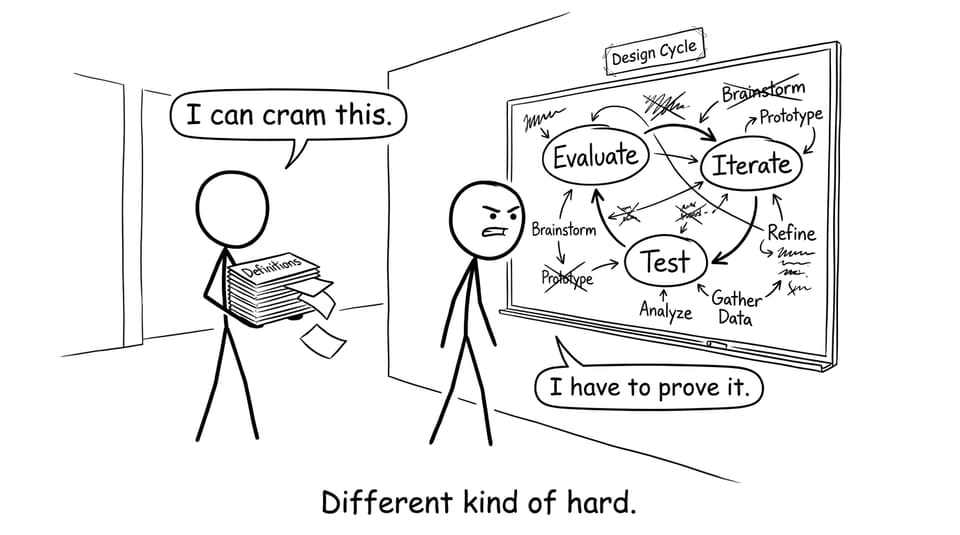
If your honest answers are “yes, strict” and “no, effort-only doesn’t work,” you’re not dealing with a soft subject. You’re dealing with a different kind of hard.
Why IB Design Technology gets called “soft”
IB Design Technology is often judged by its surface features:
-
It includes a major design project (coursework), not only timed exams.
-
It rewards applied problem-solving more than memorisation.
-
It can involve less advanced mathematics than Physics.
-
It asks you to make decisions, not just recall facts.
To students raised on a steady diet of markschemes and “one correct method,” that last point can feel like freedom. But in assessment terms, freedom is expensive. If you can choose your approach, you also have to defend it.
If you’re new to the course structure, start with What Is IB Design Technology? Complete Beginner's Guide and the IB Design Technology Resources hub. You’ll quickly see that the subject is built around standards, not vibes.
What IB Design Technology actually assesses (and why that’s rigorous)
A genuinely “soft” subject would have fuzzy criteria and generous marking. IB Design Technology is the opposite: you’re rewarded for precision of thinking.
In practice, strong DT work repeatedly does three things:
It turns choices into arguments
You don’t just pick a material or manufacturing method. You justify it against constraints: cost, sustainability, mechanical properties, user needs, safety, and feasibility.
If you want to level up this skill, RevisionDojo’s IB Design Technology 4.1 Properties of Materials Notes are a good reminder that DT is full of technical vocabulary and real-world trade-offs.
It rewards evaluation, not description
Many students can describe a prototype. Fewer can evaluate it: What failed? Why? What does the data imply? What changes follow logically?
That is why exam questions can feel “unsafe” in IB Design Technology. The course expects judgement.
It uses the same thinking universities want
Universities rarely ask, “Is DT soft?” They ask, “Can this student research, iterate, and explain their reasoning?” DT is essentially training in that loop.
For exam practice that matches those command terms, use the RevisionDojo Questionbank, for example Classic Design Questionbank to practise concise, markscheme-ready responses.
The design project: not “easy coursework,” but long-form difficulty
The design project in IB Design Technology is demanding for one simple reason: it exposes your habits.
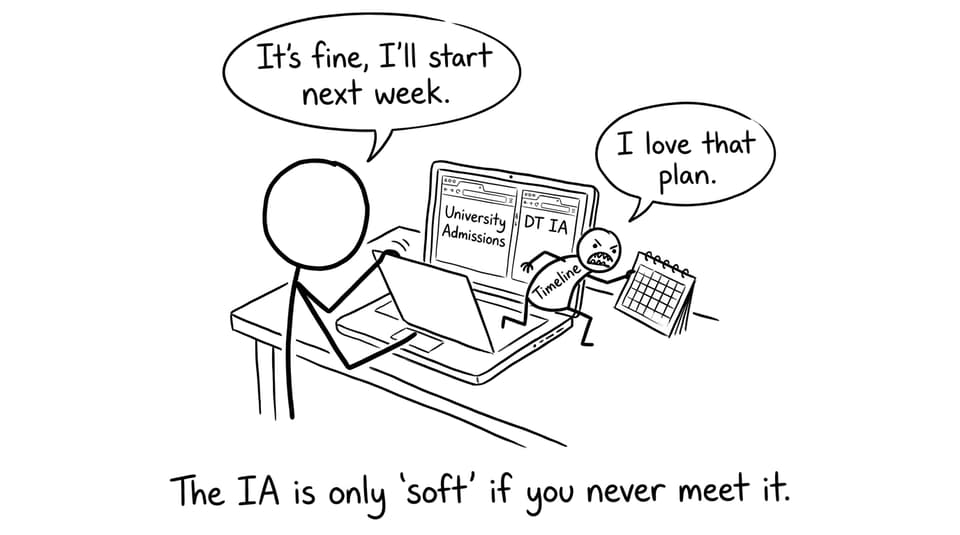
If you plan well, document intelligently, and iterate based on evidence, the project becomes manageable. If you drift, it becomes a slow-motion deadline.
Two posts worth bookmarking early:
And if you need proof that DT punishes shallow thinking, read IB Design Technology: Can You Reuse Products or Ideas?. Reuse is allowed, but only if you can demonstrate analysis, improvement, and honest iteration.
Why IB Design Technology can feel harder than Physics (in its own way)
Physics often rewards pattern recognition: practise enough, and question styles start to repeat.
IB Design Technology rewards something less comfortable: decision-making under uncertainty.
That means revision should look different too. A solid routine is:
-
Learn definitions and key terms (then test them).
-
Attach every concept to a product example.
-
Practise short, examiner-style explanations.
-
Review your own work for “claims without evidence.”
A practical guide to this approach is Best Study Strategies for IB Design Technology Students.
On RevisionDojo, students usually combine:
-
Study Notes (to build clear understanding) via Study Notes | RevisionDojo
-
Flashcards (to lock terminology)
-
Questionbank (to convert knowledge into marks)
-
AI Chat (to rewrite weak justifications in examiner-style language)
-
Grading tools (to check whether your evaluation actually evaluates)
-
Mock Exams and Predicted Papers (to train timing and command terms)
-
Coursework Library and Tutors (when you need model structure and feedback)
How to make IB Design Technology look “serious” on results day
The myth becomes risky only when students treat IB Design Technology casually.
Do the opposite:
-
Pair DT with subjects that match your university plans.
-
Aim for clarity and evidence in every paragraph.
-
Use precise terminology, not vague design language.
-
Show iteration: data, changes, and reasons.
If you want project inspiration that naturally lends itself to measurable testing, see IB Design Technology Project Ideas for Students.
Conclusion: the “soft subject” myth misses the point
IB Design Technology isn’t soft. It’s rigorous in a way that doesn’t always look like rigor from the outside: it demands justification, iteration, and evaluation under constraints.
If you want your IB Design Technology grade to reflect that rigor, build your revision around the tools that turn thinking into marks. Start at the IB Design Technology Resources hub, drill exam technique with the Questionbank, lock in terminology with Flashcards, and use AI Chat and grading tools to strengthen your explanations until they sound like an examiner wrote them.
Treat IB Design Technology like the serious subject it is, and it will pay you back in marks and in skills you’ll still use long after exams.