
IB Chemistry: Nuclear Charge and Electron Arrangement
The first time nuclear charge really clicks for most IB Chemistry students is usually mid-question, when a trend that felt like memorisation suddenly becomes a story: the nucleus gets “stronger,” electrons get “pulled in,” and the atom quietly changes its behaviour.
That story matters because IB Chemistry exam questions rarely ask you to recite a definition. They ask you to explain why an atom is smaller, why ionization energy rises, or why electron arrangement isn’t as simple as “fill the next box.” Nuclear charge is the thread that ties those explanations together.
Quick checklist: what nuclear charge changes
For IB Chemistry, nuclear charge affects electron arrangement by changing:
-
Attraction between nucleus and electrons (stronger pull)
-
Effective nuclear charge (what outer electrons actually feel)
-
Orbital energies (which sublevels are more stable)
-
Ionization energy (how hard it is to remove an electron)
-
Periodic trends you must explain under time pressure
If you want the clean syllabus foundation first, anchor yourself in S1.2 The nuclear atom and the matching nuclear atom notes.
Nuclear charge: the “volume knob” of attraction
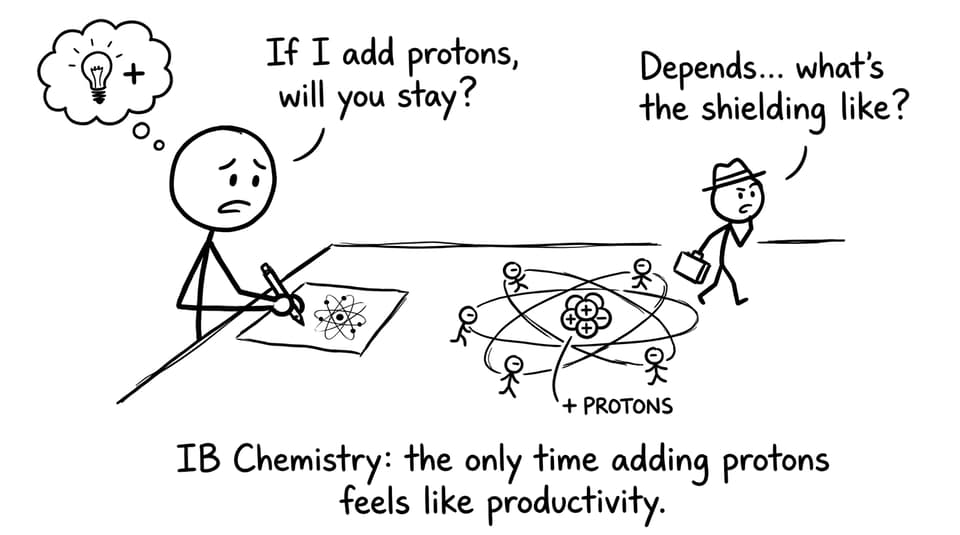
In plain IB Chemistry language, nuclear charge is the positive charge of the nucleus, determined by the number of protons.
When proton number increases, electrons experience stronger electrostatic attraction. That changes electron arrangement in two practical ways:
-
Electrons in the same shell are pulled closer, so atomic radius can decrease across a period.
-
Electrons become harder to remove, so ionization energy tends to rise.
This is why “more protons” is not just a counting fact. It’s the mechanism behind the trend.
To connect this to how electrons are organised in shells and sublevels, revise electron arrangement with 2.2 Electron configuration and 2.2 Electron configuration notes.
Effective nuclear charge: why shielding never “fully fixes” it
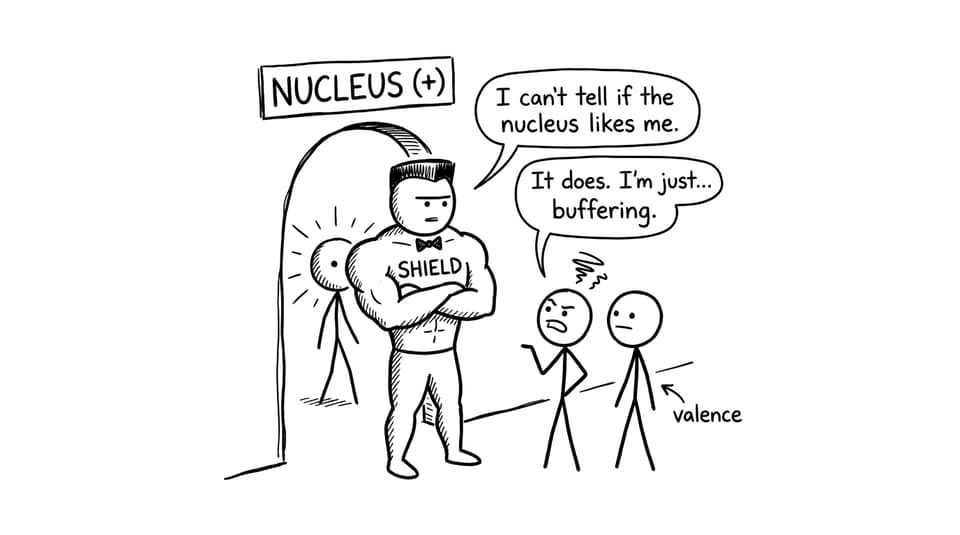
Most exam explanations in IB Chemistry actually need effective nuclear charge (Z_eff), not raw nuclear charge.
Inner-shell electrons repel outer electrons and reduce the pull from the nucleus. But they do not cancel it completely. So outer electrons feel a net attraction:
-
Nuclear charge increases across a period (more protons)
-
Shielding is roughly constant within the same shell
-
Therefore Z_eff increases, pulling valence electrons inward
If you want one page that makes periodic trends feel inevitable, study Effective Nuclear Charge Explained alongside S3.1.3 Periodicity of properties notes.
Orbital filling: nuclear charge quietly reshapes energies
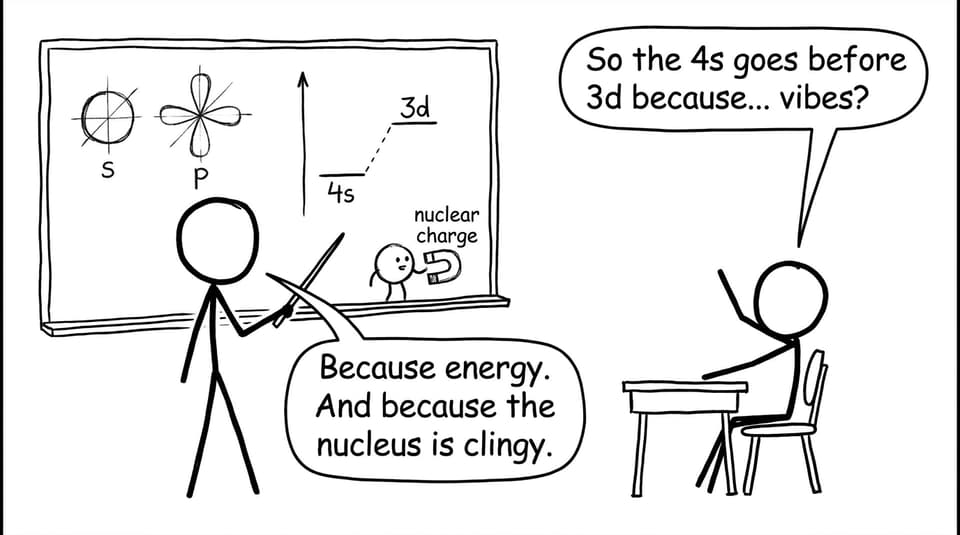
Electron arrangement is also about energy, not just “where space is available.” As nuclear charge increases, orbitals can become more stabilised (lower in energy) because electrons are held more tightly.
This is the deeper reason IB Chemistry sometimes feels subtle around sublevels, transition metals, and exceptions: the nucleus changes the energy landscape.
To strengthen the rules-based side of electron arrangement, revise:
Then make it exam-real with the broader IB Chemistry Questionbank so the explanations become automatic.
Ionization energy: the exam-friendly payoff
If nuclear charge is the cause, ionization energy is the measurable consequence. Stronger effective nuclear charge means electrons are held tighter, so more energy is needed to remove one.
That single idea powers many IB Chemistry explanations, especially “across a period” questions. For a focused walkthrough, use Ionization Energy Explained Simply and, for HL depth, S1.3.6 Ionization energy notes.
Conclusion: turn nuclear charge into easy marks
In IB Chemistry, nuclear charge is not a trivia detail. It’s a lever that changes effective nuclear charge, orbital energies, ionization energy, and the electron arrangement patterns that show up everywhere in exams.
If you want this to feel effortless under time pressure, build a loop: study notes, then drill questions, then get feedback. RevisionDojo brings that loop together with Study Notes, Flashcards, AI Chat, Grading tools, Predicted Papers, Mock Exams, a Coursework Library, and Tutors, so IB Chemistry explanations become instincts, not guesses.