


A strange kind of relief: when “infinite” has an answer
In IB Math, there’s a moment that feels like a magic trick the first time you see it: you add forever, and the total still lands on a neat number. Not “approximately.” Not “very large.” Just… finished.
That’s the heart of an infinite geometric series. It looks like it should explode into chaos, yet sometimes it settles down quietly, like a noisy class that finally notices the teacher is watching. If you’re doing AA SL or AA HL, this is one of those topics where examiners reward you for thinking like a mathematician (limits, convergence, justification) rather than only substituting into a formula.
If you want the syllabus-aligned home base for this entire skill set in IB Math, start with SL 1.3: Geometric sequences and series and then narrow to the infinite case in SL 1.8: Sum of infinite geometric sequence.
Quick checklist (the 20-second routine that saves marks)
Before you calculate anything in an IB Math infinite series question, do this:
-
Identify the first term (a).
-
Identify the common ratio (r) (divide term 2 by term 1).
-
State the convergence condition: (|r| < 1).
-
Only then use the formula (S_\infty = \frac{a}{1-r}).
-
Finish with a sanity check: does your answer make sense in size and sign?
For a broader refresher on geometric foundations, pair this with Geometric sequences explained (AA SL & HL) and Geometric series explained (AA SL & HL).
What is an infinite geometric series (in IB Math terms)?
A geometric sequence looks like:
An infinite geometric series is what happens when you add those terms forever:
In IB Math, the key conceptual move is this: “infinite” describes the number of terms, not automatically the size of the sum. The sum depends on what the terms do as (n) grows.
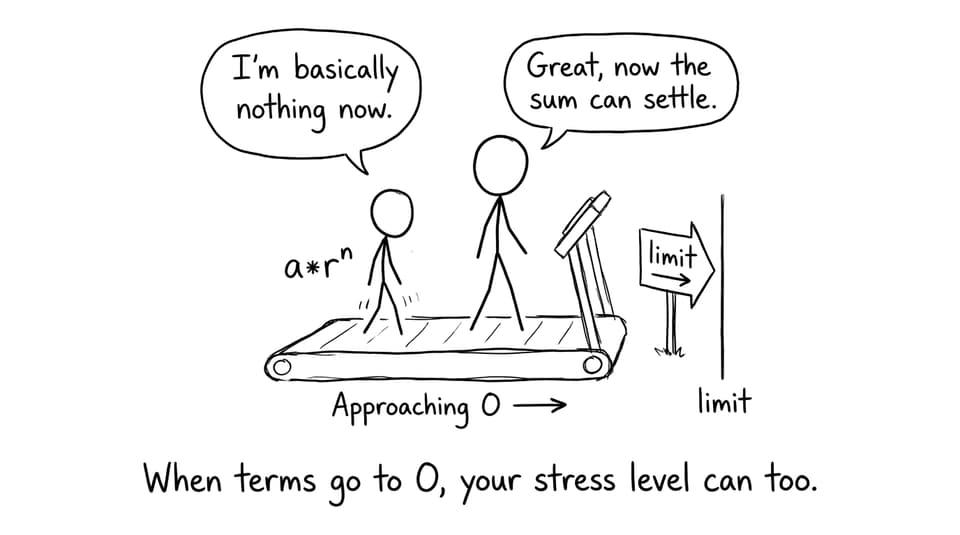
If the terms shrink toward 0 fast enough, the running total approaches a fixed limit. That limit is what we call the sum to infinity.
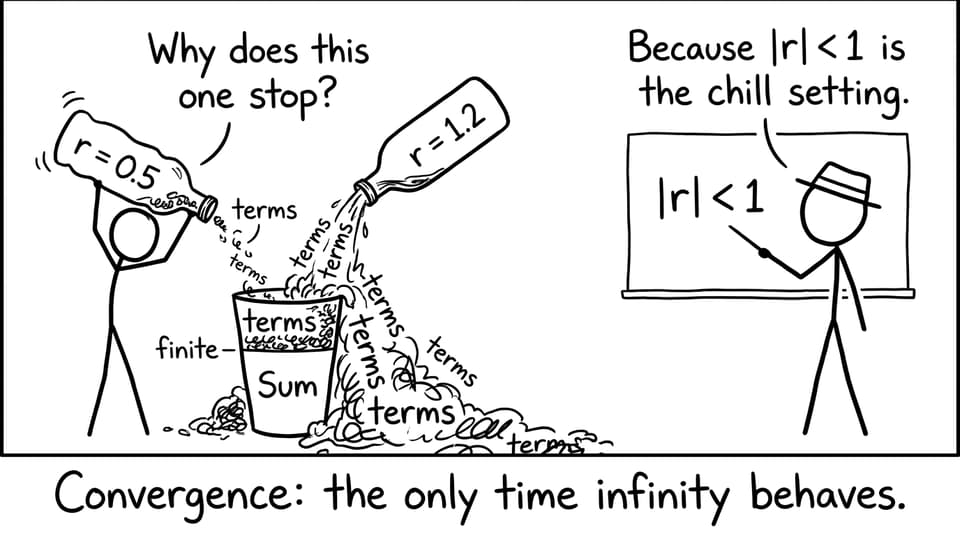
Convergence: why (|r| < 1) is the whole story
Convergence means the partial sums (the totals after 1 term, 2 terms, 3 terms, …) get closer and closer to a single value.
For an infinite geometric series, the convergence condition is:
Why? Because the (n)th term is (ar^{n-1}). If (|r|<1), then (r^{n-1} \to 0), so each new term becomes tiny. The additions become gentler and gentler, and the total can “settle.”
If (|r|\ge 1), the terms don’t decay to 0 (or they bounce without shrinking), so the sum doesn’t converge. In IB Math, writing this justification clearly is often where the method marks live.
The IB Math formula for the sum to infinity (and when you’re allowed to use it)
When (|r|<1), the sum to infinity is:
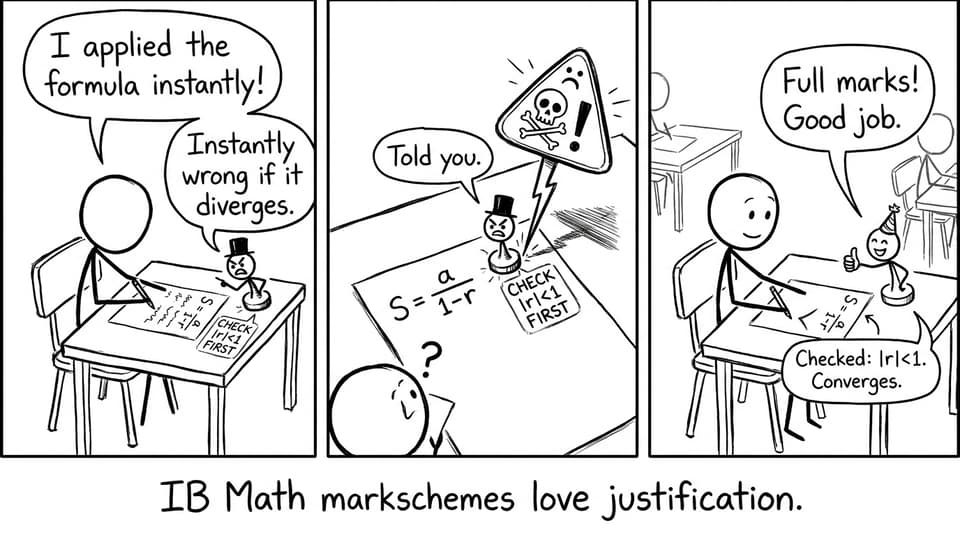
Two examiner-friendly habits:
-
Write the condition first: “Since (|r|<1), the series converges.”
-
Then apply the formula: substitute carefully, keep brackets, watch negatives.
This is exactly the kind of micro-structure RevisionDojo trains with: you see the same skill from multiple angles in the SL 1.3 Questionbank, then reinforce it with SL 1.3 videos and the step-by-step SL 1.3 lessons.
Why infinite geometric series show up so often in IB exams
In IB Math, this topic is a favourite because it tests multiple ideas at once:
-
Algebraic fluency (identify (a) and (r), manipulate expressions)
-
Conceptual clarity (convergence vs divergence)
-
Limits in a “friendly” disguise
-
Communication (justifying why a formula applies)
If you want the big-picture map of where this sits in AA, use IB Mathematics AA resources to navigate between topics quickly.
Common mistakes (and how to avoid them)
Mistake 1: Using (S_\infty) without checking (|r|<1). In IB Math, this is the classic “looks right, loses marks” error. Always state the condition.
Mistake 2: Mixing finite and infinite formulas. Finite sums use (S_n) formulas with (r^n) inside. Infinite sums have no (n) because the limit has already been taken.
Mistake 3: Index confusion. Sometimes the first term given is (u_0) not (u_1). Slow down and label what “first term” actually means in the question.
FAQ (Infinite geometric series in IB Math)
What exactly is an infinite geometric series in IB Math?
In IB Math, an infinite geometric series is the sum of the terms of a geometric sequence that continues without end. The terms follow a constant multiplication pattern, so each term is the previous one times (r). What matters most is not that it’s infinite, but whether the partial sums approach a limit. If they approach a single number, the series converges and we treat that limit as the sum to infinity. If they don’t, the series diverges and you should not force a “sum” out of it. In exams, definitions are less important than demonstrating you understand convergence.
Why does IB Math insist on the condition (|r| < 1)?
Because IB Math is testing whether you understand the logic behind the formula, not just memorisation. If (|r|<1), then (r^n\to 0), which makes later terms negligible and allows the running total to stabilise. If (|r|\ge 1), terms don’t shrink toward zero, so the total can’t settle to one finite value. Even in the tricky case (r=-1), the partial sums bounce between two values rather than converging. Writing “since (|r|<1), it converges” is often the sentence that earns method marks. It also prevents you from making a confident-looking but incorrect substitution.
How do I get faster at these questions before exams?
Start by drilling recognition: spot (a) and (r) quickly and write the convergence line automatically. Then practise mixed sets where some series converge and some diverge, because IB Math questions often test judgment, not just calculation. Use spaced repetition for the formula and the condition so they become one mental package, not two separate facts. On RevisionDojo, that’s a smooth loop: read the SL 1.3 notes, watch a targeted explanation in SL 1.3 videos, then do timed practice in the SL 1.3 Questionbank. When you get stuck, RevisionDojo’s AI Chat and Grading tools help you fix the reason you lost marks, not just the final line. And if you’re short on time, Predicted Papers and Mock Exams help you rehearse the exam feeling without guessing what to revise next.
Bring it home: make infinity feel predictable
Infinite geometric series are one of those IB Math topics that reward calm routines. Check (|r|<1). Justify convergence. Apply (S_\infty = \frac{a}{1-r}). Then sanity-check.
When you’re ready to turn that routine into exam confidence, RevisionDojo is built for exactly this: syllabus-aligned Study Notes, Flashcards, videos, Lessons, a sharp Questionbank, AI Chat support, and full Mock Exams and Predicted Papers to test your timing. Start with SL 1.8: Sum of infinite geometric sequence and practise until “infinite” stops feeling dramatic and starts feeling solvable.