


In the last ten minutes of a timed commentary, most IB English students make the same bargain with themselves: I’ll just name a few rhetorical devices and hope it sounds analytical.
It’s understandable. Your brain is tired, the clock is loud, and the text is doing that annoying thing where it feels “persuasive” without being obviously poetic.
But in IB English, rhetorical devices only earn marks when they become meaning: how a writer builds credibility, steers emotion, and makes a viewpoint feel inevitable.
IB English rhetorical analysis: a fast checklist
Use this before you write a single body paragraph in IB English (Paper 1 or IO):
-
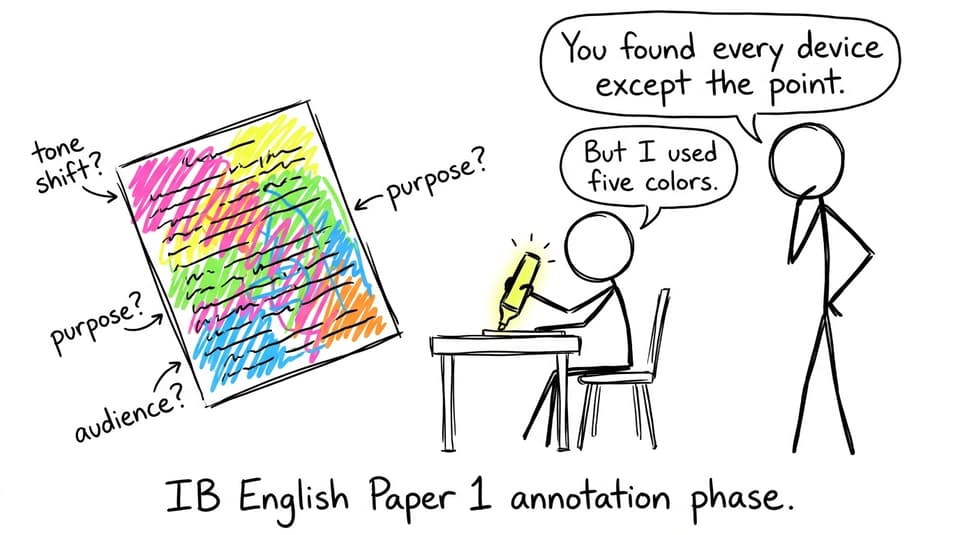
Identify text type + target audience + purpose (your “why” compass)
-
Spot 2-3 technique clusters (not 10 isolated devices)
-
Match each cluster to an effect (reader response) and a purpose (writer’s goal)
-
Choose short evidence (one phrase is often enough)
-
Write analysis in the order the text persuades (opening -> build -> pivot -> close)
If you want structured practice sets that mirror assessment style, start in IB English A: Language & Literature resources and the Paper 1 hub.
What rhetorical devices are (in IB English terms)
Rhetorical devices are deliberate choices in language and structure that shape what an audience thinks, feels, or does. In IB English, you can group them into three practical buckets:
-
Diction and tone (loaded words, formality, inclusive language)
-
Structure and pacing (contrast, parallel phrasing, accumulation, strategic endings)
-
Figurative framing (metaphor, imagery, analogies that simplify complex issues)
The important shift: you’re not hunting devices like collectibles. You’re describing how the writer engineers agreement.
For a broader skill that supports every device you spot, train your method with Close Reading Techniques for Prose and Poetry.
The rhetorical triangle: ethos, pathos, logos
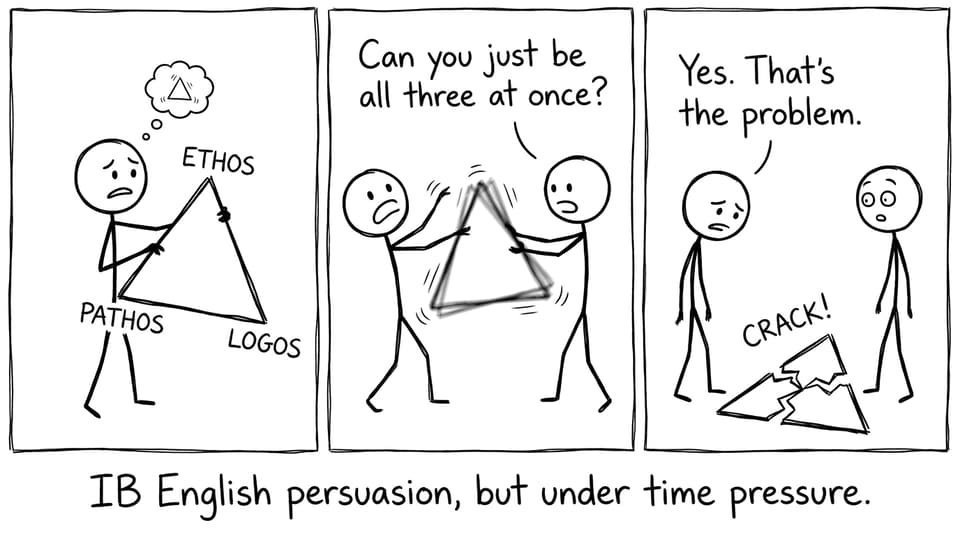
Aristotle’s three appeals are the backbone of non-fiction analysis in IB English because they describe the route persuasion takes.
Ethos (credibility)
Ethos answers: Why should I trust you? Writers build credibility through professional expertise, confident tone, moral positioning, or alignment with shared values.
Look for:
-
references to experience or authority
-
measured, controlled language
-
ethical framing (right/wrong, duty, responsibility)
Pathos (emotion)
Pathos answers: Why should I care? It often appears through vivid examples, personal anecdotes, fear/hope language, or emotionally loaded diction.
Look for:
-
imagery that makes consequences feel personal
-
sentimental or urgent tone shifts
-
“imagine if…” scenarios
Logos (logic)
Logos answers: Why does this make sense? Writers use statistics, cause-effect reasoning, definitions, and structured progression to make arguments feel rational.
Look for:
-
data and comparisons
-
stepwise reasoning
-
rebuttals of counterarguments
To practise this under exam conditions, use timed sets from the IB English Paper 1 Questionbank and build quick feedback loops with the IB English A: Language and Literature Grader.
Common rhetorical devices in non-fiction (and what to say about them)
These show up constantly in speeches, op-eds, campaign texts, and editorials in IB English.
Repetition, anaphora, and epistrophe
Repetition builds rhythm and makes an idea feel “bigger than the sentence.” In speeches, anaphora (repeating openings) can sound like moral certainty; epistrophe (repeating endings) can sound like inevitability.
In analysis, go beyond naming it:
-
What idea becomes “non-negotiable” through repetition?
-
Does it create unity, urgency, or moral pressure?
Parallelism
Parallel phrasing makes claims feel balanced and memorable. It can simplify complexity into a clean takeaway, which is persuasive because it reduces friction.
Rhetorical questions
Rhetorical questions often disguise persuasion as participation. The audience mentally answers, and the writer quietly controls what the “reasonable” answer is.
Antithesis (contrast)
Contrast sharpens a choice: good/bad, us/them, progress/regression. In IB English, link contrast to ideology: what worldview is being normalized?
Inclusive language
Words like we, our, together create group identity. That can be comforting, manipulative, or both. Ask: who gets included, and who gets left out?
Figurative language in factual writing
Metaphor and imagery can make policy feel like a personal story. If you want more examples built around news and opinion writing, see Analyzing Figurative Language in News and Opinion Pieces.
How to write about rhetorical devices (Device -> Effect -> Purpose)
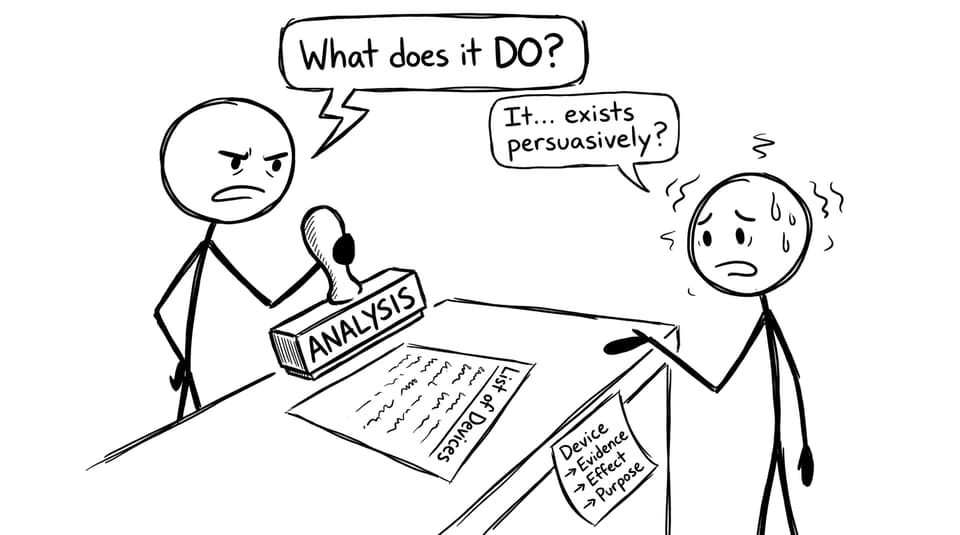
A reliable IB English sentence pattern:
Device + evidence: Identify the choice and embed a short quote.
Effect: Explain what it does to tone, reader alignment, pacing, or credibility.
Purpose: Link to why the writer needs that effect for the broader argument.
Example frame:
By repeating “we” and positioning collective responsibility as unavoidable, the writer manufactures solidarity, making dissent feel like a rejection of shared values.
For Paper 1 structure and timing, keep IB English Paper 1 Revision: A Step-by-Step Guide nearby while you practise.
Where rhetorical devices appear in Paper 1, IO, and HL work
In IB English, rhetorical analysis travels across tasks:
-
Paper 1: treat rhetorical devices as part of the text’s overall method (how persuasion unfolds). Use the IB English A Lang & Lit Paper 1 page to align practice to your level.
-
Individual Oral (IO): connect rhetorical choices to the global issue, showing how language shapes public thinking. Use the Individual Oral hub and the Language A Individual Oral exemplars to calibrate what strong analysis sounds like.
-
HL Essay: rhetorical devices become evidence for ideology, power, identity, and perspective across a larger argument.
FAQ
How many rhetorical devices should I analyse in IB English Paper 1?
In IB English, depth beats breadth, especially under time pressure. Aim for 2-3 clusters of choices per body paragraph, where each cluster supports one clear claim about purpose and effect. If you list ten devices, you often end up writing ten mini-descriptions rather than analysis. Examiners reward controlled selection because it shows you understand relevance, not just terminology. A good self-check is asking: if I removed this device, would my argument change? If not, it may be a named feature without analytical weight. Practise this selection skill with timed prompts in RevisionDojo’s Questionbank and review using the rubric-aligned Grading tools.
What’s the easiest way to explain ethos, pathos, and logos without being generic?
Start by tying the appeal to a specific moment and audience response, not a definition. For ethos, explain how credibility is built (professional voice, ethical framing, confident certainty) and why the writer needs trust at that moment. For pathos, name the emotion being triggered (fear, pride, guilt, hope) and show how diction or imagery produces it. For logos, describe the logic pattern (cause-effect, comparison, statistics, rebuttal) and how that structure makes the claim feel “reasonable.” Then connect it to purpose: what action or belief is being engineered? This approach keeps IB English analysis precise and prevents the “this uses logos because facts” trap. If you need practice identifying patterns quickly, use Study Notes plus Flashcards to make the language automatic.
How do I prepare rhetorical device analysis for the Individual Oral?
For the IO in IB English, rhetorical devices matter most when they illuminate the global issue. Choose an extract where the writer’s persuasion is visible: a tonal pivot, a repeated slogan, a contrast that frames blame, or imagery that makes a social problem feel personal. Annotate with a hierarchy: first purpose and audience, then technique clusters that achieve that purpose. Build a 10-point outline where each point includes one device and one effect, so you avoid rambling. Record yourself and check whether every device leads to an interpretation about power, perspective, or ideology. Then use RevisionDojo’s Coursework Library and IO pages to compare your structure to strong exemplars. When you get stuck, ask AI Chat for alternative phrasing of effects, but keep your claims rooted in the extract.
Conclusion: turn IB English devices into decisions
Rhetorical devices are not decoration. In IB English, they are decisions: choices that turn language into credibility, emotion, and logic.
If you want to train that skill with less guesswork, RevisionDojo gives you the full loop in one place: Study Notes for clarity, Flashcards for quick recall, a Questionbank for exam-style practice, AI Chat for targeted fixes, Grading tools for rubric feedback, Predicted Papers and Mock Exams for timed rehearsal, a Coursework Library for IO support, and Tutors when you want human-level diagnosis.
Open one non-fiction text today, pick three technique clusters, and write three Device -> Effect -> Purpose sentences. That’s IB English progress you can actually measure.