


If you’ve ever stared at the IB Math course options and felt your brain do that quiet little shutdown, you’re not alone. Choosing between SL and HL can feel like choosing a future version of yourself: the one who keeps weekends, or the one who learns to enjoy multi-step reasoning at 11:47 p.m.
The good news: IB Math SL vs HL isn’t a mystery. It’s a set of trade-offs you can measure: depth, pace, assessment style, and what universities expect. Below is a clear breakdown, plus how RevisionDojo helps you train for the course you actually picked (not the course you wish you had time for).
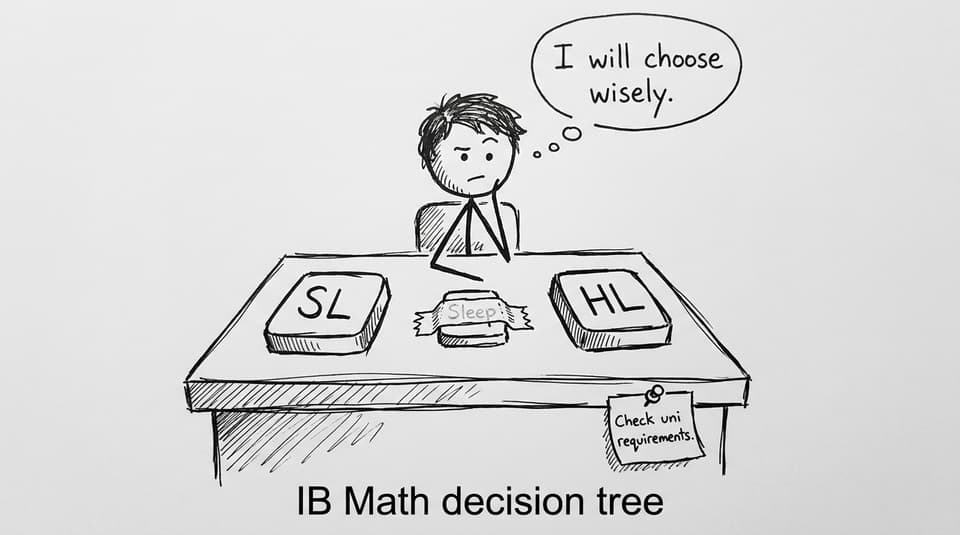
IB Math SL vs HL: a quick checklist
Before you decide (or re-commit) to your level, run this fast filter:
-
University requirements first: some STEM programs strongly prefer HL.
-
Your stress profile: can you handle longer papers and more unfamiliar problems?
-
Your weekly bandwidth: HL needs more hours, and it shows.
-
Your strengths: do you enjoy theory and proofs, or applied fluency?
For a broader map of course choices (AA vs AI, plus SL vs HL), keep this guide open: AA vs AI, SL vs HL: How to Choose.
Content depth: what SL builds, what HL extends
At SL, IB Math is about building a solid, usable foundation: algebraic technique, functions, trigonometry, introductory calculus, vectors, and statistics. You’re still doing real mathematics, but the emphasis is on mathematical literacy and confident execution.
At HL, IB Math becomes more theory-driven. You go further into calculus and proof-style thinking, and you meet topics that demand abstraction and stamina: complex numbers, series, differential equations, and longer chains of reasoning. The shift isn’t only “more content.” It’s also a higher expectation of structure: you must explain why methods work, not just apply them.
If calculus is a deciding factor for you, explore the topic breakdown here: IB Math AA Calculus.
Teaching hours and workload: the 150 vs 240 reality
One of the cleanest differences is time.
-
SL is taught in about 150 hours.
-
HL is taught in about 240 hours.
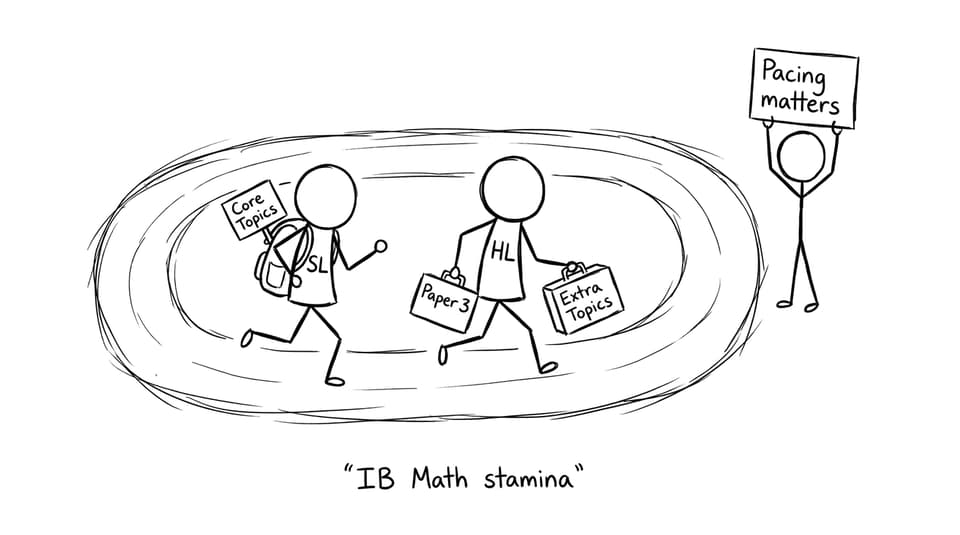
That extra time reflects extra subtopics and a faster pace. In practice, HL also tends to require more independent practice because the questions are designed to stretch your reasoning.
RevisionDojo helps you manage that load with a tight loop: Study Notes for clarity, Flashcards for active recall, and the Questionbank for targeted practice with feedback.
Exam structure: HL adds a new kind of pressure
Assessment is where many students feel the difference most.
SL assessments:
-
Paper 1 (non-calculator, 90 minutes)
-
Paper 2 (calculator, 90 minutes)
-
Internal Assessment (20%)
HL assessments:
-
Paper 1 (120 minutes)
-
Paper 2 (120 minutes)
-
Paper 3 (calculator, 60 minutes, HL-only)
-
Internal Assessment (20%)
That HL Paper 3 matters because it rewards adaptability: unfamiliar problem-solving under time pressure.
To train for this style, you can build focused sets in the IB Math AI Calculus Questionbank or drill specific AA methods via the IB Math AA Calculus Questionbank.
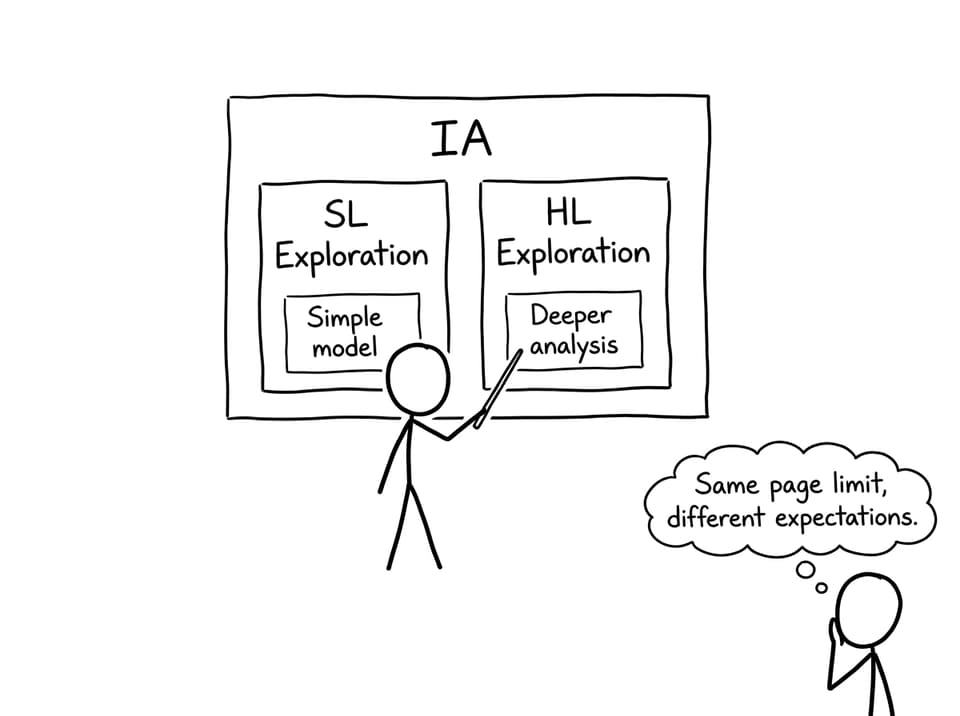
Internal Assessment: same page limit, higher ceiling at HL
Both levels complete a Mathematical Exploration (often 6-12 pages). The difference is the expectation of depth.
SL explorations can succeed with a narrower question and simpler techniques. HL explorations usually need stronger modelling, richer mathematics, and more critical reflection. Markers tend to expect more sophisticated communication at HL: clearer assumptions, deeper interpretation, and better justification of steps.
If you want a system for turning ideas into an organised IA-ready workflow, this helps: Build a Personal Math Portfolio Using RevisionDojo.
Choosing what’s “worth it”: match IB Math to your direction
HL is strongly recommended if you’re aiming for engineering, physics, mathematics, computer science, data science, or highly competitive quantitative economics.
SL is often the smarter choice if your degree path is humanities, many business routes, social sciences, or arts, especially if SL lets you be consistent rather than constantly catching up.
If you’re thinking about switching levels, read this before you decide: Can You Switch from SL to HL Midway?.
How RevisionDojo turns differences into a study plan
No matter your level, IB Math rewards the same habit: tight feedback loops.
A practical weekly structure:
-
Learn the concept fast with IB Mathematics AA Resources
-
Drill weaknesses using Targeted Revision Using the Questionbank
-
Convert recurring mistakes into Flashcards
-
Use AI Chat when you get stuck mid-solution and need the next logical step
-
Use Grading tools to check reasoning and communication quality
-
As exams approach, use Predicted Papers and Mock Exams to practise timing
-
Pull strong examples from the Coursework Library, and get 1:1 support with Tutors if you need it
For study habits that keep you calm and organised, this is worth bookmarking: IB Math Note-Taking Strategies That Actually Work.
FAQ
Is IB Math HL “harder,” or just “more”?
Both. IB Math HL includes more content, but the bigger shift is the kind of thinking it demands. You’re asked to connect ideas across topics, not just repeat a familiar method. That means you can feel confident in revision, then still get surprised by a question that twists the context. The solution isn’t panic-practice; it’s deliberate practice on unfamiliar items and reflection on mistakes. RevisionDojo’s Questionbank helps by filtering practice by topic and style so you can train adaptability, not just accuracy. Over time, HL stops feeling like random difficulty and starts feeling like a set of learnable patterns.
Can I score highly in IB Math SL without being “a math person”?
Yes, if you treat SL like a skill you build, not a personality trait you either have or don’t. SL rewards clean algebra, consistent method, and good exam habits under time pressure. Most score drops come from small, repeatable errors: sign mistakes, missing conditions, or skipping justification. A system of short practice sessions beats occasional long sessions because it keeps techniques fresh. RevisionDojo supports this with Study Notes for quick clarity and Flashcards for daily recall prompts. If you can practise consistently and learn from feedback, high marks are realistic.
What’s the best way to prepare for HL Paper 3-style questions?
Start earlier than you think, and practise questions that feel slightly unfamiliar on purpose. HL Paper 3 rewards reasoning under pressure, so you need exposure to problems that don’t announce the method immediately. After each set, write a short post-mortem: what was the first clue, what method finally worked, and what you’d try first next time. Mix topics, because Paper 3 often tests connections between areas. Use RevisionDojo’s Questionbank to assemble targeted sets, then simulate timing with exam-style conditions using its exam prep tools. The goal is to build calm decision-making, not just more content knowledge.
Conclusion: pick the level, then build the loop
The real SL vs HL decision in IB Math is about the contract you’re signing: SL prioritises breadth and balance; HL demands depth, endurance, and a higher ceiling of reasoning.
Whichever level you’re taking, make RevisionDojo your home base: learn with Study Notes, drill with the Questionbank, lock in recall with Flashcards, pressure-test with Mock Exams and Predicted Papers, and tighten your writing with Grading tools. Your future self doesn’t need more motivation; they need a system that keeps working when the week gets busy.