


It usually happens halfway through a tough Paper 3-style question: you know the method, you can feel the marks sitting there, and then your brain goes blank on one small detail. In IB Math, that moment is where the formula booklet stops being “a sheet of equations” and becomes a time-saving tool you can actually lean on.
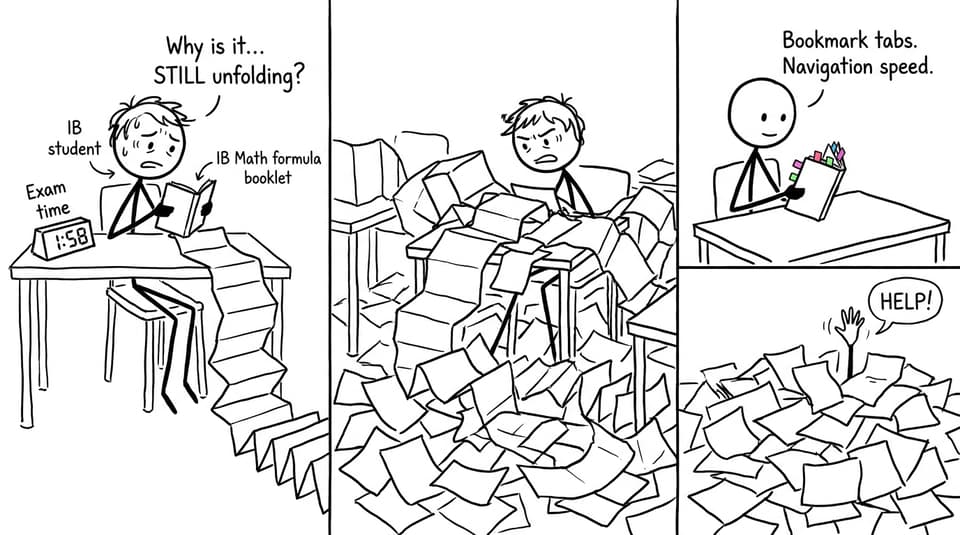
The catch is simple: the booklet only helps if you can find what you need fast and recognise when to use it.
IB Math AA HL formula booklet: quick checklist
Use this before every timed practice set in IB Math:
-
Skim the booklet once a week so the layout feels familiar.
-
Learn the “high-frequency” formulas so you look up less.
-
Practice locating formulas under time (navigation is a skill).
-
After each set, write one line in an error log: what formula you used (or missed).
-
Drill the exact weak topic using RevisionDojo’s Questionbank and Study Notes.
If you want the cleanest starting point, keep these open while you revise: IB Mathematics Analysis and Approaches Resources and the IB Mathematics Analysis and Approaches Data Booklet.
What the IB Math AA HL formula booklet includes
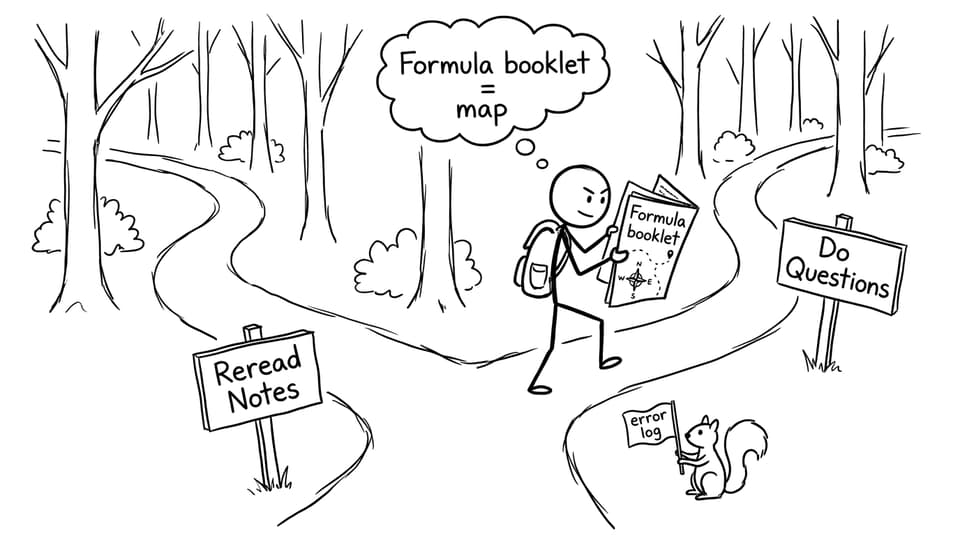
The IB Math AA HL formula booklet is provided in exams and covers core formulas across the syllabus. Think of it as a map of the course: algebra and functions, calculus, trigonometry, vectors (HL-heavy), and statistics/probability.
But the biggest advantage isn’t that it “saves memorisation.” It saves decision fatigue. When you are tired, the booklet can confirm the exact form of an identity, a derivative, or a distribution formula so you can focus on structure and method.
For a broader view of how formula sheets change exam performance in IB Math, see The Importance of Formula Sheets in IB Math Exams.
Essential IB Math formulas by section (AA HL focus)
Algebra and functions (the daily drivers)
In IB Math, these show up constantly:
-
Laws of indices and logarithms
-
Quadratic formula
-
Sequences and series formulas
Pair this with targeted practice so it becomes automatic: IB Math: Targeted Revision Using the Questionbank.
Calculus (where marks pile up fast)
AA HL calculus is less about memorising and more about selecting the right tool quickly:
-
Differentiation rules (product, quotient, chain)
-
Standard derivatives and integrals (polynomial, trig, exponential)
-
Definite vs indefinite integrals
-
Area/volume setups
If calculus is a priority topic, revise it directly from: IB Mathematics Analysis and Approaches Calculus.
Trigonometry (identities that unlock simplification)
Common “essential” identities you should be able to spot quickly in IB Math:
-
Pythagorean identities
-
Angle sum/difference identities
-
Double-angle and half-angle formulas
-
Radian/degree conversions
For a focused refresher, use: IB Math - Cosine Rule & Trigonometric Identities.
Vectors (HL leverage)
Vectors often reward clear structure:
-
Vector addition/subtraction
-
Dot product
-
Lines and planes in vector form
If this area feels shaky, isolate it early (it compounds quickly). A good subtopic entry point is AHL 3.16 Vector Product (HL).
Statistics and probability (formulas plus interpretation)
You will use formulas, but you also need to interpret results correctly:
-
Binomial distribution formula
-
Mean/variance basics for discrete distributions
-
Normal distribution and z-scores
Study the topic directly here: IB Mathematics Analysis and Approaches Statistics and Probability.
How to use the IB Math formula booklet effectively
The best IB Math students don’t “search for formulas.” They search for signals.
-
If a question mentions “maximum/minimum” or “rate,” your calculus page is calling.
-
If you see an expression that can collapse, trig identities are the lever.
-
If the question is geometric in 3D, vectors might be the cleanest language.
Build that instinct with a simple loop inside RevisionDojo: Study Notes to learn, Flashcards to remember, Questionbank to apply, then Mock Exams and Predicted Papers to rehearse. If you need a routine that actually fits school weeks, use The Ultimate IB Math Study Routine for Busy Students.
FAQ
Is the IB Math formula booklet the same for SL and HL?
Not exactly. In IB Math, SL and HL students are given official formula resources, but the HL pathway expects you to handle more advanced applications and (in AA HL) additional depth, especially in vectors and calculus. The practical takeaway is to revise using the booklet that matches your course and level, so your “look-up instincts” match exam day reality. If you switch between versions while studying, you can waste time hunting for items that are organised differently. Keep one consistent practice copy and make it familiar. RevisionDojo helps by keeping AA resources clearly organised at the course hub: IB Mathematics Analysis and Approaches Resources. That way your IB Math revision stays aligned and predictable.
Can I bring my own formula sheet into the IB Math exam?
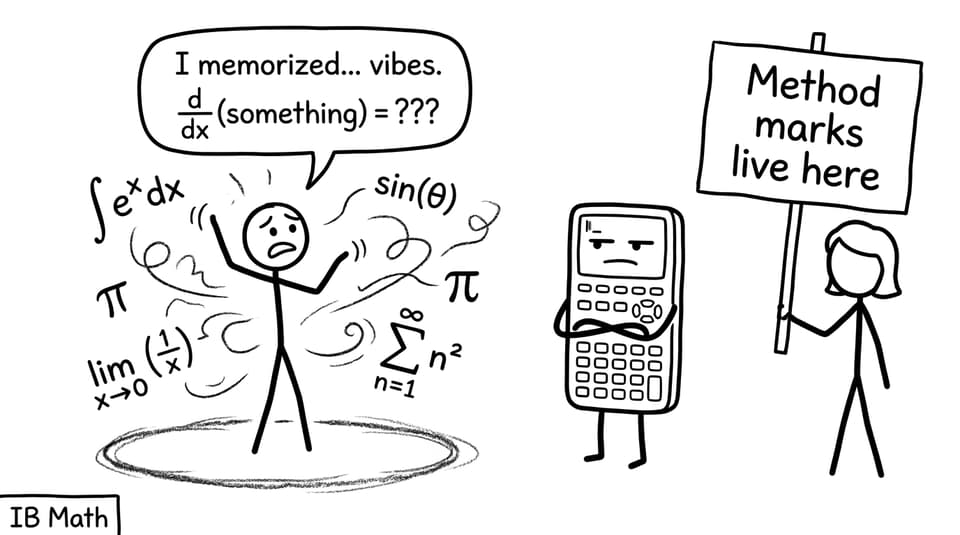
No. In IB Math exams, you are expected to use the official booklet provided by the examination. This matters because it changes your preparation strategy: instead of building a personal sheet, you build speed and confidence with the official layout. The smartest approach is to practice exactly as you will perform: booklet beside you, timed questions in front of you, and an error log ready. On RevisionDojo, you can recreate that pressure using topic practice first, then shifting into full-paper rehearsal with Mock Exams and Predicted Papers. It is a more honest form of preparation because it trains both memory and navigation. The result is fewer panicked page flips and more time spent earning method marks.
Does the IB Math AA HL formula booklet include every formula I need?
It includes a lot, but not “everything you will ever want.” In IB Math, you still need fluency with foundational ideas so you can start a solution without hesitation, especially under non-calculator constraints. The booklet won’t replace understanding: you still need to know which formula applies, what the symbols mean, and how to communicate steps clearly. A useful rule is this: if a formula appears constantly (like core trig identities or standard differentiation results), you should aim to know it without searching. Then use the booklet for confirmation, uncommon forms, or to reduce careless errors. To build that recall, combine Mathematics Analysis and Approaches Flashcards with focused practice and AI-supported feedback. That mix turns the IB Math booklet into a support tool, not a crutch.
How do I practice using the IB Math formula booklet without wasting time?
Practice “booklet-first” in short bursts. Pick one topic (say, calculus), do 5-8 questions, and force yourself to name the exact page/section you used after each question. This trains fast retrieval and keeps you from staring at the booklet hoping it will solve the problem for you. After marking, write a one-line note: “I used the correct formula but set up the limits wrong,” or “I forgot the dot product form.” Then immediately drill that micro-skill in the Questionbank. RevisionDojo’s tools make this loop smooth: Study Notes for the method, Questionbank for precision, AI Chat when you are stuck, and Grading tools to see what the examiner would reward. That is how IB Math revision becomes measurable instead of mood-based.
Conclusion: turn the IB Math booklet into an advantage
The IB Math AA HL formula booklet is already on your desk in the exam. Your job is to make it feel familiar enough that it saves time, reduces errors, and frees your brain for real problem-solving.
Start today by opening the IB Mathematics Analysis and Approaches Data Booklet, then run a short loop on RevisionDojo: Study Notes, Flashcards, Questionbank, and a timed rehearsal with Mock Exams and Predicted Papers. That’s how IB Math formulas become something you can use, not just recognise.