


IB Math AA HL Formula Booklet + Hardest Questions
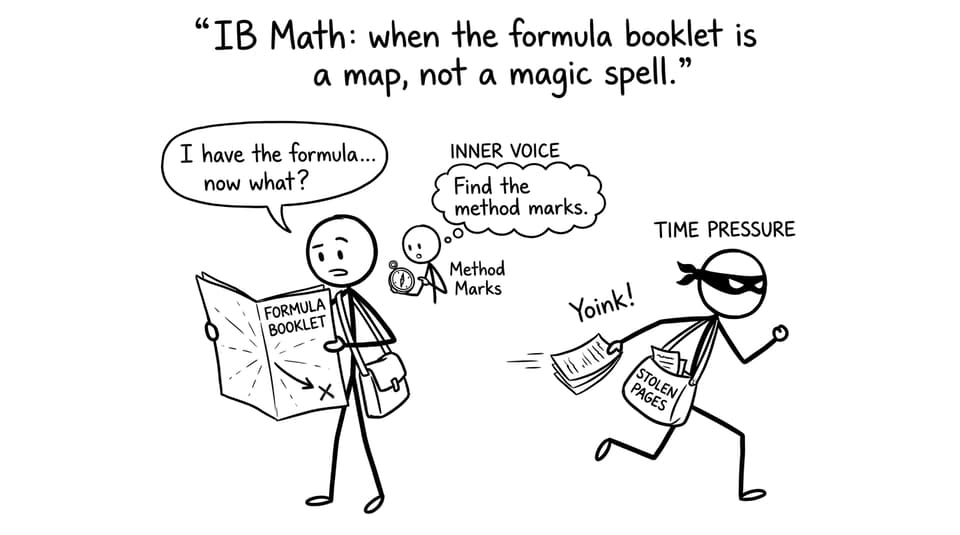
You sit down for IB Math AA HL revision, open the formula booklet, and feel a quick flash of relief. Then you try a “hard” question and realize something uncomfortable: the booklet doesn’t remove difficulty, it just removes excuses. The hardest problems were never about missing formulas. They were about choosing a method, controlling algebra, and staying calm long enough to finish.
In this guide, you’ll learn how to use the IB Math AA HL formula booklet like a tool (not a crutch), and what the hardest HL-style questions are really testing.
Quick checklist (save this before your next timed set)
-
Download the official-style booklet and practice navigating it fast: IB Mathematics Analysis and Approaches Data Booklet
-
Train 2 skills at once: “find the formula” + “justify why this method fits.”
-
Memorize a small core anyway (so you don’t burn time flipping pages).
-
Do mixed-topic drills weekly (because the hardest questions are rarely single-topic).
-
Use RevisionDojo to loop: notes: practice: feedback: retest.
What’s actually inside the IB Math AA HL formula booklet?
The IB Math AA HL booklet covers a wide spread: algebraic relationships, trigonometric identities, calculus rules, probability/statistics, and (for HL) the expectation that you can combine these pieces without being told what to use.
The key shift at HL isn’t “more formulas.” It’s more situations where formulas are only the starting line.
Two high-impact ways to get better fast:
-
Build topic fluency from the syllabus map, then drill weakness by section: IB Mathematics Analysis and Approaches Resources
-
Practice calculus under pressure (where most students lose structure): IB Math AA Calculus
If you want a deeper strategy for using the booklet efficiently, keep this open while you practise: How to Master the IB Math AA HL Formula Booklet.
Why the hardest IB Math HL questions feel “unfair”
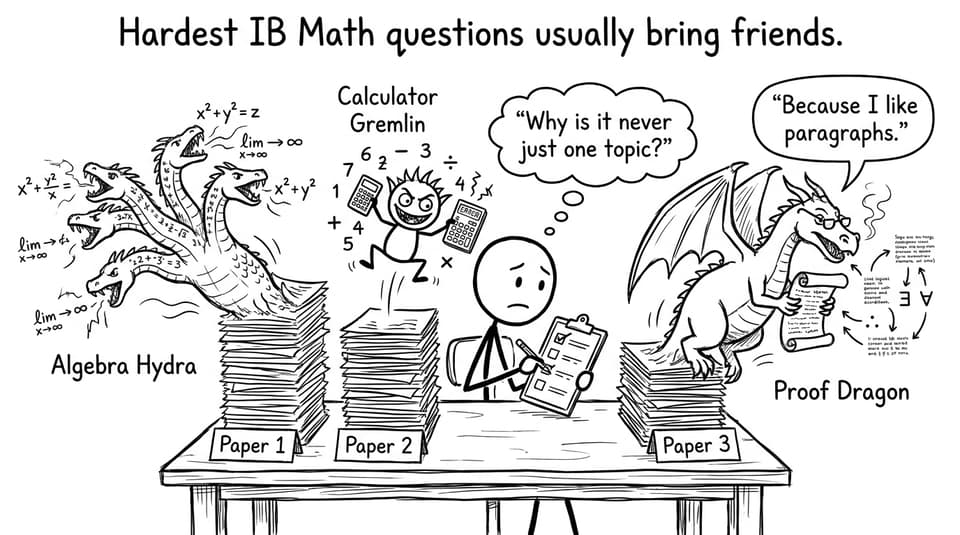
Hard IB Math AA HL questions usually share the same DNA:
They are multi-topic on purpose
You might start with functions, pivot into calculus, then finish with probability or interpretation. That’s not a trick. It’s what mathematical thinking looks like when it’s not neatly separated into chapters.
Train this by doing mixed drills from the Questionbank, not only single-skill worksheets: Number & Algebra Questionbank, plus targeted sets like Calculus Questionbank and Statistics & Probability Questionbank.
They demand communication, not just calculation
The hardest questions reward method marks: clear steps, definitions, and a reason your approach makes sense. The formula booklet supports this, but it can’t write your chain of reasoning.
They punish time drift
HL difficulty often becomes “running out of minutes.” Learn the Paper rhythm and decision-making: IB Math AA Paper 2: What to Expect and Score Smart.
A simple strategy for beating hard questions (without heroics)
When a question looks brutal, do this:
Start from the finish line
Write what the question is asking in your own words. In IB Math, clarity often creates the method.
Match the request to a “tool family”
-
“show that / prove”: structure + algebra control
-
“maximum/minimum”: derivative + sign/interpretation
-
“approximate / series / limit”: expansion logic (and careful order tracking)
Use RevisionDojo to shorten the stuck-time
When you stall, you don’t need motivation. You need the next step. RevisionDojo makes that loop tight: Study Notes for the method, Flashcards for the part you keep forgetting, Questionbank for repetition, AI Chat for debugging, and Grading tools to see where marks disappear. If you’re building full exam stamina, add IB Predicted Papers by IB Examiners (Free) and timed Mock Exams.

FAQ
Do I still need to memorize formulas if I have the IB Math booklet?
Yes, for a small set. In IB Math AA HL, the booklet prevents blank-mind moments, but it doesn’t prevent time loss. If you look up basics (like common derivatives, trig identities you use constantly, or core algebraic results), you trade marks for seconds. Memorising a short “high-frequency” list also reduces cognitive load, which matters when questions get long. Think of the booklet as your safety net, not your walking speed. Your goal is to save the booklet for less common relationships and for confidence-checking under pressure.
What topics create the hardest IB Math AA HL questions most often?
The hardest IB Math AA HL questions tend to appear where ideas overlap: calculus with functions, calculus with series/approximations, and probability/statistics with interpretation. Another common source is anything that requires proof-style reasoning or a careful written explanation, because that’s where method marks are earned and lost. Vectors (especially HL depth) also become difficult when the question is multi-step rather than computational. The pattern is consistent: difficulty rises when you must choose a pathway instead of following a template. That’s why mixed practice matters more than isolated drills.
How can RevisionDojo help me improve on the hardest HL questions quickly?
RevisionDojo helps by turning vague effort into a repeatable loop. You can learn the method from syllabus-aligned Study Notes, then immediately apply it in the Questionbank with exam-style prompts. When you get stuck, AI Chat can guide your next step without replacing your thinking, and Grading tools highlight where method marks were missed. Then you lock the fragile bits with Flashcards so the fix survives until exam day. Finally, you rehearse performance with Predicted Papers and Mock Exams, which is where hard IB Math questions stop feeling like surprises and start feeling like patterns.
Closing: the formula booklet is the start, not the solution
The IB Math AA HL formula booklet is powerful, but only if you’ve trained yourself to choose methods, show structure, and manage time. The hardest HL questions are designed to test that exact blend. If you want one home base to run the full improvement loop, use RevisionDojo: Questionbank, Study Notes, Flashcards, AI Chat, Grading tools, Predicted Papers, Mock Exams, Coursework Library, and Tutors, all built to make hard questions feel beatable, one attempt at a time.