

The quiet moment when IB ESS stops being “the easy option”
Some syllabus changes feel like a repaint. Others feel like the room has moved.
The IB ESS update (first teaching 2024, first examination 2026) is the second kind. It keeps the same big question -- how humans and natural systems collide and co-exist -- but it raises the bar on how you’re expected to think. The old approach of collecting neat definitions and a few familiar examples won’t carry you far anymore. The new IB ESS expects you to make decisions with evidence, compare perspectives, and explain trade-offs like someone who actually has to live with the outcome.
If you want the official-style overview in one place, start with RevisionDojo’s IB ESS new syllabus hub.
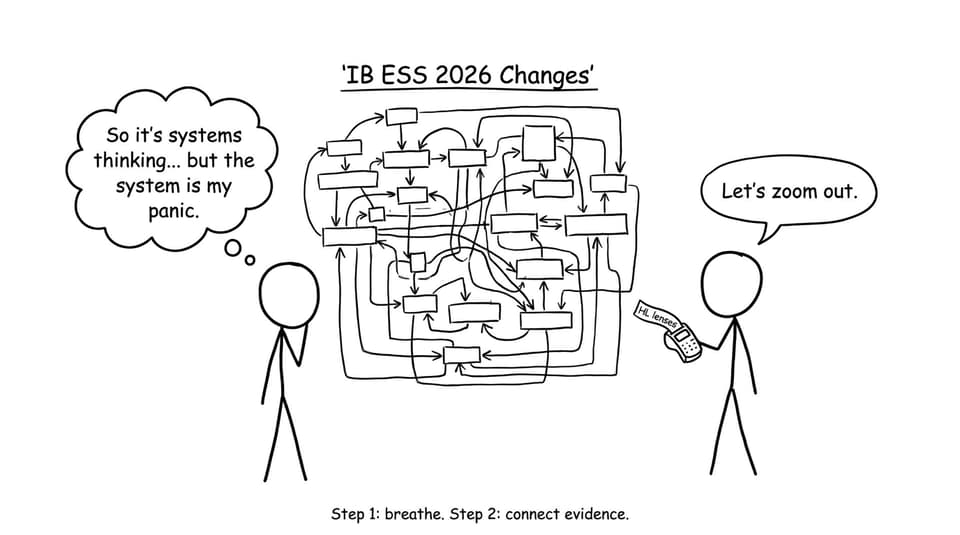
IB ESS 2026 changes checklist (save this)
Use this as your fast “what changed?” scan for IB ESS:
-
IB ESS now has SL and HL (first time).
-
HL adds three lenses: environmental law, ecological economics, environmental ethics.
-
Content is reorganised with clearer systems thinking and modern emphasis (climate change, urban systems, sustainability).
-
Skills are more central: data interpretation, inquiry, evaluation, case study application.
-
Assessment leans harder into real-world scenarios and competing viewpoints.
-
HL coursework expectations rise (more depth and synthesis).
To build your revision loop around exam-style practice, keep the RevisionDojo Questionbank open alongside your notes.
The biggest shift in IB ESS: SL vs HL finally becomes real
The headline change is simple: IB ESS is offered at Standard Level and Higher Level. But the practical meaning is bigger than the labels.
SL still gives you the interdisciplinary foundation: environmental science concepts tied to social systems and sustainability decisions. HL, however, pushes you into analysis that feels closer to first-year environmental studies: you’re not just describing problems, you’re evaluating responses using explicit frameworks.
In other words, HL is not “SL plus extra content.” HL is a different type of thinking.
Want a clearer sense of difficulty and workload? This reflection helps many students decide how to revise: How difficult is IB ESS vs other IB sciences?
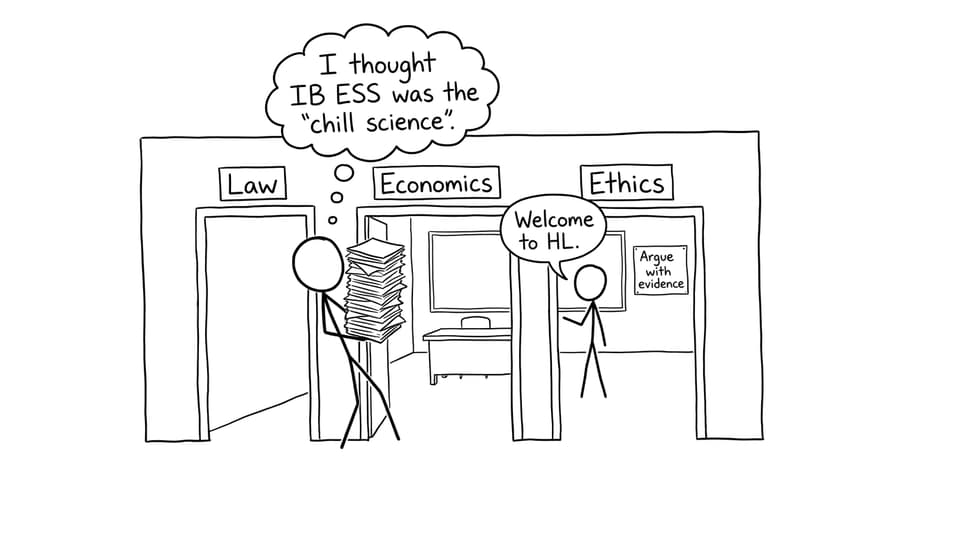
HL lenses: the new core skill in IB ESS
HL introduces three analytical lenses that shape how you argue:
-
Environmental law: rules, enforcement, governance, and policy mechanisms.
-
Ecological economics: scarcity, externalities, cost-benefit trade-offs, and who pays.
-
Environmental ethics: values, rights, justice, and moral reasoning.
What does this change in your answers?
It means a strong IB ESS response can’t just say “this management strategy reduced emissions.” It should also ask: Was it fair? Was it economically viable? Was it enforceable? Who benefited, and who was harmed?
A useful way to train this is to practise one question, then rewrite the evaluation paragraph three times -- once per lens. RevisionDojo’s Study Notes feature makes that process fast because you can refresh definitions without losing your momentum.
Content feels familiar, but it’s been reorganised for the world you live in
A lot of IB ESS topics still sound recognisable: ecosystems, biodiversity, water, sustainability, human pressures. The difference is emphasis and structure.
The new course more clearly reflects modern environmental reality:
-
Climate change becomes a unifying thread rather than a side topic.
-
Urban environments and human-modified systems matter more because that’s where most students actually live.
-
Sustainability and resilience aren’t slogans -- they’re decision frameworks.
If you want an example of how a single topic becomes a high-value exam area, see: IB ESS: Do you need urban systems for 2026 exams?
And when you’re revising a concrete unit, anchor it with a topic hub such as IB ESS Topic 4: Water.
Assessment changes: more data, more real-world decisions
The direction of travel is clear: IB ESS exams are increasingly about thinking with information.
Expect more of:
-
Data-based questions (interpreting unfamiliar graphs/tables)
-
Scenario questions where you propose and evaluate management responses
-
Perspective tension (stakeholders disagree, and you have to weigh them)
Your safest preparation strategy is repetitive exam-style practice with feedback. A simple routine is: read the question, answer under time, then use AI Chat to ask “What did I assume without evidence?” and “Where did I evaluate vs describe?”
For case study pressure (and how many you actually need), use: IB ESS case studies: how many to memorise for 2026
How to revise IB ESS for 2026 without burning out
Here’s a calm plan that fits the new IB ESS:
-
Build a small set of flexible case studies you can reuse across topics.
-
Practise data interpretation weekly, not “later.”
-
Train evaluation by always adding: benefits, limits, stakeholders, scale, uncertainty.
-
For HL, practise writing one paragraph through each HL lens.
A good structure is RevisionDojo’s loop: Study Notes (clarity) -> Flashcards (retention) -> Questionbank (marks) -> Grading tools (feedback) -> Mock Exams + Predicted Papers (timed realism) -> repeat.
To make that loop practical, start with: IB ESS revision: efficient Paper 1 + Paper 2 plan (2026)
FAQ
Is IB ESS harder in 2026?
Yes, IB ESS is more demanding in 2026, but not because it suddenly became a different subject. It’s harder because it rewards deeper thinking: interpreting data, evaluating solutions, and handling real-world ambiguity. Students who relied on memorising notes and repeating generic statements will feel the change first. Students who build a habit of using evidence and weighing trade-offs will often find the course more logical. The skill shift can actually reduce stress, because you stop trying to remember everything and start learning how to argue well. If you want to sanity-check your approach, use the IB ESS: what it is (and how the 2026 syllabus works) guide as your map.
What should HL students do differently in IB ESS?
HL students in IB ESS should practise writing with the three lenses from the beginning, not after the first mock. That means taking any management strategy (like a carbon tax or protected area) and asking legal, economic, and ethical questions about it. HL answers need clearer structure: claim, evidence, evaluation, limitation, and a perspective comparison. HL also benefits from keeping a short “stakeholder bank” so you can quickly show tensions in viewpoints. If your writing feels descriptive, use RevisionDojo’s Grading tools to see exactly where marks are lost and what evaluative language fixes it. You can also use RevisionDojo’s Tutors when you need someone to diagnose why your paragraphs aren’t reaching top bands.
How do I prepare for the IB ESS IA under the new syllabus?
Treat the IB ESS IA like a project that needs early decisions, not a document you write at the end. Start by choosing a research question that creates measurable data and allows meaningful evaluation (including uncertainty and limitations). Plan your method so it’s realistic to repeat and explain clearly, because clarity is often where marks are won. Collect data with enough range to analyse, not just enough to fill a table. Then write your evaluation like an examiner: what worked, what didn’t, what improved reliability, and what you’d change next time. To keep your IA aligned to the rubric, run drafts through the IB ESS (new) IA Grader and use RevisionDojo’s Coursework Library to compare your structure to strong exemplars.
Closing: treat IB ESS like decision-making practice
The 2026 update makes IB ESS feel more adult: more evidence, more perspectives, more accountability for what you claim. That can be intimidating for a week. Then it becomes freeing, because the goal stops being “know everything” and becomes “think clearly under pressure.”
Build your routine around RevisionDojo’s Questionbank, Study Notes, Flashcards, AI Chat, Grading tools, Predicted Papers, Mock Exams, Coursework Library, and Tutors and you’ll prepare for IB ESS the way the new syllabus actually rewards: by connecting systems, evidence, and real-world choices.