
IB English has a strange kind of honesty.
You can read a novel twice, highlight half of it, and still freeze when an unseen text lands in front of you. You can memorize quotes and still write an essay that somehow says a lot… while proving very little. The students who improve fastest in IB English usually aren’t the ones who feel "naturally good" at it. They’re the ones who treat every task like a lab report: observe, adjust, repeat.
Reflection turns practice into progress. Feedback turns effort into direction. Continuous improvement turns the whole course into something you can actually control.
A quick IB English improvement checklist
Keep this small on purpose. In IB English, consistency beats intensity.
-
After each essay or oral, write three sentences of reflection: what worked, what didn’t, what you’ll change.
-
Turn feedback into one measurable target (not five vague goals).
-
Redo one paragraph or one 60-second oral segment using the target.
-
Rehearse under time at least once a week.
-
Use a rubric-aligned tool to check if the change actually raised the level.
If you want a clear overview of what you’re training for, start with Preparing for IB English A: Literature Exams.
Why reflection matters in IB English
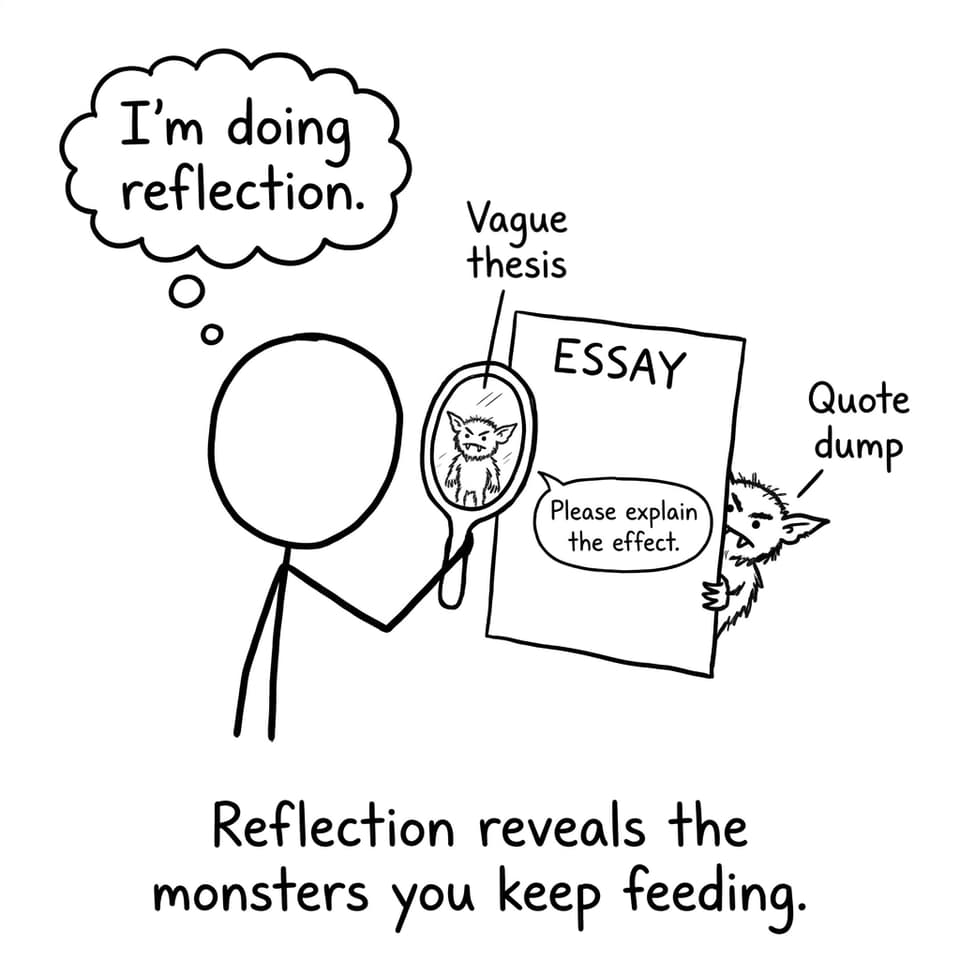
Most students reflect accidentally. They finish an essay, feel relieved, and move on. But IB English rewards the ability to notice what your writing is really doing.
Reflection is how you stop repeating the same invisible mistakes: summarizing instead of analyzing, dropping quotes without explaining effects, or writing introductions that sound impressive but never commit to an argument.
A useful way to reflect is to track patterns across tasks. If you keep losing marks for focus and organization, it’s not a one-off. It’s a system problem. In IB English, system problems are good news because systems can be redesigned.
For Paper 1 skill-building, you can pair reflection with a method-driven routine from IB English Paper 1 Revision: A Step-by-Step Guide.
How to use feedback without getting stuck
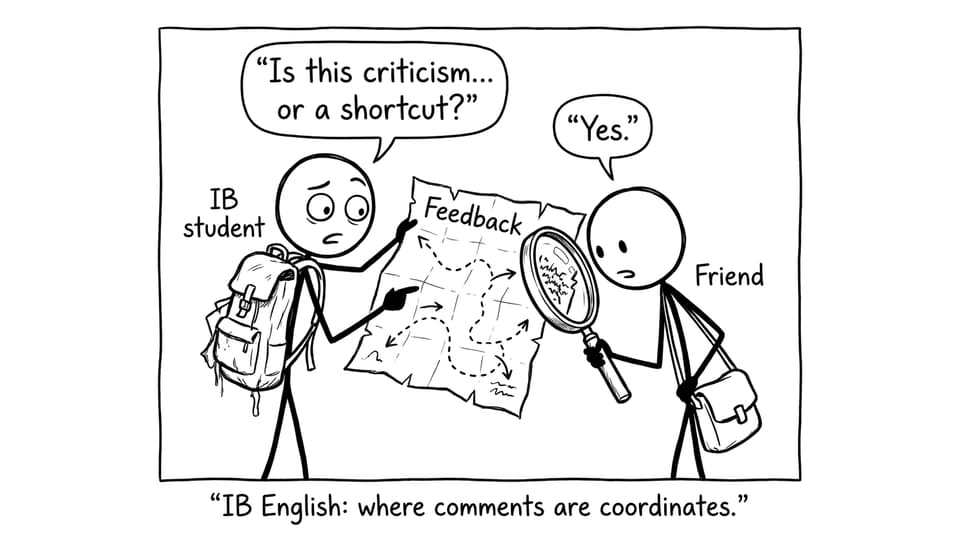
Feedback only helps if you can convert it into an action you can repeat.
Try this three-part filter:
Translate the comment into a behavior
-
“More analysis” becomes: After each quote, explain effect + purpose in one sentence.
-
“Stronger thesis” becomes: Answer the question directly, then name 2 techniques you’ll prove.
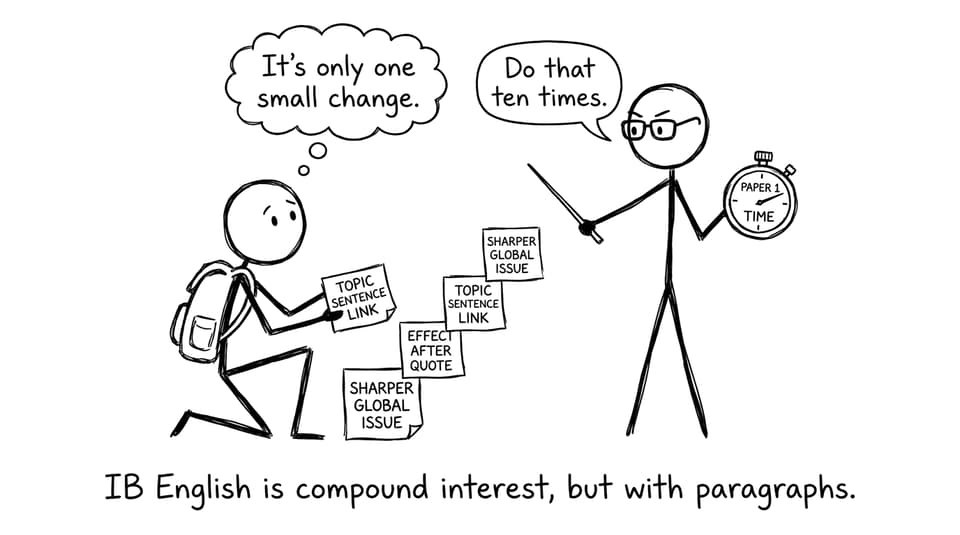
Make it smaller than you think it should be
In IB English, one upgraded paragraph can shift your whole essay. Aim for a change you can practice three times this week, not a reinvention of your personality.
Verify it against the rubric
This is where many students guess. A calm shortcut is using a rubric tool that shows you what the criteria are actually asking. RevisionDojo’s IB English Language and Literature Paper 1 Grader helps you check whether your revision improved knowledge, analysis, organization, and language.
When you’re ready to practice at volume, RevisionDojo’s ecosystem makes the loop tighter: Study Notes to clarify concepts, Flashcards to retain techniques and key terms, and the Questionbank to apply under exam conditions. If you want the full workflow, bookmark RevisionDojo App: The Smarter Way to Prep for IB Exams.
Continuous improvement across Paper 1, Paper 2, and the IO
IB English looks like three separate challenges. Underneath, it’s one repeating skill: making a claim, proving it with method, and staying focused.
IB English Paper 1: improve your method, not your mood
Paper 1 is the place where reflection pays off fastest because you can run many short reps.
Two high-impact reflection questions:
-
Did my paragraphs stay technique-led, or did they drift into summary?
-
Did I explain how the choice creates meaning, not just that it exists?
If you mix up Paper 1 and Paper 2 practice, use IB English: Best Way to Study for Paper 1 vs Paper 2 to keep your sessions aligned.
IB English Paper 2: reflection builds a reusable comparison frame
Paper 2 punishes beautiful insights that arrive too late. Reflection helps you standardize your planning so you can think clearly under time.
A practical upgrade target:
- Build one “comparison spine” you reuse: thesis + 3 comparative angles + micro-evidence for each text.
To refine your structure, see Structuring Your IB English Paper 2 Essay and keep IB English Paper 2 Structure: Lang & Lit Guide open when you review.
IB English Individual Oral: feedback is easiest when you record yourself
The IO improves dramatically when you stop relying on how it felt and start using what it sounded like.
Your best loop:
-
Record one run.
-
Choose one fix (signposting, global issue clarity, or extract integration).
-
Record again.
For guidance and practice tools, use IB English Individual Oral: Strategies + Practice Tools and the broader IB Oral (IO) Guide: Language & Lit and Literature.
FAQ
How often should I reflect when studying IB English?
In IB English, reflect after every meaningful output: a timed paragraph, a full essay, or an oral rehearsal. If you only reflect once a month, you’ll forget the exact decision that caused the mistake. The goal is not journaling for its own sake, but capturing a repeatable lesson while it’s still fresh. Keep it short: three bullets is enough. Over time, those bullets become your personal markscheme of what actually raises your score. That is how continuous improvement becomes real instead of motivational.
What if feedback feels confusing or inconsistent?
That happens often in IB English because comments can be broad (“develop your analysis”) while your problem is specific (you aren’t explaining effects). Your job is to translate the comment into a behavior you can test. Ask one clarifying question: “Do you mean my thesis is unclear, or my paragraphs aren’t proving it?” Then run a controlled experiment: rewrite one paragraph using the new behavior and compare it to the old version. Tools like RevisionDojo’s grading features can help you map feedback to rubric strands so it stops feeling subjective. Confusing feedback becomes useful when it produces a concrete next step.
Can reflection and feedback reduce exam anxiety in IB English?
Yes, because anxiety often comes from unpredictability. When you build a reflection loop, you start seeing patterns: which prompts derail you, what your common time traps are, and which paragraph structure keeps you focused. That turns revision into preparation rather than hope. Feedback also lowers the emotional temperature because it becomes data, not judgment. When you know your next improvement target, you walk into Paper 1, Paper 2, or the IO with a plan you’ve already tested. In IB English, confidence is usually the side effect of a reliable process.
Closing: make IB English a system you can trust
The quiet advantage in IB English is not talent. It’s iteration.
When you reflect clearly, you stop practicing the same mistakes. When you use feedback actively, you stop guessing what “better” means. And when you repeat small upgrades across weeks, your writing starts to feel inevitable in the best way.
If you want one place to run that loop, RevisionDojo is built for it: targeted Study Notes, recall-ready Flashcards, exam-style Questionbank practice, rubric-aligned Grading tools, supportive AI Chat, realistic Mock Exams and Predicted Papers, plus a Coursework Library and Tutors when you need a human checkpoint. Use RevisionDojo to turn IB English into a steady process of reflection, feedback, and continuous improvement -- right up to exam day.


