


In IB Digital Society, marks often disappear quietly.
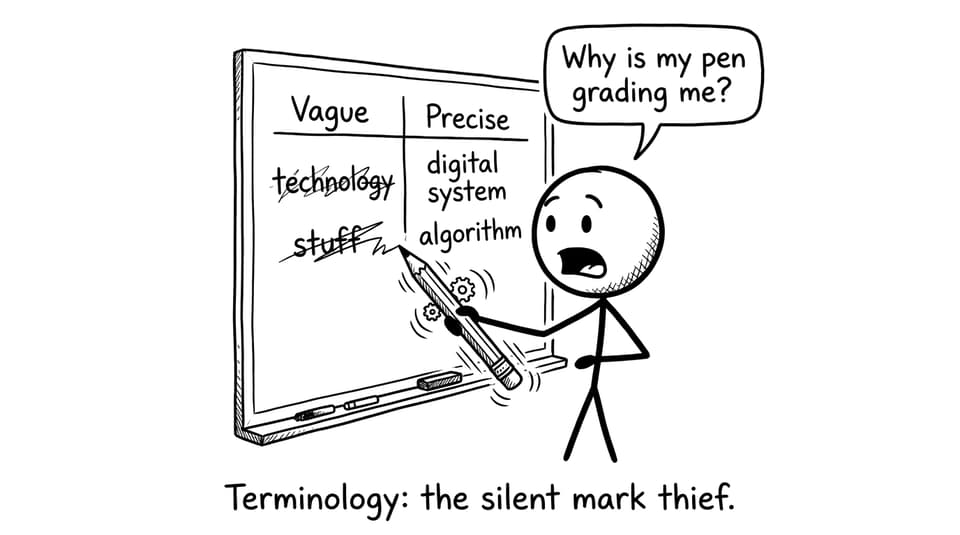
Not because you lack opinions, or because your examples are weak, but because your language is soft. You write “technology affects people” when the course wants you to name a digital system, trace its mechanisms, and evaluate its impacts on individuals and communities. That gap between what you mean and what you write is where examiners stop awarding credit.
This glossary is designed to fix that. It gives you a clean, exam-focused set of IB Digital Society terms, plus guidance on how to use each one in analysis, evaluation, and the internal assessment.
If you want a structured place to practise these terms immediately, keep the IB Digital Society resources hub open alongside this article.
Quick checklist: how to use this IB Digital Society glossary
Use this IB Digital Society glossary like a toolkit, not a list to cram.
-
Pick 8-12 terms you keep using vaguely.
-
Rewrite each definition in one sentence you could say out loud.
-
For each term, write one exam-ready line: term + mechanism + impact + stakeholder.
-
Drill application with timed practice in RevisionDojo’s Questionbank.
-
When your wording feels fuzzy, ask a targeted question in AI Chat (for example: “Is this impact actually ethics or accountability?”).
For a bigger revision routine that fits the course, see Revision Strategies That Work for IB Digital Society.
Why terminology matters in IB Digital Society
IB Digital Society is concept-driven. Examiners reward answers that show you can move from a specific digital system to a defensible evaluation. Precise terms are how you make your thinking visible.
Terminology helps you:
-
avoid generic “tech is good/bad” claims
-
show you understand mechanisms (how outcomes are produced)
-
link a case study to concepts like power, ethics, or inequality
-
write with control under time pressure
If you want the course framed clearly first, What Is IB Digital Society? A Beginner’s Guide is a useful orientation.
Core IB Digital Society glossary terms (with exam usage)
Digital system
A digital system is a set of connected digital components that collect and process data to produce outcomes.
How to use it in IB Digital Society: Always name the specific system (platform, feature, model, policy, device). “Technology” is usually too broad to analyse.
Exam-ready sentence starter: “This digital system shapes outcomes by collecting X data, processing it through Y rules, and producing Z effects for stakeholders.”
Algorithm
An algorithm is a rule-based or data-driven process a digital system uses to sort information, make predictions, or automate decisions.
How to use it in IB Digital Society: Focus on purpose, inputs/outputs, feedback loops, and who benefits. You do not need computer science detail.
For deeper exam guidance, read IB Digital Society: Algorithms Explained for Exams.
Data
Data is information collected about users, behavior, or environments that digital systems store and process.
How to use it in IB Digital Society: Specify data types (location, clicks, biometrics, purchase history), then evaluate control, access, and consequences.
Common upgrade: Replace “they collect data” with “they collect behavioral data to infer preferences, then use it to personalize content.”
Automation
Automation is the use of digital systems to perform tasks with minimal human intervention.
How to use it in IB Digital Society: Link automation to responsibility and error. Ask what humans no longer do, and what happens when the system is wrong.
Power
Power is the ability to control, influence, or benefit from digital systems.
How to use it in IB Digital Society: Power is concrete. Identify who designs the system, who owns infrastructure or data, and who can challenge decisions.
If you want a wider concept lens, see IB Digital Society: Key Themes Explained.
Ethics
Ethics is reasoned evaluation of whether a digital system and its impacts are justified.
How to use it in IB Digital Society: Ethics is not “I feel.” It is structured judgment based on harm, fairness, rights, and trade-offs.
Exam-ready move: State a value (fairness, autonomy, well-being), then evaluate how the system supports or violates it.
Agency
Agency is an individual’s ability to make informed choices and act independently within digital systems.
How to use it in IB Digital Society: Look for manipulation, hidden defaults, dark patterns, or automated decisions that narrow real choice.
Privacy
Privacy is control over personal information and how it is collected, shared, and used.
How to use it in IB Digital Society: Privacy is contextual. Evaluate consent quality, necessity, proportionality, and downstream use.
Surveillance
Surveillance is the monitoring of individuals or groups through digital systems.
How to use it in IB Digital Society: Move beyond cameras. Tracking, profiling, and behavioral prediction are central.
Bias
Bias is when a digital system produces systematically unfair outcomes, often affecting groups unevenly.
How to use it in IB Digital Society: Identify where bias can enter: training data, design decisions, deployment context, or feedback loops.
Inequality
Inequality is uneven distribution of benefits, risks, or access created or reinforced by digital systems.
How to use it in IB Digital Society: Analyse which communities gain convenience and which communities carry costs (exclusion, misclassification, exploitation).
Transparency
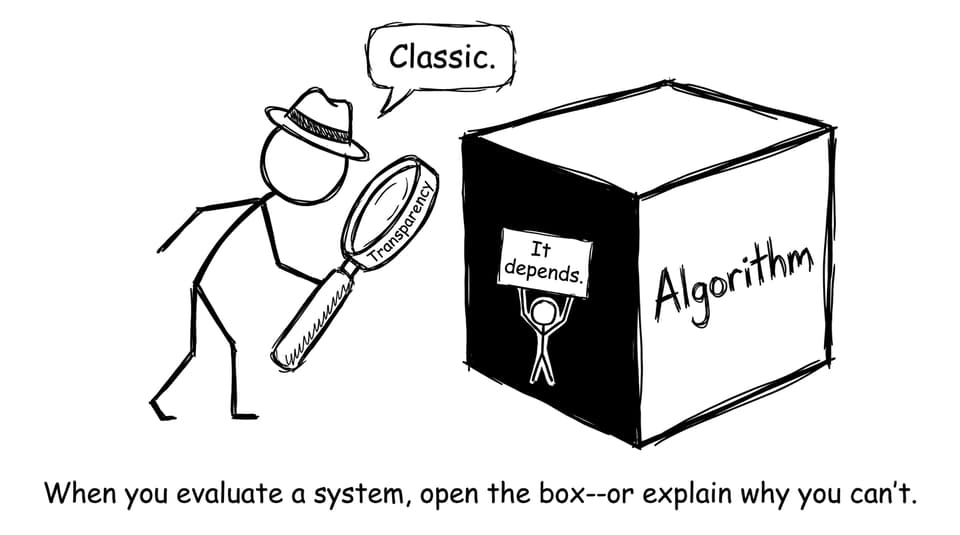
Transparency is how open and understandable a digital system’s processes and decisions are.
How to use it in IB Digital Society: Explain whether stakeholders can understand, audit, or contest outcomes. Lack of transparency often concentrates power.
Accountability
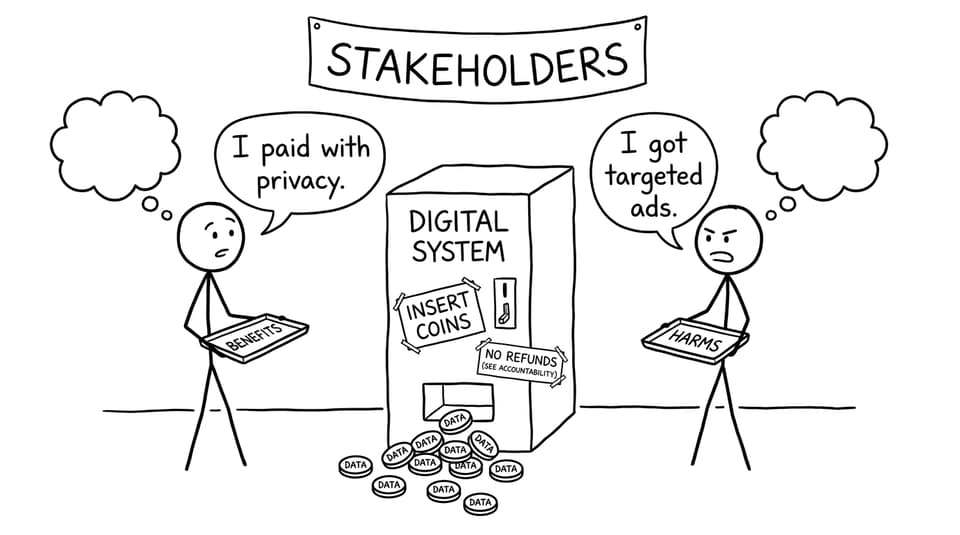
Accountability is clarity about who is responsible when a digital system causes harm, and what mechanisms exist to address it.
How to use it in IB Digital Society: Name the responsible actors (platform, developer, government, institution), then evaluate enforcement and redress.
Change
Change is how digital systems transform behavior, norms, institutions, or structures over time.
How to use it in IB Digital Society: Prove change with before/after comparisons and mechanisms, not headlines.
To practise this concept, see Understanding Change in Digital Society.
Community
A community is a group affected collectively by a digital system (local, national, online, or identity-based).
How to use it in IB Digital Society: Push beyond individual experience. Show patterns: who is repeatedly advantaged or disadvantaged, and why.
Common mistakes students make with IB Digital Society terms
In IB Digital Society, most terminology mistakes are really thinking mistakes in disguise.
-
Calling everything “ethics”: sometimes it’s accountability, power, or inequality.
-
Treating power as abstract: always ground it in ownership, control, and decision rights.
-
Describing instead of analysing: you list features, but never explain mechanisms or impacts.
-
Using buzzwords without links: “AI” is not analysis unless you connect it to data, bias, transparency, and outcomes.
Command terms help you control this quickly. Keep IB Digital Society Exam Command Terms Explained nearby when you practise.
How to revise this IB Digital Society glossary efficiently
A calm way to revise IB Digital Society terms is to build a loop you can repeat.
-
Study Notes: clarify a term once, cleanly, without rewriting for hours. Use the IB Digital Society revision notes.
-
Flashcards: lock definitions and “exam sentences” into active recall with Digital Society Flashcards.
-
Questionbank: apply terms under exam pressure using RevisionDojo Questionbank.
-
AI Chat + Grading tools: when your evaluation feels thin, get feedback and rewrite one paragraph, not your whole life.
-
Mock Exams + Predicted Papers: practise terminology when you are tired and timed, because that’s when precision matters most.
If you’re also working on coursework, the IB Digital Society Internal Assessment Guide helps you align these terms with what criteria actually reward.
FAQ: IB Digital Society glossary and exam terminology
How many IB Digital Society terms should I memorise?
You do not need to memorise a huge dictionary for IB Digital Society. What you need is a smaller set of terms you can use accurately, repeatedly, and flexibly under time pressure. A practical target is 15-25 core terms (like the ones in this IB Digital Society glossary) plus a handful of topic-specific terms linked to your favorite case studies. The real skill is not reciting definitions but applying them to a specific digital system in a way that shows mechanism and impact. If a definition never appears inside an analytical sentence, it probably will not earn you marks. Build toward fluency: you should be able to explain a term in your own words and then apply it to an unseen stimulus.
What’s the difference between privacy and surveillance in IB Digital Society?
In IB Digital Society, privacy is about control: who can access personal information, how it is used, and whether consent is meaningful. Surveillance is about monitoring: the act of tracking individuals or groups, often continuously, through digital systems. The two overlap because surveillance often relies on large-scale data collection that reduces privacy. But they are not identical: a system can collect data with consent (privacy question) while still enabling broad monitoring or profiling (surveillance question). In exam answers, you can score higher by separating them: define what data is taken, then evaluate how that data enables monitoring and power imbalance. Finally, link to accountability: who can challenge the monitoring and what limits exist.
How do I show “evaluation” using glossary terms in IB Digital Society?
Evaluation in IB Digital Society means you weigh trade-offs and justify a judgment using concepts and evidence. Glossary terms give you the structure: for example, you can evaluate an algorithm by discussing bias (fairness), transparency (explainability), accountability (who is responsible), and agency (user autonomy). You should also identify stakeholders, because evaluation without stakeholders becomes abstract. A strong evaluative paragraph usually contains: a clear claim, one benefit, one harm, and a justified conclusion about whether the system is acceptable in context. It also helps to acknowledge uncertainty: what you cannot know due to lack of transparency, or what might change over time. If you want to practise this under timed conditions, do short sets using RevisionDojo tools, then refine one paragraph at a time.
Closing: turn IB Digital Society vocabulary into marks
This IB Digital Society glossary is not here to make you sound impressive. It’s here to make you precise.
When you can name a digital system, explain its data and algorithms, and evaluate power, ethics, privacy, surveillance, bias, and accountability, your writing stops drifting. It starts landing.
Keep your revision anchored in RevisionDojo: learn quickly with Study Notes, lock terms with Flashcards, apply them in the Questionbank, and sharpen your evaluation with AI Chat, Grading tools, Mock Exams, Predicted Papers, the Coursework Library, and Tutors. That’s how IB Digital Society terminology becomes confident, exam-ready thinking.