


When you open an IB Digital Society exam paper, it rarely feels like a gentle check of what you studied. It feels like a live test of judgment: unfamiliar systems, dense prompts, and a clock that seems to run faster when you start writing.
The strange part is this: most mark losses in IB Digital Society are not from “not knowing enough.” They’re from leaking marks through rushed reading, loose structure, or panic when the example is unfamiliar.
This is an IB Digital Society exam day strategy designed to keep your thinking calm and your marks high.
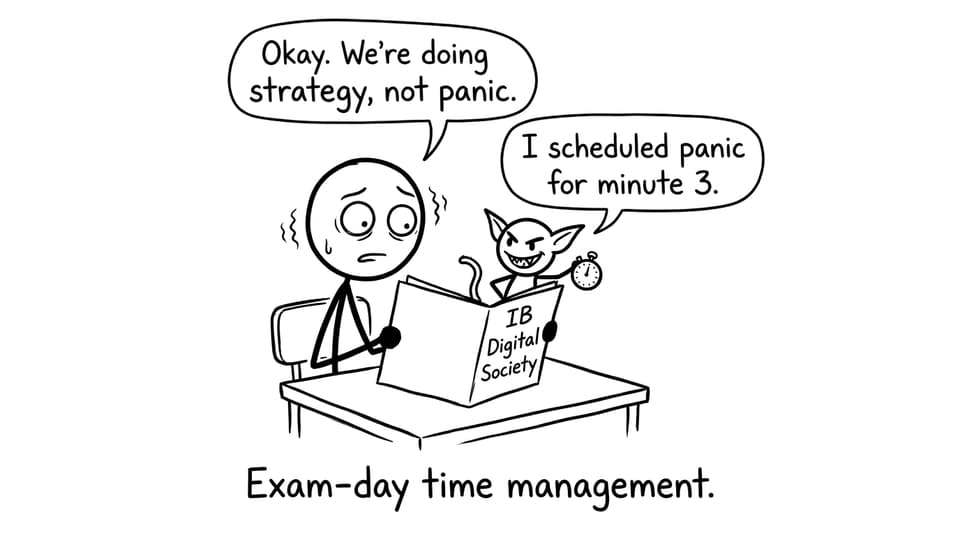
IB Digital Society exam day checklist (fast)
Use this as your 60-second reset before you write a single sentence.
-
Scan marks and command terms first (your time budget is hidden there).
-
Read the stimulus twice and underline what the question is actually asking.
-
Plan for 30--60 seconds: 2--4 bullet points max.
-
Write in visible structure: paragraph-per-idea, impact-per-stakeholder.
-
Evaluate with a decision: trade-offs, then judgment.
If you want your prep to match this strategy, anchor it in the IB Digital Society resources hub so you can move between Study Notes, Flashcards, and Questionbank practice quickly.
Why exam-day strategy matters in IB Digital Society
A good IB Digital Society student can still underperform if the exam turns into improvisation. The paper rewards clear interpretation and disciplined analysis. That means you lose marks when you:
-
answer a different question than the one asked,
-
spend too long perfecting early responses,
-
describe the digital system without analyzing impacts,
-
forget communities, power, or ethical implications.
This is why timed rehearsal matters. RevisionDojo’s Questionbank feature is useful here because it forces the same pattern again and again: interpret, respond, check feedback, tighten structure.
The first five minutes: calm beats clever
Your goal at the start of an IB Digital Society exam is not brilliance. It’s stability.
Try this routine:
-
Breathe, then tell yourself: “Unfamiliar examples are the point.”
-
Look at the marks per question and silently decide your time limits.
-
Commit to moving on when time is up (you can return later).
That small promise keeps your thinking sharp later, when fatigue hits.
Read like an examiner: command terms decide format
In IB Digital Society, command terms are the blueprint. If you miss them, your answer may be well-written but structurally wrong.
A practical method:
-
Read the question.
-
Circle the command term (for example: discuss, evaluate, to what extent).
-
Identify the digital system in the stimulus (platform, policy, algorithm, device, network).
-
Check whether it asks for individuals, communities, ethics, or power explicitly.
If your course revision feels scattered, RevisionDojo’s explanation of key themes in IB Digital Society gives you reusable lenses to spot what the question wants.
Plan in 30--60 seconds (or your answer will wander)
Planning sounds slow, but it saves time because it prevents rewrites and repetition.
For most IB Digital Society extended responses, a tiny plan is enough:
-
Idea 1 (mechanism): how the system creates the effect.
-
Idea 2 (impact): one strong impact on individuals.
-
Idea 3 (community/power): who gains control, who loses agency.
-
Idea 4 (ethics/evaluation): trade-off and judgment.
If you struggle to find a mechanism quickly, build that skill by practicing “mini-plans” with RevisionDojo’s IB Digital Society Topic 3: Content page and then immediately applying it in Questionbank.
How to handle unfamiliar digital systems in IB Digital Society
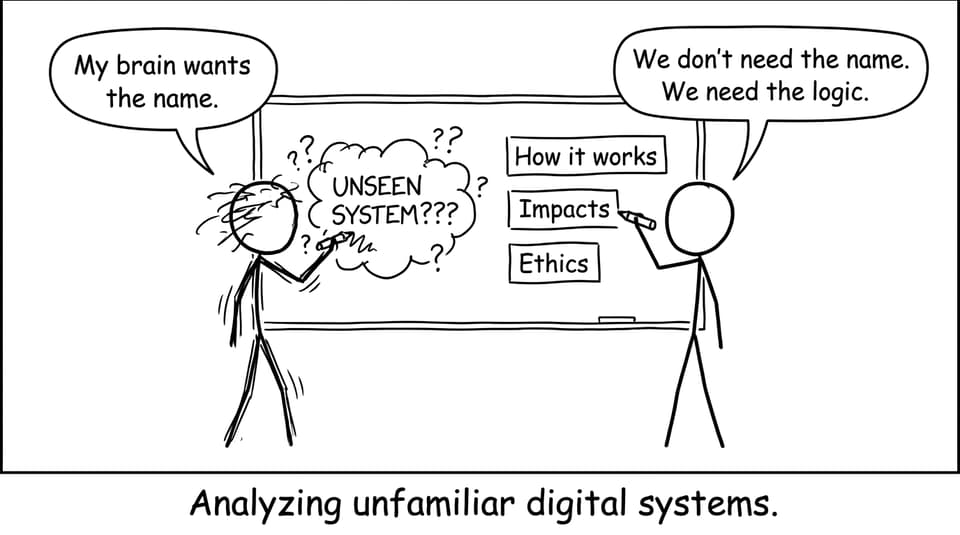
The exam is designed to show you something you haven’t revised directly. That does not mean you’re stuck. In IB Digital Society, you are assessed on transferable thinking.
Ask three questions:
-
How does it work? (inputs, outputs, incentives, feedback loops)
-
Who does it change? (individual behavior, community norms, institutions)
-
Who is accountable? (designers, platform owners, governments, users)
For algorithm-heavy prompts, keep a ready mental template. The RevisionDojo guide on IB Digital Society algorithms explained for exams is a strong reference for the “inputs--outputs--feedback loop--power” structure.
Structure that makes marks easy to award
Examiners reward answers they can mark quickly. Your structure is a kindness to them, and a weapon for you.
A reliable IB Digital Society paragraph pattern:
-
Point: one sentence that answers the question.
-
Mechanism: how the digital system causes the outcome.
-
Impact: specify impact on individuals and/or communities.
-
Mini-judgment: why that impact matters (and for whom).
When evaluation is required, add a short conclusion with a decision: which side is stronger and under what conditions?
Time management: protect the whole paper
In IB Digital Society, a perfect answer to one question can be less valuable than decent answers to all questions.
Use these rules:
-
Spend time proportional to marks.
-
If you hit your time limit, move on mid-sentence if needed and finish later.
-
If you’re stuck, write a “skeleton answer”: 3 bullet points with one example each.
To train this calmly before the real exam, do one timed session weekly using RevisionDojo’s Mock Exams and practice workflow and add targeted drills from the Questionbank the next day.
Ethics without fear: short, sharp, justified
Ethics in IB Digital Society can feel like a trap because students either avoid it or write a vague speech.
A high-mark ethics move is simple:
-
Name the ethical tension (privacy vs safety, autonomy vs convenience, equality vs efficiency).
-
Weigh one benefit and one harm.
-
Decide, with a condition (for example: acceptable only with transparency and consent).
If you want a deeper lens on how IB expects you to think, RevisionDojo’s post on the role of inquiry in IB Digital Society helps you keep evaluation grounded rather than opinion-based.
Common exam-day mistakes (and quick fixes)
These are frequent in IB Digital Society, and they’re fixable.
-
Over-describing the system -> replace description with “because” and “therefore.”
-
Repeating the question -> turn the question into a claim, then add mechanism.
-
Only writing about individuals -> add one community-level impact every time.
-
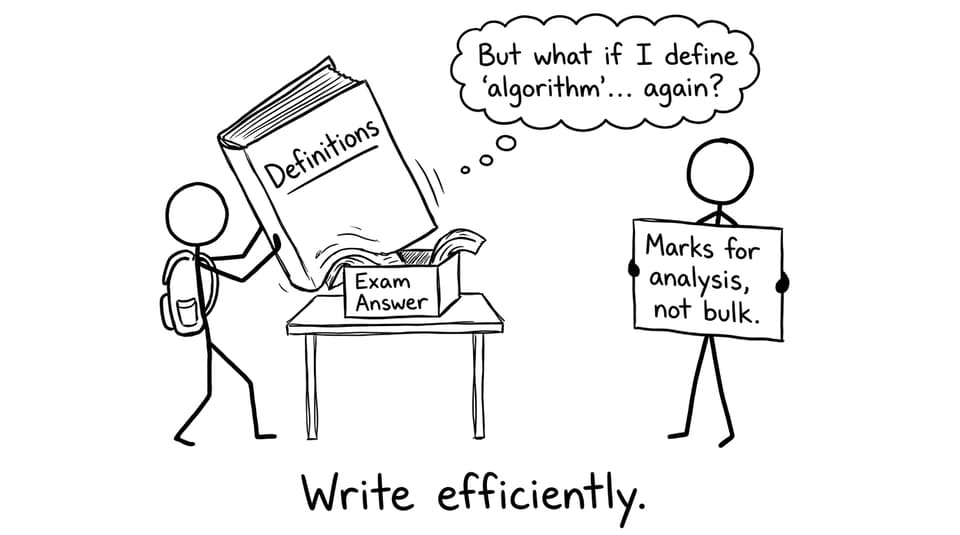
Jargon dumping -> use terms only when they sharpen analysis.
If you want a broader prep mindset that supports this exam-day strategy, RevisionDojo’s IB Digital Society survival guide is a good companion read.
FAQ
What should I do if I panic during the IB Digital Society exam?
Start by slowing your body down, because the brain follows. Put your pen down for ten seconds, inhale for four counts, exhale for six, and then look only at the next command term. In IB Digital Society, panic usually comes from the feeling that you must recognize the example, but you don’t. The exam expects you to analyze what’s in front of you, not prove that you’ve seen it before. Give yourself one tiny task: underline the digital system, circle the command term, and write a 3-bullet plan. Once you have a plan, you have traction, and once you have traction, the panic usually fades.
How do I write high-scoring evaluation in IB Digital Society without writing too much?
Evaluation is not length, it’s judgment with reasons. In IB Digital Society, you can often earn strong marks by weighing two outcomes, naming who benefits and who is harmed, and then choosing which outcome is more significant. A useful sentence frame is: “While X improves Y for group A, it risks Z for group B, so overall…” Then add one condition that changes the judgment, such as regulation, transparency, user consent, or unequal access. This shows you understand trade-offs, not just one-sided impacts. Finally, avoid vague endings like “it depends” unless you immediately specify what it depends on.
What is the best way to practice for IB Digital Society exam day conditions?
Practice has to resemble the exam, especially in timing and uncertainty. Start with short timed sets in a questionbank so you learn to interpret prompts quickly, not just recall notes. Then review your responses for patterns: did you miss the command term, lose structure, or forget community impacts? Use RevisionDojo’s Making the most of IB question banks and practice papers approach: attempt, get feedback, rewrite one answer more cleanly, then repeat. Add Flashcards for the specific terms and frameworks you keep forgetting, not for everything. Finally, simulate pressure occasionally with predicted-style practice and mock exams so your skill survives when the clock is loud.
Closing: turn preparation into performance
The IB Digital Society exam rewards students who can stay clear when the scenario is unfamiliar and the time is tight. Read slowly, plan briefly, write in visible structure, and treat ethics as a disciplined trade-off rather than a speech.
If you want one place to train this exact exam-day strategy, use RevisionDojo as your home base: Study Notes for fast clarity, Flashcards for daily recall, Questionbank for exam-style practice, AI Chat when you’re stuck, Grading tools for feedback, and timed realism through Predicted Papers and Mock Exams. Add the Coursework Library and Tutors when you want examples and human guidance.
Build calm on purpose, and your IB Digital Society marks will follow.
