


If you have ever opened your planner, looked at IB Design Technology, and felt that specific kind of stress that is half excitement and half uncertainty, you are not alone. DT is one of the few IB subjects where creativity is not a bonus feature; it is the point. But the exam does not grade “creativity.” It grades evidence: terminology, application, and decisions you can justify.
That is why understanding the IB Design Technology assessment structure early is like finding the legend on a map. The terrain is the same, but suddenly you know where the steep climbs are.
Quick checklist: the IB Design Technology assessment at a glance
Here is the simple structure you should be able to explain in under 20 seconds:
-
First exams: 2027 (new syllabus)
-
Two assessment routes: external exams + Internal Assessment (IA)
-
External papers:
-
Paper 1: multiple-choice
-
Paper 2: data-based questions + extended response
-
Paper 3: HL only, structured questions based on a case study
-
-
IA: an individual design project following a design cycle / design thinking process
-
Weighting differs by level: SL depends more on IA than HL
For an always-updated home base, keep the IB Design Technology resources hub open while you plan.
External assessment in IB Design Technology: what each paper really rewards
External assessment in IB Design Technology is not just “how much you know.” It is “how quickly you can apply what you know to a context you did not choose.” Each paper asks for a different kind of thinking.
Paper 1 in IB Design Technology: multiple-choice with sharp edges
Paper 1 is multiple-choice, which sounds friendly until you meet the mark scheme logic. The questions tend to reward:
-
precise key definitions and terminology
-
quick recognition of concepts (materials, processes, sustainability, design theory)
-
clean, low-drama application to a small scenario
The best preparation is boring in the right way: frequent, short practice sets. RevisionDojo makes this easy with the IB Design Technology Questionbank, plus Flashcards for daily recall and AI Chat when a definition feels “almost right” but not exam-ready.
Paper 2 in IB Design Technology: data response + extended response
Paper 2 is where students often lose time, not marks. It blends short responses with longer answers that expect structure, not vibes.
To do well, you need to:
-
read design data quickly (tables, test results, user feedback)
-
make a claim that answers the command term
-
justify using DT concepts (not personal preference)
-
evaluate trade-offs clearly (cost vs sustainability, performance vs safety, user needs vs manufacturability)
If your notes are currently long paragraphs, convert them into tools. A strong next step is building topic-by-topic clarity with IB Design Technology Revision Notes (SL/HL), then drilling those topics with Questionbank sets.
Paper 3 in IB Design Technology (HL only): case study thinking under time
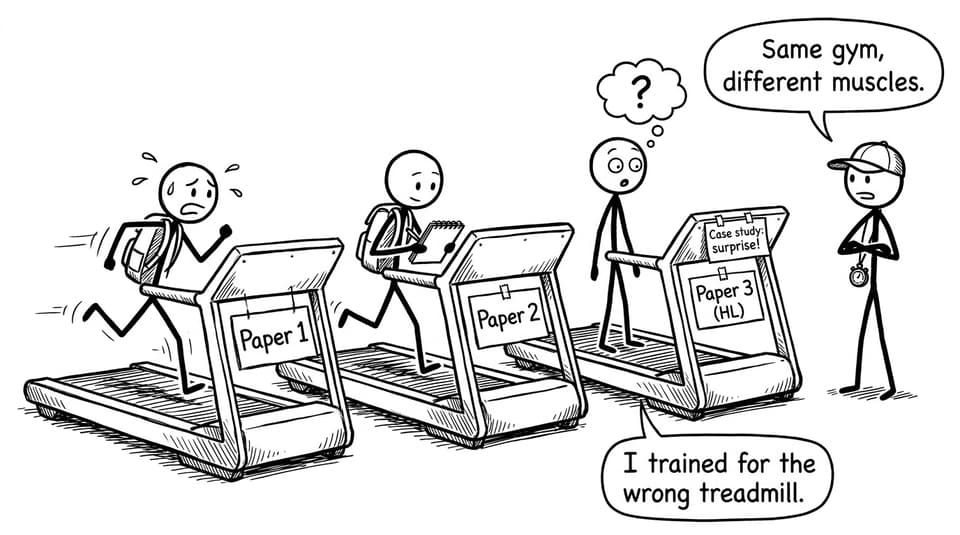
HL adds Paper 3: structured questions based on an unseen case study. Many students describe it as the hardest paper, not because the content is alien, but because the paper rewards synthesis.
Paper 3 tends to reward:
-
connecting multiple syllabus areas in one answer
-
analysing constraints in a real context
-
evaluating design decisions using evidence and DT theory
The cleanest way to train is to practise “case-study moves”: identify stakeholders, constraints, criteria, and then choose a justified direction. If you are unsure how exam questions phrase those moves, use command-term practice alongside articles like What command terms appear most in IB Design Technology exams.
Internal Assessment (IA): the design project that teaches you the course
The IA in IB Design Technology is a long design project completed over roughly 40 hours (both SL and HL). It is where students learn the quiet truth of DT: a project is not a single idea. It is a chain of decisions.
A strong IA usually shows:
-
a specific user and a specific problem (not a generic “students need better backpacks”)
-
research that directly becomes design requirements
-
modelling, prototyping, and testing with evidence
-
iteration that is explained and justified
-
evaluation that uses data and feedback, not just opinion
If your starting point is fuzzy, begin with IB Design Technology Problem Statement: Write It Strong. Then use RevisionDojo’s Coursework Library and Grading tools to keep the write-up aligned with what examiners actually reward.
SL vs HL weightings (and what that means for your revision plan)
The weightings matter because they change what “risk” looks like.
-
SL weighting: Paper 1 (20%), Paper 2 (40%), IA (40%)
-
HL weighting: Paper 1 (20%), Paper 2 (40%), Paper 3 (20%), IA (20%)
So SL students should treat the IA as a core scoring engine, while HL students need an exam-forward routine from early in the course. Either way, the smartest strategy is to revise the way you will be assessed: practise Paper 1 speed, Paper 2 structure, and (HL) Paper 3 synthesis.
A useful complement to this is building a weekly routine from Best study strategies for IB Design Technology and then turning it into timed practice through Mock Exams and Predicted Papers.
A simple weekly routine that matches the assessment structure
Use this as a realistic template during exam prep:
-
2x 20 minutes: Paper 1 multiple-choice drills (Questionbank)
-
2x 35 minutes: Paper 2 short responses (focus on command terms)
-
1x 45 minutes: one longer Paper 2 extended response (plan first, then write)
-
HL only 1x 45 minutes: Paper 3 case-study style practice
-
1 small IA block: keep your project “alive” (write, test, reflect, document)
To keep it all in one place, RevisionDojo links the workflow: Study Notes for clarity, Flashcards for recall, Questionbank for application, AI Chat for quick explanations, Grading tools for feedback, and Predicted Papers and Mock Exams for full exam simulation. If you want the broader platform overview, see the RevisionDojo app guide for IB exam prep.
FAQ: IB Design Technology assessment structure
What is the most important part of IB Design Technology assessment?
In IB Design Technology, the most important part is the one you are currently under-preparing for. That sounds like a joke, but it is true because the course is balanced across different skills. Paper 1 rewards precision and speed, while Paper 2 rewards structured reasoning and application. The IA rewards evidence of process, iteration, and evaluation, not just a polished final product. SL students often feel the IA most intensely because it is 40% of the grade and takes months of consistent work. HL students often feel the exam load more because Paper 3 adds another layer of synthesis and unfamiliar context.
Is the IA different for SL and HL in IB Design Technology?
The IA in IB Design Technology is the same core idea at SL and HL: an individual design project of about 40 hours following a design cycle. What changes is not the project “type,” but the expectations you set for yourself. HL students benefit from pushing harder on justification, trade-offs, and linking decisions to DT theory because their overall profile is more exam-heavy. SL students benefit from treating the IA as a structured scoring opportunity and documenting consistently so nothing is left to memory. In both levels, the biggest mistake is doing the work but not capturing the evidence. If you want a practical platform workflow for this, RevisionDojo’s Coursework Library plus Grading tools can help you keep drafting aligned with criteria.
How should I prepare for Paper 3 (HL) in IB Design Technology?
Prepare for Paper 3 in IB Design Technology by training your ability to think with constraints, not by hunting for the “perfect topic list.” Case-study questions reward students who can extract key information fast and then organise it into a justified recommendation. Start by practising short case-study drills: identify stakeholders, constraints, success criteria, and risks in five minutes. Then write one or two paragraphs that explicitly use DT concepts (sustainability, materials choice, production systems, ergonomics) to justify a decision. Finally, review your answer against command terms: did you analyse, evaluate, and recommend as asked. You can build this habit by combining structured notes with targeted questions and then moving into timed mock practice.
Final thought: the structure is not a limitation; it is your leverage
The new-syllabus uncertainty (first exams in 2027) can feel unsettling in IB Design Technology. But it also gives you an advantage: you can prepare with intention instead of imitation. When you know exactly how Paper 1, Paper 2, Paper 3 (HL), and the IA are weighted, you stop revising “more” and start revising “right.”
If you want one place to run the whole system, including Questionbank drills, Study Notes, Flashcards, AI Chat support, Grading tools, Predicted Papers, Mock Exams, and a Coursework Library for your IA, start with the IB Design Technology hub on RevisionDojo and build outward. That is how IB Design Technology stops feeling mysterious and starts feeling manageable.