


If you have ever watched the clock melt away while you hunt for one line in the formula booklet, you already know the truth about IB Math: marks are often lost to hesitation, not difficulty. The HL formula booklet is supposed to level the playing field. But in the 2026 exams, it will only help you if it feels familiar enough to use under pressure.
Think of the booklet less like “help” and more like a shortcut you earn through repetition.
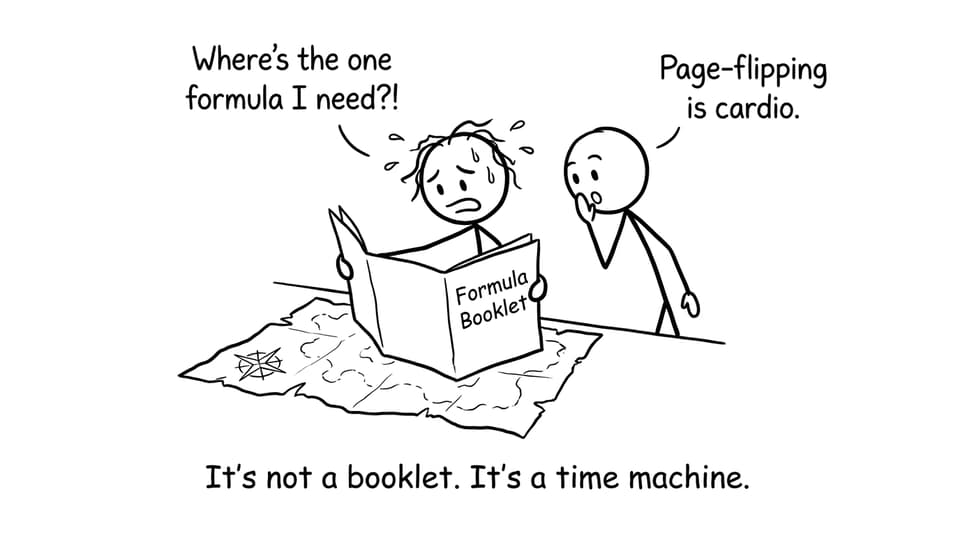
Quick checklist: how to train the booklet (fast)
Before your next IB Math study session, do these five things:
-
Open the formula booklet first, not last.
-
Learn the layout: where algebra ends and calculus begins.
-
Practice “index-first” navigation (no random flipping).
-
Memorize the high-frequency formulas you use weekly.
-
Pair each formula with one exam-style question immediately.
For an exam-aligned copy and a clean layout, start with the IB Mathematics AA Data Booklet.
Why the HL formula booklet matters in IB Math
The booklet reduces memorisation load, but it does not reduce thinking. In IB Math, you are graded on method, communication, and interpretation. The formula booklet supports the method. You still have to decide what applies and why.
It also protects your accuracy. Under timed conditions, even confident students misremember constants, signs, or conditions. A quick check can prevent a full chain of errors.
If you are building your overall exam approach, the broader structure helps too: IB Math HL: What to Expect in the Final Exams pairs well with booklet training.
What is inside the Math HL formula booklet (and how to map it)
Most HL students benefit from a simple mental map of the main clusters:
-
Algebra and functions: exponent and log laws, sequences/series structure.
-
Trigonometry: identities, sine/cosine rule, transformations.
-
Calculus: derivative rules, standard integrals, HL additions like series expansions.
-
Probability and statistics: distributions, expectation/variance.
-
Vectors and geometry (HL-heavy): scalar/vector products, lines and planes.
To make that map practical, link it to your course route:
-
AA students: build your home base at IB Mathematics Analysis and Approaches (AA).
-
AI students: build yours at IB Mathematics Applications & Interpretation (AI).
How to use the booklet while revising (the high-score routine)
Practice with the booklet every time
The fastest way to make the booklet useful is to remove the novelty. Keep it open during every set of timed questions. In IB Math, speed comes from recognising patterns, not from reading faster.
A practical workflow is:
-
Skim the question, circle the goal.
-
Identify the topic family (calculus, vectors, probability).
-
Open the booklet to confirm the exact form.
-
Write the formula down before substitution.
Then drill the same skills in targeted practice using the How to Master IB Math AA HL Topics Efficiently approach.
Memorize the “everyday” formulas anyway
Yes, the booklet is provided. But in IB Math, the most common formulas are also the ones you will use in multi-step chains. If you rely on page-flipping every time, you pay a time tax.
Aim to memorise what you use constantly (core trig identities, standard derivative rules, common distribution forms), and use the booklet as confirmation and backup.
To turn this into automatic recall, RevisionDojo’s Flashcards and Study Notes are built for short daily reps (especially when you are tired).
Match formulas to command terms
Command terms often tell you when the booklet is a starting point.
-
“Show that”: you are expected to substitute cleanly and simplify with discipline.
-
“Hence”: the previous part likely sets up a formula-based shortcut.
-
“Determine”: method marks matter as much as the final value.
This is where RevisionDojo’s AI Chat is useful: after practice, ask it to explain which formula choice the mark scheme expected and why.
Common mistakes IB Math students make with the booklet
-
Searching instead of deciding: you flip pages before you understand the task.
-
Using the right formula at the wrong moment: early substitution creates algebra clutter.
-
Over-trusting the booklet: it gives tools, not judgement.
-
Ignoring HL-only hotspots: vectors and HL calculus deserve extra navigation practice.
For time pressure strategy, pair your booklet work with Best Time Management Tips for IB Math Exams.
Using the booklet in the 2026 exams (Paper-by-paper)
Paper 1 (no calculator)
Paper 1 rewards calm execution. Your booklet use should be quick: confirm, write, apply. If you are still “learning the booklet” here, you will feel rushed.
If Paper 1 is your focus, build routine-based practice using How to Master IB Math AA Paper 1: Step-by-Step Strategy.
Paper 2 (calculator allowed)
The booklet and calculator are a team. Use the booklet to set up the mathematics, then use calculator skills for computation and checking reasonableness.
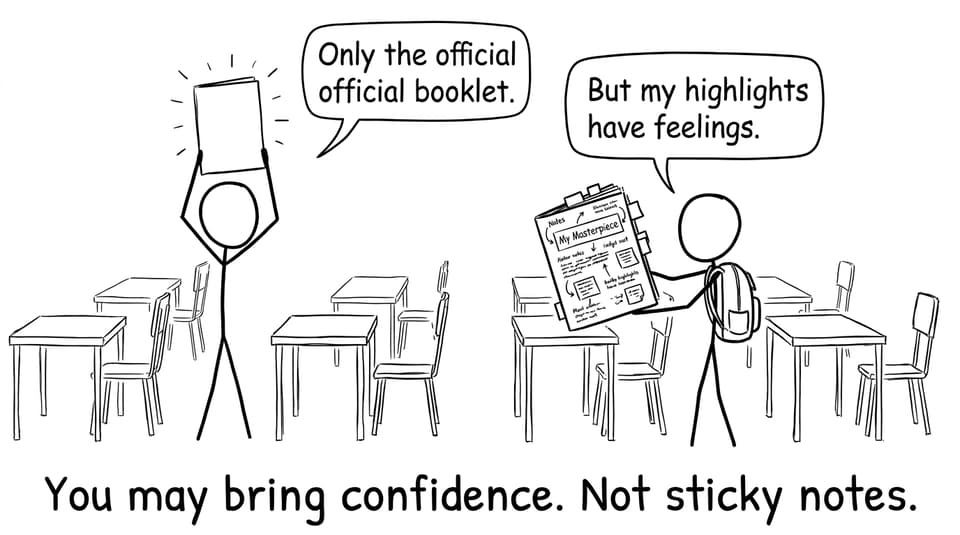
For exam-day readiness (including what is allowed), see IB Math Exam Day Essentials.
HL Paper 3 (HL only)
Paper 3 often rewards flexibility: combining topics, adapting methods, and explaining choices. This is where the booklet becomes a “confidence anchor” while you reason through unfamiliar contexts.
Conclusion: turn the IB Math booklet into an advantage
The HL formula booklet is not magic. In IB Math, it becomes an advantage only when you have rehearsed it enough that it feels like muscle memory. Learn the layout, memorise the high-frequency essentials, and practise “index-first” navigation under time.
If you want a system that connects everything, RevisionDojo is built for this exact loop: Study Notes for clarity, Flashcards for recall, Questionbank for repetitions, AI Chat for mark-scheme thinking, Grading tools for feedback, and full-timing rehearsal through Mock Exams and IB Predicted Papers. Train the booklet now, and your future self in the 2026 IB Math exam will feel the difference.