
When you’re writing under pressure, it’s tempting to believe the author’s words will do the heavy lifting for you.
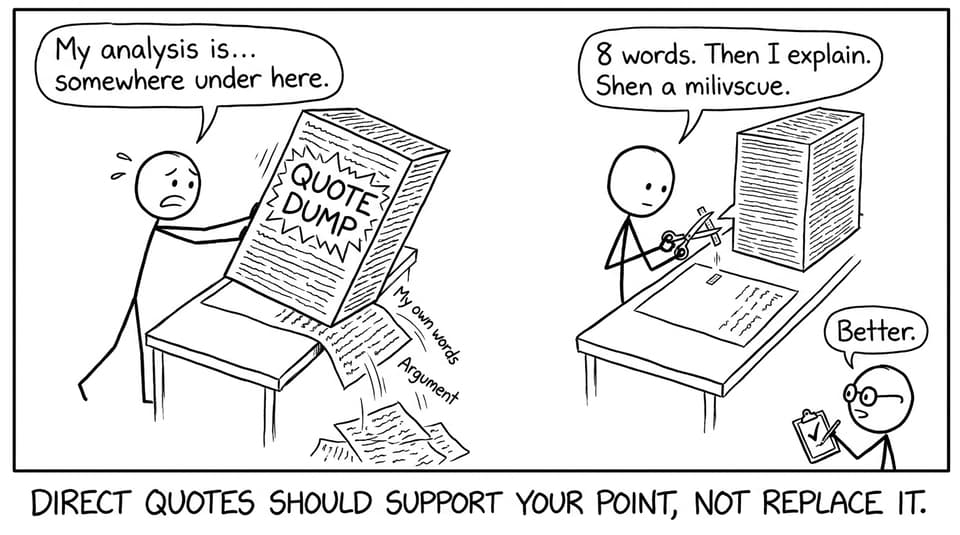
So you drop in a long line. Then another. The page looks impressive. But your argument feels quieter, almost crowded out.
In IB English, that’s the invisible difference between an essay that contains evidence and an essay that controls evidence. Examiners reward the second one because it proves you can make choices: what to quote, what to paraphrase, and how to turn both into analysis.
This guide shows you how to use direct quotes and paraphrasing effectively in IB English across Paper 1, Paper 2, the Higher Level Essay, and the Individual Oral.
The 20-second checklist (before you add any evidence)
Use this quick loop in IB English whenever you’re about to insert a quote or paraphrase:
-
Point: What claim am I making?
-
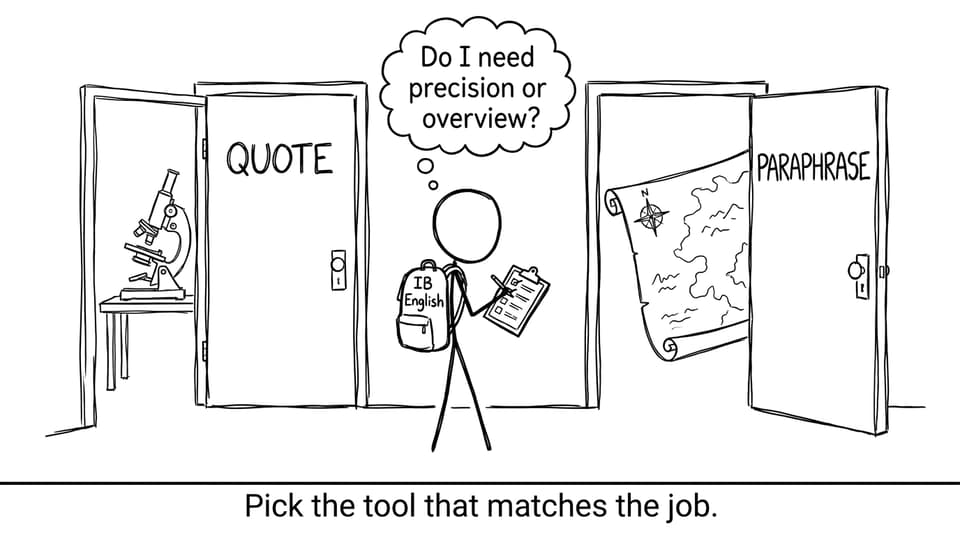
Proof: Do I need exact wording (quote) or idea summary (paraphrase)?
-
Placement: Can I embed it into my own sentence?
-
Payoff: Can I explain the effect in 2-4 sentences?
-
Purpose: Have I linked it back to audience, purpose, and the thesis?
If you want a broader workflow for exam practice, pair this with IB English Paper 1: Best Ways to Prepare.
Direct quotes vs paraphrasing in IB English (what each is for)
A simple rule keeps most students safe in IB English: quote for precision, paraphrase for control.
Direct quotes (quote for precision)
Use a direct quote when the exact language choice matters: diction, imagery, irony, repetition, modality, syntax, sound.
How to do it well in IB English
-
Keep quotes short: a phrase or clause is usually enough.
-
Embed it grammatically into your sentence.
-
Analyse immediately. Never leave a quote standing alone.
Example
Instead of copying a whole sentence, zoom in: the writer’s repeated use of “still” suggests emotional paralysis, making the tone feel trapped rather than merely sad.
For technique-first analysis drills, Mastering Literary Devices in IB English Exams is a strong companion.
Paraphrasing (paraphrase for control)
Paraphrasing re-expresses meaning in your own words. In IB English, it’s especially useful when:
-
the passage is long,
-
the idea matters more than the wording,
-
or you need to move quickly without losing clarity.
How to do it well in IB English
-
Stay faithful to the original meaning.
-
Keep it specific (avoid generic plot summary).
-
Use it to set up your analysis, not replace it.
Example
Rather than quoting every detail, paraphrase how the narrator shifts from observational description to accusation, tightening the emotional pressure on the reader.
How to integrate quotes and paraphrasing (the “sandwich” that actually scores)
Most high-scoring IB English paragraphs follow a quiet pattern:
Lead-in (your claim)
Name what you’re arguing in a way that is already analytical.
Evidence (quote or paraphrase)
Choose the smallest piece that still proves the point.
Breakdown (what it does)
Analyse technique and effect. Be concrete: tone, pacing, contrast, imagery, audience positioning.
Meaning (why it matters)
Link back to theme, global issue, purpose, or thesis.
A helpful sentence frame for IB English:
By using “___”, the writer ___, which ___ the reader and ultimately ___.
If you struggle with the “why it matters” step, use Effective Thesis Statements for English A Essays to keep every paragraph tied to a single promise.
Balancing direct quotes and paraphrasing across each assessment
Different tasks in IB English reward different evidence choices.
Paper 1 (unseen commentary)
Paper 1 is where quote discipline matters most.
-
Quote: short, vivid fragments you can analyse deeply.
-
Paraphrase: context, movement, and structural shifts.
Best next reads:
Paper 2 (comparative essay)
Paper 2 rewards comparison, not memorised lines.
-
Use 1-2 short quotes per text per paragraph.
-
Paraphrase to summarise broader patterns (character arcs, recurring motifs, structural choices).
Build your course foundation via IB English A Lit Resources or the broader IB English tag hub.
Higher Level Essay (HLE)
The HLE is where your voice must stay dominant.
-
Paraphrase to keep momentum and scope.
-
Quote precisely when technique is central to your claim.
Planning support:
Individual Oral (IO)
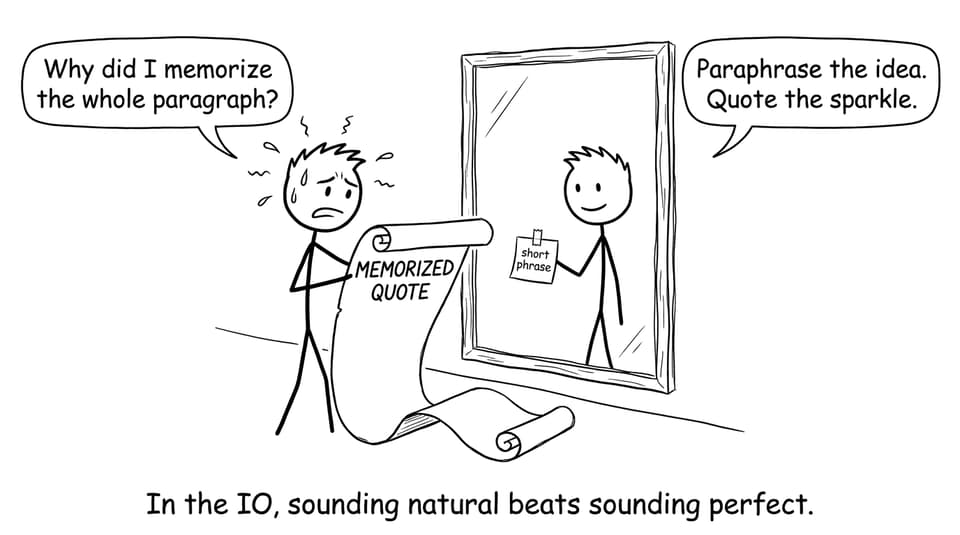
In the IO, long quotations often sound like recitation.
-
Paraphrase the idea so you sound natural.
-
Quote a short “spark” phrase when language is the point.
For IO structure help, use How to Approach the IB English Individual Oral (IO).
The five mistakes examiners notice immediately
These show up constantly in IB English scripts:
-
Quote dumping: evidence appears, analysis doesn’t.
-
Over-quoting: your paragraph becomes a collage.
-
Under-explaining: you name a device but don’t show its effect.
-
Context loss: the quote is accurate but irrelevant to your claim.
-
Voice loss: the author’s language replaces your argument.
A practical ratio that keeps you safe in IB English: for every short quoted fragment, aim for at least three times as many words of analysis.
How RevisionDojo helps you practice evidence like an examiner
In IB English, improvement comes from feedback loops, not inspiration.
RevisionDojo makes those loops faster:
-
Questionbank to drill Paper 1 and Paper 2 prompts with variety.
-
Study Notes and Flashcards to lock in terminology and technique vocabulary.
-
AI Chat when you need to test an interpretation or refine a thesis.
-
Grading tools (including rubric-aligned graders) to see whether your quote integration is actually earning marks.
-
Predicted Papers and Mock Exams to rehearse timing and evidence selection under pressure.
-
Coursework Library and Tutors when you want exemplars and human feedback for your HLE or IO.
A final way to think about IB English evidence
Direct quotes are like close-up photographs: sharp, detailed, easy to mis-handle.
Paraphrasing is like a map: it keeps you moving in the right direction.
In IB English, top answers use both. They quote with restraint, paraphrase with purpose, and let analysis take up the most space on the page.
If you want to practise this quickly, take one Paper 1 paragraph you’ve written and rewrite it with one fewer quote and two more sentences of interpretation. Then run it through RevisionDojo’s practice workflow, including Questionbank, Notes, AI feedback, and graders, until your evidence starts sounding like a choice, not a habit.