
Differential equations have a special talent: they can make confident IB students feel like they just walked into the wrong classroom.
The page fills with symbols. Derivatives appear like warning lights. And yet, almost every differential equation question in IB Math is asking something surprisingly human: if I tell you how something changes, can you tell me what it is?
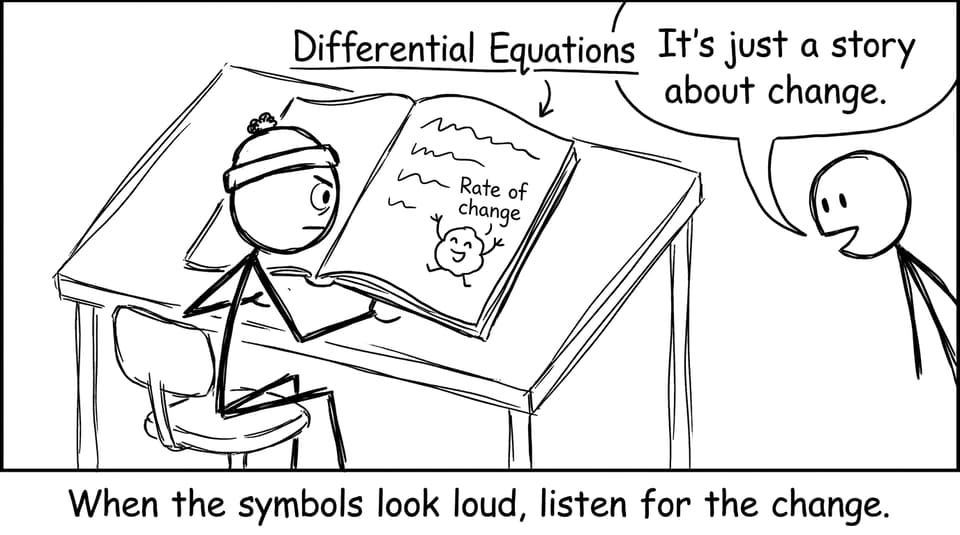
That’s the whole idea. Differential equations are not “extra calculus.” They’re change, written down carefully.
Quick IB checklist for differential equations
Before you try to “solve,” make sure you can do these quickly:
-
Translate the question into a rate-of-change sentence (what changes with what?).
-
Recognize whether it’s separable (the most common IB setup).
-
Integrate confidently, including logarithms and exponentials.
-
Always include the constant of integration +C.
-
Use an initial condition when given to find a specific value of C.
-
Check your final answer by differentiating.
If you want a clean place to organise these patterns, start with the syllabus-aligned IB Mathematics Analysis and Approaches Resources and keep your “templates” alongside your practice.
What a differential equation really is (in IB language)
A differential equation links a function to one (or more) of its derivatives.
In plain terms: it links a quantity to its rate of change.
Example:
- (\frac{dy}{dx} = 3x^2)
The left side says: “how y changes as x changes.” The right side says: “that change behaves like (3x^2).”
Solving it means: find a function y that has that derivative.
That’s why differential equations can feel like reverse differentiation. In IB, most are designed so the algebra is manageable and the integration is standard.
If you want a structured set of notes for the calculus foundations underneath all this, RevisionDojo’s IB Mathematics Analysis and Approaches Calculus Notes are a strong home base.
Why IB uses differential equations: the “story of change”
IB doesn’t include differential equations to show off. It includes them because they model real processes where change is the main character.
Common IB modelling stories:
-
Growth/decay: (\frac{dy}{dt}=ky) (the rate is proportional to the amount)
-
Cooling/heating: (\frac{dT}{dt}=-k(T-A)) (temperature moves toward ambient)
-
Motion: (\frac{dv}{dt}=a) (acceleration changes velocity)
When you read one of these, practise saying it out loud:
-
“The rate of change of y is proportional to y.”
-
“Temperature decreases faster when it’s far from room temperature.”
That translation step is where many IB marks quietly hide.
Separable differential equations (the IB workhorse)
Most first encounters in IB are separable differential equations: you can rearrange them so x-stuff is on one side and y-stuff is on the other.
A classic form:
- (\frac{dy}{dx} = f(x)g(y))
Then you separate:
- (\frac{1}{g(y)},dy = f(x),dx)
Then integrate both sides.
Example:
(\frac{dy}{dx} = xy)
Separate:
(\frac{1}{y}dy = xdx)
Integrate:
(\int \frac{1}{y}dy = \int xdx)
(\ln|y| = \frac{x^2}{2} + C)
Exponentiate:
(|y| = e^{\frac{x^2}{2}+C} = e^C e^{\frac{x^2}{2}})
So:
(y = Ae^{\frac{x^2}{2}}) where (A) is a constant.
That final simplification step (turning (e^C) into a constant) is very IB-friendly and very worth remembering.

The constant +C: why IB cares about it
In IB, forgetting +C is one of those mistakes that feels small but collapses the whole solution.
Here’s the intuition: differentiation loses information. Many different functions share the same derivative shape, just shifted up or down (or scaled).
So when you integrate, you recover a family of solutions. The constant C labels which member of the family you mean.
When the question gives an initial condition, like:
- “when (x=0), (y=2)”
you substitute into the general solution and solve for C (or A). That converts your answer into a particular solution that fits the real situation.
This is also why differential equations are good modelling tools: the equation captures the rule of change, and the initial condition anchors it to reality.
Recognising the most common IB differential equation patterns
IB differential equations repeat patterns. The exam pressure mostly comes from recognising them quickly.
Exponential growth/decay
(\frac{dy}{dx}=ky) leads to (y=Ae^{kx}).
In words: the bigger y is, the faster it changes.
Cooling/heating style
(\frac{dT}{dt}=-k(T-A)) gives an exponential approach to (A) (ambient).
In words: change is fastest when you’re far from the ambient value.
Motion links
If (\frac{dv}{dt}=a(t)), integrate to get v(t). Then integrate v(t) to get displacement.
These are the moments where RevisionDojo’s IB Mathematics Analysis and Approaches Topic Calculus Questionbank helps because repeated exposure builds pattern recognition fast.
Checking your solution (a calm IB habit)
A reliable IB move: differentiate your final answer and substitute back.
Example: Suppose you propose (y=e^{3x}).
Then (\frac{dy}{dx}=3e^{3x}=3y).
So it satisfies (\frac{dy}{dx}=3y).
This check is not just for correctness. It also trains your intuition for what solutions should “look like.” If your answer produces an ugly derivative that doesn’t match the original structure, you likely separated or integrated incorrectly.
When IB introduces numerical methods (Euler’s method)
Sometimes IB expects you to approximate a solution rather than find a closed-form expression. That’s where Euler’s method appears.
Conceptually, Euler’s method says:
-
Start at a known point.
-
Use the derivative to take a small step forward.
-
Repeat.
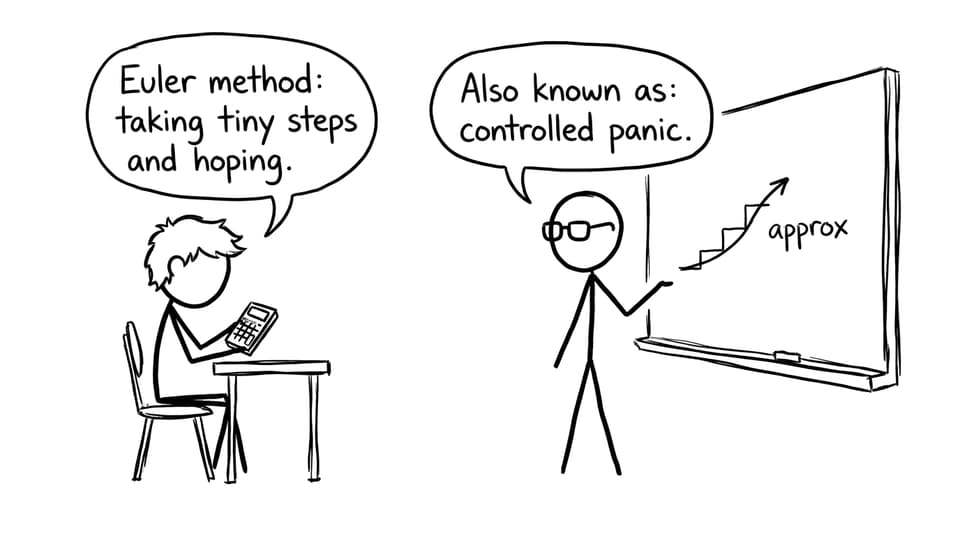
It’s like tracing a curve using lots of short tangent-line steps.
For targeted practice, RevisionDojo has an exam-aligned page on Euler’s approximation method for differential equations plus deeper supporting notes in AHL 5.18-1st order DE's.
A simple RevisionDojo routine for IB differential equations
Differential equations improve quickly when your practice is organised.
A realistic loop:
-
Read one clean explanation in Study Notes (keep it short).
-
Make 5-10 Flashcards for: separation template, log step, exponential form, initial condition workflow.
-
Do a focused set in the Questionbank on one type (separable first).
-
Use AI Chat when you get stuck on an algebra step, then write the corrected step into your error log.
-
Every week, do one timed set using Mock Exams or Predicted Papers to build calm.
If you want the broader system, RevisionDojo App: The Smarter Way to Prep for IB Exams maps out how these tools fit together, including Grading tools, the Coursework Library, and Tutors when you want human feedback.
Closing: differential equations are change with a memory
Differential equations feel difficult when they’re treated as a new topic. They feel simple when they’re treated as a sentence: this is how the world changes.
For IB, that mindset is the advantage. It helps you choose the method, keep your constants straight, and explain your answer in context.
If you want differential equations to become predictable, build a small system inside RevisionDojo: learn with Study Notes, lock patterns with Flashcards, train accuracy in the Questionbank, unblock confusion with AI Chat, and rehearse under pressure with Mock Exams and Predicted Papers. Differential equations stop being intimidating when your practice stops being random, and RevisionDojo is built to make IB revision feel that structured.