
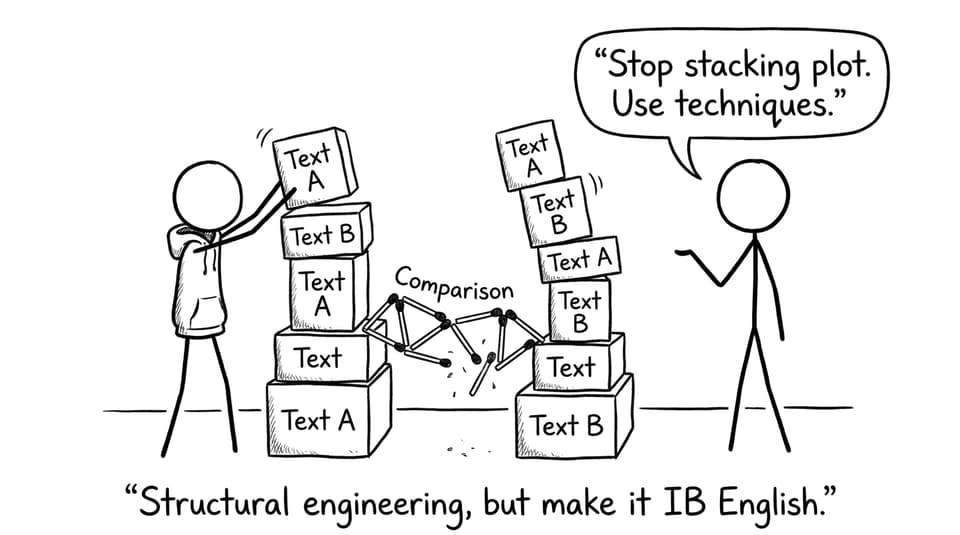
A comparative essay rarely fails because the student “didn’t know the texts.” It fails because the essay turns into two parallel book reports that never meet.
That’s the quiet tragedy of IB English: you can have sharp insights about both works, but if the structure doesn’t force comparison, your best thinking stays trapped in separate rooms.
This guide shows you how to structure a comparative essay for IB English A: Language & Literature (and Literature), especially for Paper 2 and the HL Essay mindset. We’ll focus on what examiners actually reward: balanced argument, authorial choices, and a repeatable paragraph rhythm.
A quick comparative essay checklist (save this)
Before you draft a single sentence in IB English, check that you can do all of the following:
-
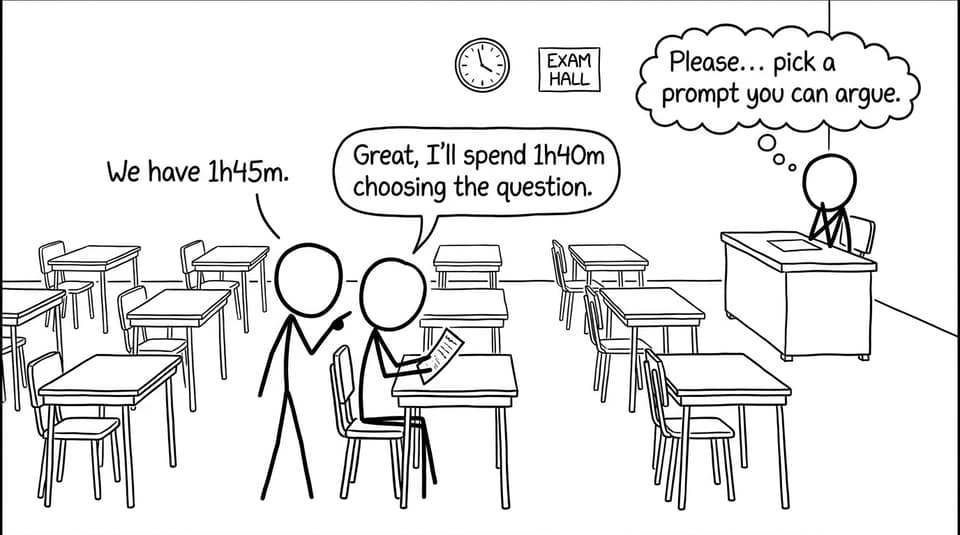
Choose a prompt you can genuinely argue, not just “talk about”
-
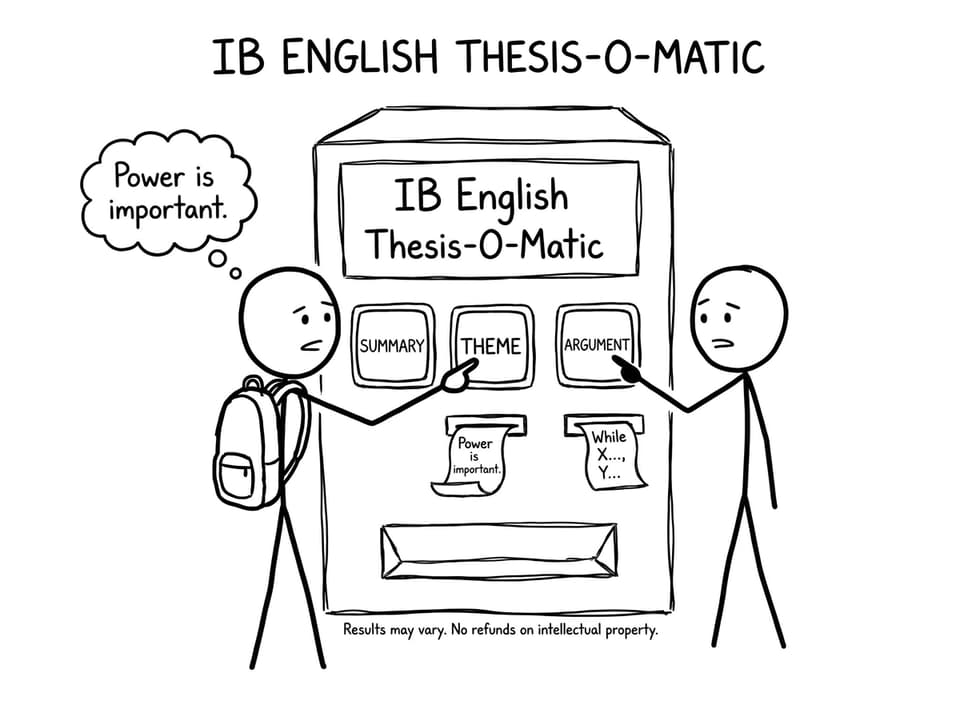
Write a one-sentence thesis using while/but/whereas
-
Pick 2-3 comparative angles (themes or craft moves), not 8
-
For each angle, gather technique-based evidence from both texts
-
Decide on one structure and commit to it
-
Build paragraphs that contain both texts every time
If you want prompt practice that matches this exact skill, RevisionDojo’s IB English A Lang & Lit Paper 2 Questionbank helps you train comparison under exam constraints.
What a comparative essay is in IB English (and what it is not)
A comparative essay in IB English is a single argument that uses two works as evidence.
It is not:
-
a plot recap with a “similarly” thrown in at the end
-
two mini-essays stapled together
-
a list of themes you remember the night before
It is:
-
an interpretation about a shared idea (identity, power, memory, belonging, etc.)
-
supported by authorial choices (voice, structure, imagery, symbolism, tone, genre conventions)
-
shaped by context, where relevant, to explain why choices differ
If you’re revising Paper 2 specifically, pair this guide with Structuring Your IB English Paper 2 Essay and Understanding the IB English A Literature Paper 2 Exam Structure.
The three best IB English comparative essay structures
There isn’t one “secret” structure. There is one rule: your structure must make comparison unavoidable.
Integrated (point-by-point) structure (best for most IB English students)
This is the most examiner-friendly because it keeps you comparing constantly.
Paragraph rhythm:
-
Make one claim that includes both texts
-
Evidence + technique + effect (Text A)
-
Evidence + technique + effect (Text B)
-
A comparative sentence that evaluates the difference or similarity
-
Link back to the prompt and thesis
For a deeper paragraph blueprint, see How Do You Write a Comparative Paragraph?.
Block structure (text-by-text) (use only if you’re disciplined)
Block can work if you struggle with switching, but it’s risky in IB English because it tempts you into separation.
Safer version:
-
Body section 1: Text A on the main angle (still referencing the question)
-
Body section 2: Text B on the same angle
-
Body section 3: Explicit comparative evaluation that synthesizes both
If you try block, you must “pay back” the comparison debt with an unmistakably comparative synthesis section.
Thematic cluster structure (high scoring when done well)
Here each paragraph is a thematic or conceptual lens (e.g., “silence as control” or “memory as self-protection”). Within that lens, you still compare both works.
This structure becomes powerful when your prompt is broad and you want to show control over multiple facets of the texts.
For planning help, use Comparative Essay Planning: Theme vs. Form vs. Content.
Step-by-step: how to build the structure fast (without sounding formulaic)
Structure in IB English isn’t about templates that kill originality. It’s about freeing your brain to do actual thinking under time pressure.
Choose 2-3 comparative angles that can survive any prompt
Angles should be conceptual and craft-based, not plot-based.
Strong angles include:
-
how voice shapes reliability or distance
-
how setting becomes a pressure system (confinement vs openness)
-
how symbolism carries moral judgment
-
how structure controls what readers are allowed to know
Weak angles include:
-
“both have conflict”
-
“both have a main character who changes”
If Paper 2 timing is your issue, RevisionDojo’s How to Prepare for the IB English Paper 2 Exam Under Time Pressure is a good companion.
Write a comparative thesis that is built to be proven
A thesis in IB English should sound like a decision, not a description.
A reliable formula:
While Text A uses method to suggest idea, Text B uses different method to reveal different or extended idea, showing why the comparison matters.
If you want to sharpen that one sentence, use IB English Thesis Statements: A Clear Writing Guide and Writing Effective Introductions and Conclusions in IB English Essays.
Build body paragraphs that cannot become two essays
In IB English, each paragraph should feel like a controlled comparison unit.
Use this repeatable template:
Topic sentence: one claim about both texts + key word from the prompt.
Text A: technique + effect + meaning.
Text B: technique + effect + meaning.
Comparative evaluation: “This difference matters because…”
Link: return to thesis and set up the next angle.
Notice what’s missing: plot retelling. Your evidence can be a short quotation, a moment, or a pattern. But the discussion must stay technique-first.
End with significance, not repetition
A comparative conclusion in IB English does three things:
-
reaffirms the thesis in new words
-
synthesizes what the comparison reveals about the prompt
-
widens slightly: why this literary difference matters (human experience, ideology, society)
What IB English examiners tend to reward
Across Paper 2 and extended analytical writing, examiners look for:
-
consistent comparison (not occasional “whereas”)
-
accurate, relevant knowledge of both works
-
analysis of authorial choices (language, structure, form)
-
organization that supports argument
-
clear academic style
To align your practice with those expectations, it helps to understand criteria language. Start with Understanding the IB English A Language and Literature Paper 2 Criteria.
Common structural mistakes (and the quick fixes)
-
Mistake: You write Text A for 2 paragraphs, then Text B for 2 paragraphs.
Fix: Switch to integrated paragraphs, or add a synthesis paragraph after every block. -
Mistake: Your topic sentences name a theme but not an argument.
Fix: Make the topic sentence a claim that can be debated. -
Mistake: You compare “events” instead of “choices.”
Fix: Attach every point to a technique (voice, imagery, dialogue, structure). -
Mistake: One text becomes the “main” text.
Fix: Balance your paragraph space and keep alternating which text you start with.
How RevisionDojo helps you practise comparative structure (without guessing)
The hardest part of IB English is not knowing what “good” looks like until after you’ve lost marks. RevisionDojo shortens that feedback loop.
-
Use the Questionbank to practise prompts and build flexible comparative angles.
-
Build timed practice with IB English Lang & Lit Predicted Papers and RevisionDojo’s Mock Exams workflow.
-
Draft with Study Notes, then compress them into Flashcards for technique-based recall.
-
Use AI Chat to test thesis variations quickly and pressure-test your comparative angles.
-
When you have a full draft, run it through a rubric-based grader like the IB Paper 2 25-mark Comparative Essay Grader to see whether your structure is actually doing its job.
-
If you need tailored help, RevisionDojo Tutors can help you turn vague ideas into a clean comparative line.
Closing thought: structure is a kindness you give your future self
On exam day, your brain doesn’t need more inspiration. It needs a path.
A strong IB English comparative essay structure is that path: thesis that can be proven, paragraphs that compare by design, and a conclusion that explains why the comparison matters. If you want to make that repeatable, use RevisionDojo’s Questionbank, Study Notes, Flashcards, AI Chat, Grading tools, Predicted Papers, Mock Exams, Coursework Library, and Tutors to practise the same structure until it feels automatic.
When comparison becomes your default, the examiner stops hunting for your argument and starts following it.