

RevisionDojo logoRevisionDojo logo
PricingSchools
  1. Home
  2. /Blog
  3. /IB Design Technology: How to Revise in the Last 30 Days

IB Design Technology: How to Revise in the Last 30 Days

IB Design Technology
RevisionDojo Team
•Last updated: 19 Jul 2026•6 min read
Jojo holding a cookie

This site uses cookie tracking technologies. Learn more in our Cookie Policy.

Share on
Share on
Share on
4.1/5 from students worldwide
Share
Share on X

If you’re 30 days out from IB Design Technology exams, you’re probably carrying two thoughts at once: I know a lot and I don’t know if I can prove it under time. That tension is normal. DT rewards students who can move from ideas to justification quickly -- not just those who “revised a lot.”

The good news is that the final month is long enough to change your trajectory, if you treat revision like a design project: define the problem, prototype a routine, test it, iterate.
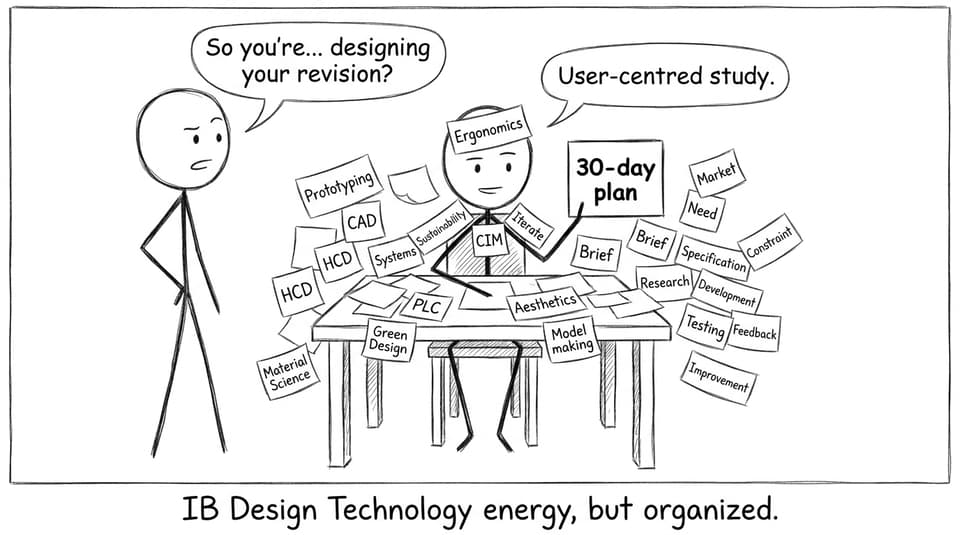
Student designs their revision plan

A 30-day checklist (save this)

Use this checklist as your daily minimum for IB Design Technology:

  • 10 minutes: key definitions (active recall, not rereading)

  • 25--40 minutes: exam-style questions (timed)

  • 10 minutes: error log (what went wrong and why)

  • 5 minutes: one diagram or annotation practice

  • 2--3 times per week: IA polish sprint (only if you’re still allowed to refine)

Keep your resources tight: start from the IB Design Technology resources page and don’t waste the month “collecting materials.”

Week 1: Build the base fast (days 1--7)

Week 1 is about turning scattered knowledge into something usable in an exam. In IB Design Technology, that means definitions + examples + the design cycle logic.

  • Build a living glossary. Keep it brutally short: one sentence definition, one product example.

  • Patch weak areas first. The month is too short to only revise what feels comfortable.

  • Read targeted notes, then immediately test with questions.

A useful starting point is RevisionDojo’s Best Study Strategies for IB Design Technology Students. Then go straight into practice using the DT hub.

If you’re on the new syllabus, anchor your practice in syllabus-specific question sets like B2.2 Modelling and Prototyping Questionbank.

Week 2: Train application (days 8--14)

Most marks in IB Design Technology disappear in the gap between knowing and explaining. Week 2 is where you close that gap.

Use command terms like a checklist

Students lose easy marks by answering at the wrong depth. Spend one session learning what each command term is asking, then apply it in your answers.

Use: What Command Terms Appear Most in IB Design Technology Exams and create a mini template for each term (for example: Explain = concept + cause/effect + impact on user/product).

Practice diagrams for speed, not beauty

Set a 3-minute timer and sketch: process flow, material choice reasoning, simple system diagrams. Clarity beats artistry.
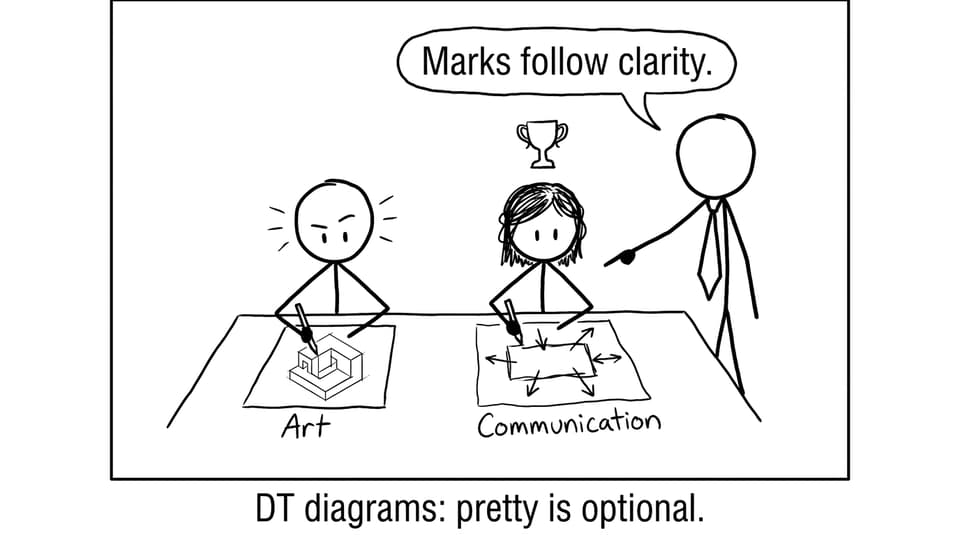
DT diagram clarity joke

To keep recall tight, add definitions to spaced repetition using RevisionDojo IB Flashcards with Spaced Repetition (SRS) or the Flashcards feature page.

Week 3: Simulate the exam (days 15--21)

By week 3, revision should feel less like studying and more like rehearsal. For IB Design Technology, that means timed sets, realistic structure, and ruthless review.

  • Do short timed blocks most days (even 20 minutes counts).

  • After each attempt, write a 3-line post-mortem: what cost marks, what to fix, what to drill.

  • Use targeted Questionbank sessions to attack one weakness at a time.

If you want a focused HL-style topic drill, try something specific like C4.1 Design for Manufacture Strategies Questionbank or a targeted chapter like 10.3 Computer-integrated manufacturing (CIM).
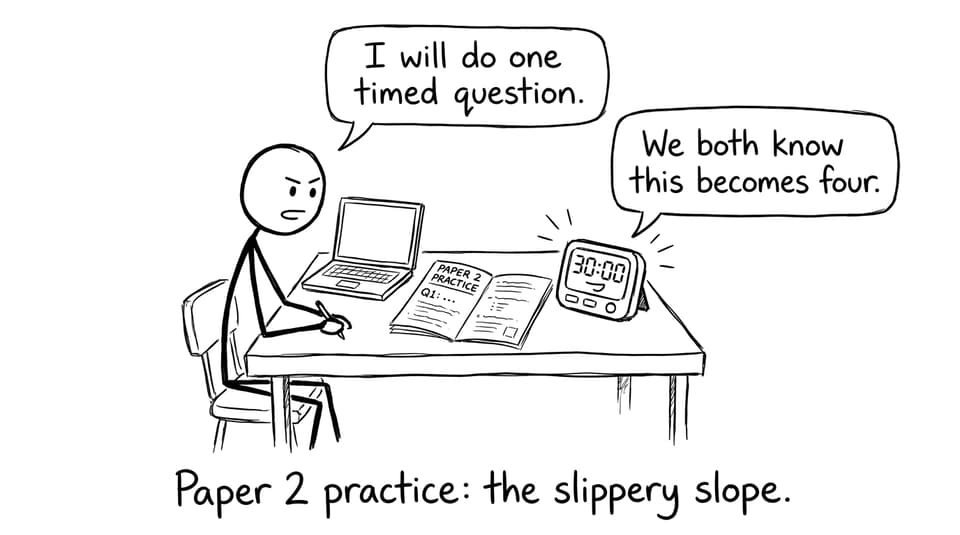
Timed practice slippery slope

Week 4: Reduce panic, increase precision (days 22--30)

The last week is not for “more content.” It’s for making your performance predictable.

  • Re-run your glossary until definitions feel automatic.

  • Reattempt the questions you got wrong earlier (same topic, new angle).

  • Create an exam-day checklist: timing plan, paragraph structure, diagram habits.

For full-paper rehearsal, add one or two sets from Design Technology Predicted Papers (Free). If you’re unsure how to use them wisely, read IB Predicted vs Specimen Papers: What They Mean.

IA polishing (only if it’s still open)

If your school allows final tweaks, keep them controlled. In IB Design Technology, IA improvements come from clearer evidence and tighter evaluation, not from rewriting everything.

  • Check that each stage of the design cycle is easy to follow.

  • Label every sketch/prototype photo like you’re helping a tired examiner.

  • Strengthen evaluation by linking back to your requirements and real testing.

If you want a broader DT support map, How to Use RevisionDojo for IB Design Technology Success lays out a practical system.

Closing: design your last 30 days

The final month of IB Design Technology is a small window with a big lever. Treat it like a design challenge: build a routine, test it under real constraints, and iterate until your performance becomes calm and repeatable.

If you want one place to run the whole system -- Questionbank, Study Notes, Flashcards, AI Chat, Grading tools, Predicted Papers, Mock Exams, and support resources like the Coursework Library and Tutors -- start with RevisionDojo’s IB Design Technology resources and work outward from there.
How helpful was this article?
Add as a preferred source on Google

Continue studying with RevisionDojo

  • IB Coursework GraderCheck an IA, EE, or TOK draft against IB assessment criteria.
  • IB Coursework ExamplesLearn from high-scoring coursework across IB subjects.
  • IB Grade CalculatorEstimate an IB grade using session-specific boundaries.
  • IB Grade BoundariesExplore historical grade boundaries by subject and session.

Join 650k+ students breezing through the IBReady to breeze through the IB?

Footer

General

  • For parents
  • For schools
  • Pricing
  • Gift RevisionDojo
  • Tutoring
  • IB syllabus
WhatsApp
LinkedIn
Facebook

Frequently Asked Questions

  • MYP syllabus
  • Blog
  • Research
  • Features

    • Jojo AI
    • Questionbank
    • Notes
    • Flashcards
    • Test builder
    • Exam mode
    • Coursework
    • Coursework grader
    • Coursework examples
    • Predicted papers
    • IB grade calculator
    • Grade boundaries

    Research

    • State of learning survey
    • IB Moderation Analysis
    • Jojo AI vs ChatGPT
    • Jojo AI vs Gemini
    • Jojo AI vs Perplexity
    • Jojo AI vs Claude
    • Jojo AI vs Poe

    Platform

    • RevisionDojo vs Others
    • Content philosophy
    • Trustpilot
    • Join usWe're hiring
    • Terms and conditions
    • Privacy policy
    • Cookie policy
    • Trust Center

    MYP Subjects

    • MYP Biology
    • MYP Chemistry
    • MYP English Lang & Lit
    • MYP Extended Mathematics
    • MYP History
    • MYP Individuals & Societies
    • MYP Physics
    • MYP Standard Mathematics
    • MYP Biology
    • MYP Chemistry
    • MYP English Lang & Lit
    • MYP Extended Mathematics
    • MYP History
    • MYP Individuals & Societies
    • MYP Physics
    • MYP Standard Mathematics

    IB Subjects

    • Arabic ab initio
    • Arabic B
    • Biology
    • Business Management
    • Chemistry
    • Chinese A Lang & Lit
    • Chinese B
    • Computer Science (CS)
    • Computer Science (First Exam 2027)
    • Design Technology (DT)
    • Design Technology (First Exam 2027)
    • Digital Society (DS)
    RevisionDojo logo

    © 2022 - 2026 RevisionDojo (MyDojo Inc)

    RevisionDojo was developed independently of the IBO and as such is not endorsed by it in any way.

    GDPR compliantDownload on the App Store

    Related Articles

    IB Design Technology · 4 min read

    What Extra Topics Are Covered in IB Design Technology HL?

    Learn what extra topics IB Design Technology HL students study, how HL content is deeper than SL, and what this means for exams and coursework.

    IB Design Technology · 7 min read

    IB Design Technology IA: How to Show Real Iteration

    IB Design Technology iteration made simple: learn what counts, where to show it in your IA, and how to document changes for higher marks.

    IB Design Technology · 8

    IB Design Technology Problem Statement: Write It Strong

    IB Design Technology problem statement guide: learn the user-first formula, avoid solution language, add evidence, and set up high-scoring IA work.

    IB Design Technology · 8

    IB Design Technology IA Referencing: A Simple Guide

    IB Design Technology IA referencing made simple: what to cite, how to format in-text citations, and how to avoid plagiarism with consistent sources.

    IB Design Technology · 7

    IB Design Technology Without Creativity: Can You Still Excel?

    IB Design Technology success isn’t about being artistic. Learn what examiners reward, how to score higher, and how RevisionDojo helps.

    IB Design Technology · 7

    Common IB Design Technology Exam Mistakes (and Fixes)

    IB Design Technology exam mistakes are predictable. Learn the most common errors and quick fixes for command terms, evaluation, timing, and structure.

  • Economics
  • English A Lang & Lit
  • English A Lit
  • English B
  • Environmental systems and societies (ESS)
  • French A
  • French ab initio
    • French B
    • Geography
    • German A
    • German ab initio
    • German B
    • Global Politics
    • History
    • Mathematics Analysis and Approaches (AA)
    • Mathematics Applications & Interpretation (AI)
    • Philosophy
    • Physics
    • Psychology
    • Psychology (First Exam 2027)
    • Spanish A
    • Spanish ab initio
    • Spanish B
    • Sports, exercise and health science (SEHS)
    • Theory of Knowledge (TOK)
    • Arabic ab initio
    • Arabic B
    • Biology
    • Business Management
    • Chemistry
    • Chinese A Lang & Lit
    • Chinese B
    • Computer Science (CS)
    • Computer Science (First Exam 2027)
    • Design Technology (DT)
    • Design Technology (First Exam 2027)
    • Digital Society (DS)
    • Economics
    • English A Lang & Lit
    • English A Lit
    • English B
    • Environmental systems and societies (ESS)
    • French A
    • French ab initio
    • French B
    • Geography
    • German A
    • German ab initio
    • German B
    • Global Politics
    • History
    • Mathematics Analysis and Approaches (AA)
    • Mathematics Applications & Interpretation (AI)
    • Philosophy
    • Physics
    • Psychology
    • Psychology (First Exam 2027)
    • Spanish A
    • Spanish ab initio
    • Spanish B
    • Sports, exercise and health science (SEHS)
    • Theory of Knowledge (TOK)
    min read
    min read
    min read
    min read