


IB Digital Society: How to Evaluate Ethics Effectively
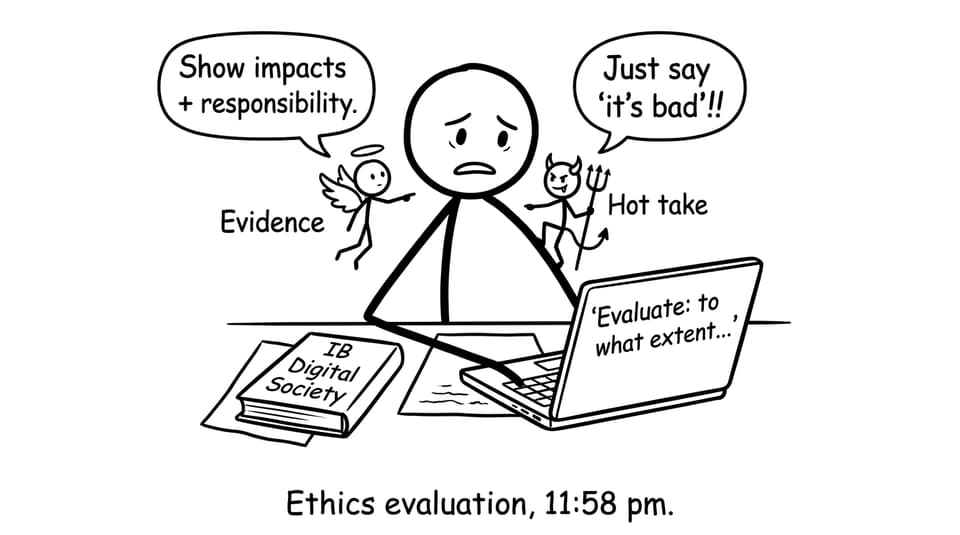
It’s 11:58 pm. You’ve written three paragraphs about privacy, bias, and “concerns.” You’ve used strong words. You’ve even sounded confident. And then you reread the question and realize the problem: you haven’t evaluated anything.
That gap -- between spotting an ethical issue and evaluating it -- is where marks are quietly won in IB Digital Society. Ethics here isn’t a personal reaction. It’s a reasoned judgment built from impacts, responsibility, and clear trade-offs. Once you see that, ethical evaluation stops feeling like guesswork and starts feeling like a method.
Ethical evaluation in IB Digital Society (what it actually means)
In IB Digital Society, ethical evaluation means deciding whether the design, deployment, or impact of a digital system is justified -- and explaining why with balanced reasoning.
It’s not:
-
A list of ethical issues
-
A dramatic “this is bad” conclusion
-
A paragraph of feelings disguised as analysis
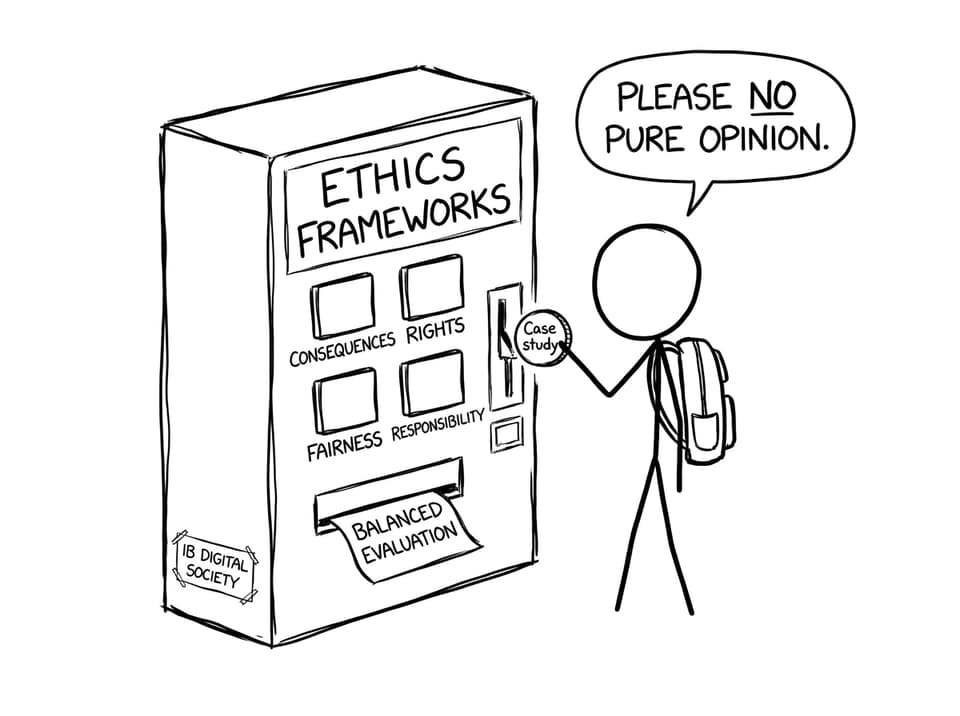
Instead, it’s structured argument. You show what the system does, who it affects, which values are in tension, where responsibility sits, and then you reach a justified judgment.
If you want a fast overview of how the course is built around these skills, start with Key Themes in IB Digital Society Explained.
A quick checklist: the ethics evaluation template
Use this five-step template in every IB Digital Society ethics response (exam or IA):
-
Name the ethical tension (privacy vs security, access vs exclusion, innovation vs protection)
-
Explain the system feature causing it (data collection, algorithm ranking, biometric ID, automated decisions)
-
Analyse impacts on individuals and communities
-
Assign responsibility (designers, platforms, governments, institutions, users)
-
Make a justified judgment (to what extent is it acceptable, and under which conditions?)
To practise this with exam-style prompts, build a set from the IB Digital Society Questionbank or the Questionbank feature page.
Start with the system, not the slogan
Strong ethics in IB Digital Society begins with something surprisingly simple: explain the specific digital system feature that creates the dilemma.
“Social media harms mental health” is a slogan. An evaluator asks: Which feature? Recommendation algorithms? Infinite scroll? Engagement-based ranking? Data-driven ads?
When you anchor ethics to mechanism, your evaluation becomes testable. It also becomes easier to use evidence, examples, and course concepts.
RevisionDojo’s IB Digital Society Resources hub is useful here because you can move quickly from Study Notes to Flashcards to Questionbank practice without losing the thread of the system.
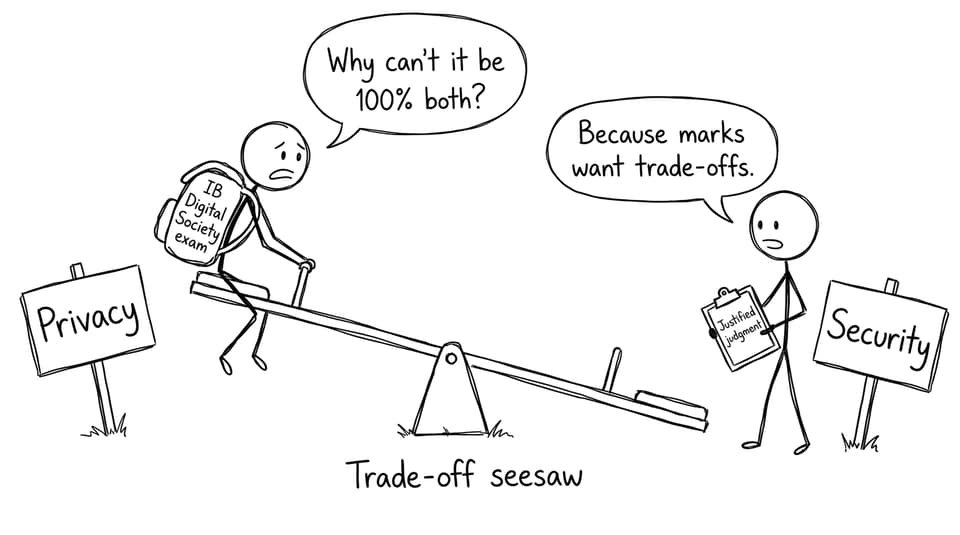
Ethics is mostly about trade-offs (and you must show them)
Examiners reward students who can hold two ideas at once: a system can solve a real problem and still create serious ethical risk.
That’s the heartbeat of IB Digital Society evaluation -- trade-offs.
Common ones:
-
Efficiency vs fairness (automation speeds decisions but can embed bias)
-
Security vs privacy (surveillance may reduce crime but erodes autonomy)
-
Innovation vs protection (new tools appear before regulation)
-
Access vs exclusion (digital services expand reach but leave some behind)
Your goal is not to “pick a side” early. Your goal is to weigh the sides, then judge.
Evaluate impacts at two levels: individuals and communities
Many IB Digital Society answers stay at the individual level because it feels concrete: a user loses privacy, a teenager experiences anxiety, a worker is monitored.
That’s necessary, but not sufficient.
To evaluate ethically, show how the same system reshapes communities:
-
Who benefits at scale (companies, governments, majorities)?
-
Who carries hidden costs (minorities, workers, non-users)?
-
Which inequalities are reinforced (income, geography, disability, language)?
-
What long-term consequences might appear (normalization of surveillance, reduced trust, political polarization)?
If you want a concept lens for “how things shift over time,” Understanding Change in Digital Society: IB Concept Explained helps you add that longer horizon.
Responsibility and accountability: the missing paragraph in most essays
A lot of students treat ethics like weather: harms “happen.” In IB Digital Society, evaluation improves when you name who had agency.
Ask:
-
Who designed the system and set its incentives?
-
Who controls deployment (school, state, platform, employer)?
-
Who can intervene (auditors, regulators, administrators)?
-
Who is blamed unfairly (users who can’t opt out)?
This is why “just don’t use the app” is usually a weak conclusion: it ignores power.
For practice applying responsibility to AI decisions, use Artificial Intelligence and Decision-Making Authority in IB Digital Society.
Make the judgment examiner-friendly (phrases that actually score)
Ethical evaluation needs a conclusion, but not an extreme one.
Use “to what extent” language:
-
“This system is partially justified because… however…”
-
“The benefits are significant for X group, but not ethically defensible for Y group unless…”
-
“Overall, it is largely problematic due to accountability gaps, despite…”
If you struggle with command terms like evaluate vs discuss, keep IB Digital Society Exam Command Terms Explained open while you practise.
RevisionDojo also makes judgment practice easier with AI Chat and Grading tools: write a conclusion, get feedback, rewrite, and compare. That loop is how evaluation becomes a habit, not a talent.
Ethics in the IA: sustained, not bolted-on
In the IB Digital Society IA, evaluation shouldn’t appear only in the final minute of your presentation. It should be sustained, tied to evidence, and repeatedly connected to the inquiry focus.
Two practical supports:
-
If your inquiry question is too broad, you’ll end up describing instead of evaluating. Use How to Write a Strong IB Digital Society IA Research Question.
-
If you need clarity on what “analysis and evaluation” looks like in the criteria, study Criterion C: Analysis and Evaluation (IA guide).
RevisionDojo’s Coursework Library, Mock Exams, Predicted Papers, and Tutors fit naturally here: you can compare strong exemplars, practise writing, and then get feedback aligned with what examiners reward.
Closing: ethics that earns marks (and builds judgment)
Ethics in IB Digital Society isn’t about sounding passionate. It’s about being precise: identify the tension, tie it to system design, weigh impacts on individuals and communities, assign responsibility, and land a justified judgment.
If you want this to feel automatic by exam day, build your routine on RevisionDojo: Study Notes for system clarity, Flashcards for concept recall, Questionbank for exam-style practice, AI Chat and Grading tools for feedback, and Predicted Papers plus Mock Exams for pressure-testing your evaluation. In IB Digital Society, that combination turns “I have concerns” into “I can evaluate.”
