


In the exam, a visual text can feel like it’s staring back at you.
You’re given an advertisement or magazine cover. The clock starts. Your brain starts narrating: There is a person. There is text. There is also… a confusing gradient.
But IB English rewards a calmer move: treating the image like an argument. Every design choice is a claim about the world, the audience, and what should matter. Once you learn how to decode those choices, visual analysis stops being “guessing” and becomes a method.
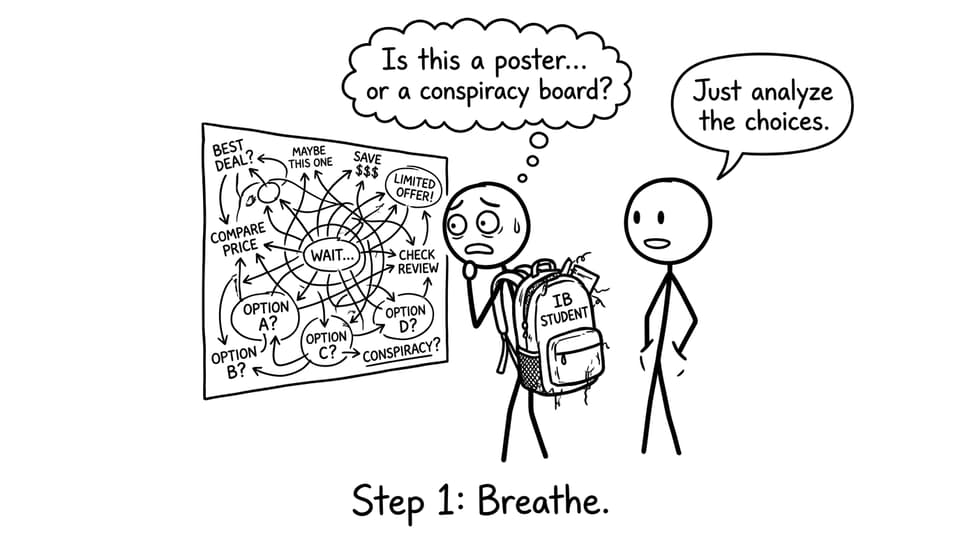
Visual text decoding checklist for IB English
Use this quick scan before you write a single sentence. It keeps your IB English analysis from turning into description.
-
Text type + context: ad, poster, infographic, social post, campaign image
-
Audience + purpose: who is targeted, and what reaction is desired?
-
Focal point: what do you notice first and why?
-
Visual techniques: layout, color, angle, framing, typography, symbols
-
Tone + ideology: what values are being normalized?
-
Effectiveness: does it persuade, pressure, reassure, shame, inspire?
If you need practice prompts, RevisionDojo’s Paper 1 Lang & Lit Questionbank is built for exactly this kind of repetition, with examiner-style tasks.
What counts as a visual text in IB English?
In IB English A: Language & Literature, a visual text is any non-literary text where meaning is carried by images and design as much as words. Think:
-
advertisements and public service campaigns
-
magazine covers and photojournalism
-
political posters and editorial cartoons
-
film posters, thumbnails, memes, social media graphics
-
infographics, packaging, billboards
The important idea for IB English is that visual texts are not decoration. They are crafted. Even “minimalist” design is still a choice with an effect.
To see how IB-style skills are taught and practiced end-to-end, start with IB English A Lang & Lit Resources.
The core visual techniques you must name in IB English
The fastest way to raise your marks is to move from vague phrasing (“it looks sad”) to precise technique language (“cool palette and high contrast lighting construct an austere tone”). These are the big buckets.
Layout and composition
Layout is basically the text’s map. It tells your eye where to go and what to treat as important.
-
Central placement often signals dominance, authority, or “this is the point.”
-
Symmetry can feel stable, orderly, trustworthy.
-
Asymmetry can feel urgent, modern, chaotic, or disruptive.
-
Negative space can isolate a subject or make a message feel stark.
RevisionDojo has a clean technique bank you can borrow phrasing from in Visual Techniques Notes.
Color and lighting
Color is emotional shorthand. In IB English, you’re not just naming colors, you’re explaining how they steer response.
-
Warm palettes can suggest intimacy, nostalgia, comfort, desire.
-
Cool palettes can suggest control, distance, professionalism, loneliness.
-
Harsh lighting and deep shadow can imply conflict, secrecy, threat, or moral tension.
Framing, angle, and distance
This is where “camera language” matters even in still images.
-
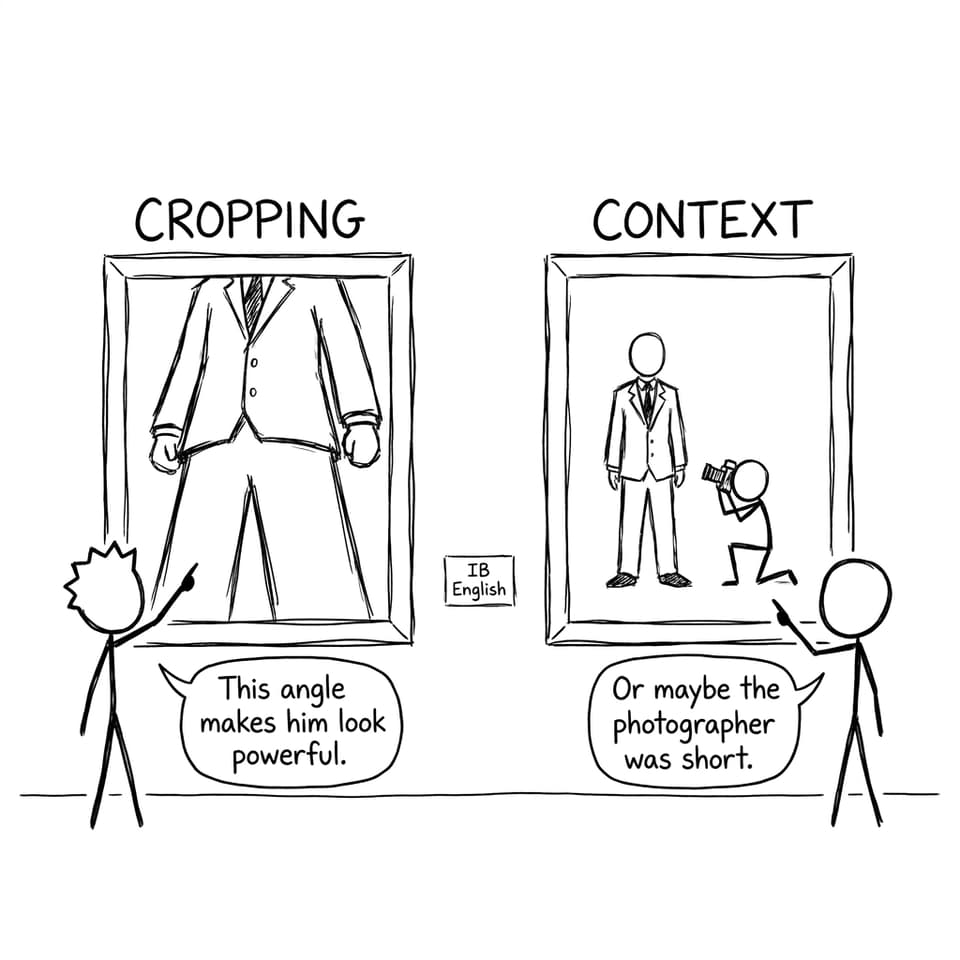
Low angle can make the subject look powerful or intimidating.
-
High angle can make the subject appear vulnerable or controlled.
-
Close-up creates intimacy, pressure, or emotional intensity.
-
Wide shot can emphasize isolation or scale.
Symbolism and imagery
Symbols are the text’s shortcuts to big ideas.
A chain does not just mean “metal.” It can imply oppression, labor, captivity, systemic power. The key is to link symbol to context and purpose.
If you want to strengthen the bridge between visual choices and theme, pair this with RevisionDojo’s close analysis habits in Close Reading Techniques for Prose and Poetry.
Text and typography
Words inside visual texts still matter in IB English. But so does how they look.
-
Bold, all-caps can feel authoritative or aggressive.
-
Handwritten fonts can feel intimate, authentic, personal.
-
Small print can signal hidden conditions, legal protection, or deliberate minimization.
A step-by-step method to decode any image in IB English
When students struggle in IB English Paper 1, it’s rarely because they “don’t get” the image. It’s because they don’t convert observations into argument.
Observe before interpreting
Give yourself 20 to 30 seconds to just look.
Ask:
-
What hits first?
-
What mood do you feel immediately?
-
What seems emphasized or minimized?
Then write three observations that are purely factual (color choice, placement, angle), so your analysis has anchors.
Lock in audience and purpose
This is the spine of your commentary.
Ask:
-
Who benefits if the audience believes this message?
-
What action is being encouraged: buy, donate, vote, fear, admire?
-
What kind of person does the text flatter or construct?
Explain technique, then effect, then meaning
A strong IB English sentence often follows this pattern:
-
Technique: “The subject is shot from a low angle…”
-
Effect: “…which enlarges their presence and suggests authority…”
-
Meaning: “…positioning the brand as protective and dominant.”
If you want to train this into muscle memory, do timed sets using the Magazines & Ads Questionbank.
Evaluate effectiveness (without getting dramatic)
End by judging how well the visual strategy works.
The best IB English conclusions don’t just say “effective.” They say effective for whom, and at what cost? A charity campaign might be persuasive, but also manipulative. A sustainability poster might look ethical while selling more consumption.
How visual decoding shows up in Paper 1 and the IO
Using visual analysis in Paper 1
Paper 1 rewards controlled, technique-led writing. Build a thesis that names:
-
the text type
-
purpose and audience
-
2 to 3 dominant visual choices
-
the ideology or message those choices normalize
For structure practice, RevisionDojo’s Step-by-Step Guide to Revising IB English Paper 1 keeps your planning tight.
If you want external feedback fast, you can draft responses and run them through the IB English Language and Literature Paper 1 Grader to see where your analysis is thin.
Using visual analysis in the Individual Oral
In the IO, visuals become powerful when they connect cleanly to a global issue: consumerism, gender representation, power, environment, identity.
If you’re building an IO pairing, RevisionDojo’s Language A Individual Oral: How to Score Higher with AI and the IB Language A: Individual Oral Grader help you rehearse like it’s the real room.
Common mistakes in IB English visual analysis
-
Describing instead of interpreting: “There is a woman” is not analysis.
-
Technique dumping: listing color, layout, font without explaining effect.
-
Ignoring ideology: visuals often sell values, not just products.
-
Forgetting the words: slogans, captions, and typography carry meaning.
A quick fix is to build a mini vocabulary bank. RevisionDojo’s English Literature Glossary helps you keep phrasing academic under pressure.
Closing: turn visuals into points on the scoreboard
Visual texts look fast. That’s why they work. And that’s also why IB English treats them as serious objects of analysis: they persuade before we notice we’re being persuaded.
If you want to get confident quickly, build a weekly routine: one timed visual commentary, one self-check against criteria, and one focused improvement. RevisionDojo makes that loop simple with the Questionbank, Study Notes, Flashcards, AI Chat, Grading tools, Predicted Papers, Mock Exams, Coursework Library, and Tutors, so you can practice the exact skill the assessment is measuring, not just reread advice.
When the next image lands on your desk, you won’t be decoding chaos. You’ll be decoding choices, and writing the kind of controlled argument IB English is designed to reward.